Adding value to traditional handicrafts in Hanoi's suburbs
Visitors can experience the stages of making products that are also souvenirs for their trip while exploring the craft villages in suburban Hanoi.
About 20 kilometers from downtown Hanoi, the suburban district of Thuong Tin has gone through a period of preserving and developing traditional craft villages with unique features.
Thuong Tin still manages to preserve its northern delta landscape of banyan trees, wells, communal houses, and old pagodas with airy and peaceful spaces amid rapid urbanization.
Many traditional craft villages with their characteristics and values have been protected in Thuong Tin, especially those that have been equipped with technology to produce handicrafts meeting the needs and tastes of domestic and foreign consumers.
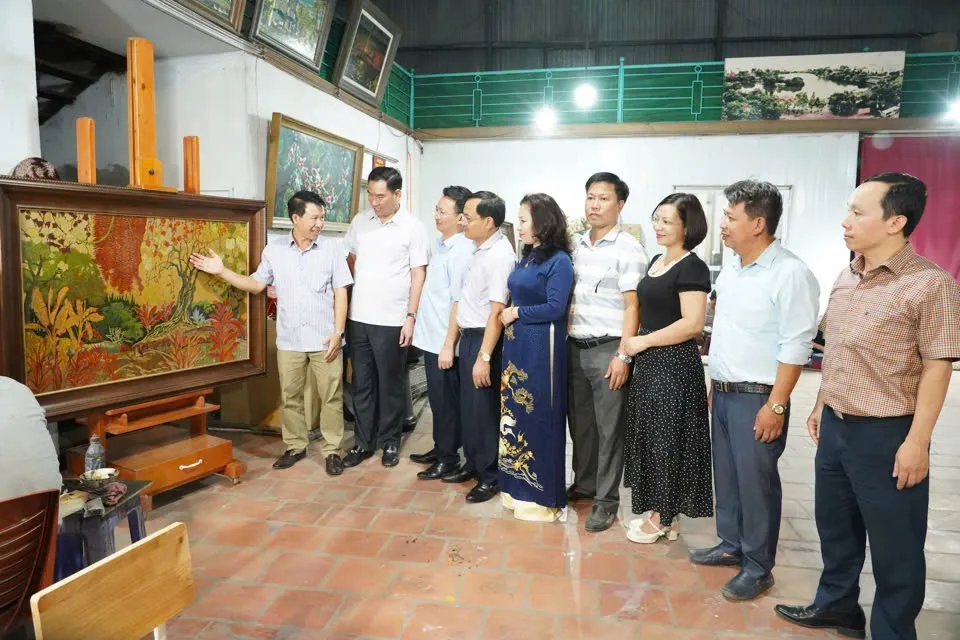
Leaders of the Duyen Thai Commune People's Committee in Thuong Tin District show visitors the products of a local traditional craft village. Photos: The Hanoi Times |
Bui Cong Than, Vice Chairman of the Thuong Tin District People's Committee, said the district is known as "the land of hundreds of handicrafts", home to 126 ancient villages specializing in various crafts. Of these, 49 villages have been officially recognized by the Hanoi People's Committee as traditional craft villages.
"At present, Thuong Tin has more than 1,600 production units and hundreds of enterprises, employing more than 40,000 workers. The district has 35 artisans awarded by the State and organizations, including three People's Artisans, five Meritorious Artisans, and 27 Hanoi Artisans," Than said.
Thuong Tin is home to numerous craft villages that have been part of the local population for hundreds of years. Quat Dong and Thang Loi embroidery, Nhan Hien sculptures, Thuy Ung horn combs, Tien Phong bedding, and other handicraft designs are among the many distinctive, culturally rich, and varied handicrafts found in the artisan villages.
In particular, the royal costume embroidery village of Dong Cuu in Dung Tien Commune was recognized as a national intangible cultural heritage, while the Ha Thai lacquer craft village was honored as a typical craft village at the city level and recognized by the city as a craft village tourist destination in 2019.
The official said that Thuong Tin District's craft villages are tourist attractions that always fascinate visitors. Over time, the traditional features that characterize the craft villages are still preserved and maintained.
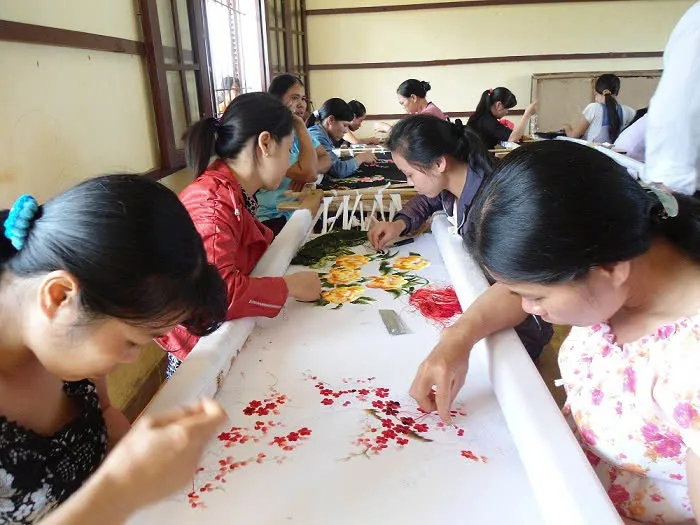
Villagers at work in Quat Dong embroidery village. |
Every lacquerware item at Ha Thai Lacquerware Village in Thuong Tin, whether it's a tiny cup, bowl, vase, tray, or lacquer painting, is elaborate, sophisticated, careful, and skillfully made at every stage.
Visitors can experience the beauty, grace, sophistication, and elegance of the motifs, as well as the shimmer of color as they view the final result. They can also sense the complexity and attention to detail that the craftsman put into each step of the creation process.
Similar to the Ha Thai Lacquerware Village, visitors to Quat Dong embroidery village will be able to appreciate the exquisite embroidered goods made by artisans and gain a deeper understanding of the elegance, attention to detail, and inventiveness of traditional embroidery, particularly in the areas of paintings, portrait embroidery, royal costume embroidery, and costume restoration.
Quat Dong Village embroiderers have created a variety of products, including traditional items such as parallel sentences, ceremonial gates, flags, parasols, canopies, tablecloths, traditional costumes, landscape and portrait embroidery paintings such as Uncle Ho's Stilt House, One Pillar Pagoda, and others.
Nguyen Thi Thuy Dao, an experienced embroiderer at Quat Dong village, said that the traditional craftsmanship of embroidery in Quat Dong village has been passed from generation to generation.
"For many years, locals have created new models with a lot of themes, featuring Vietnamese lifestyles. The embroidery has reached a sophisticated and refined level," she said.
Dao added that the embroidery technique of Quat Dong has also been significantly improved. From sewing simple patterns on the cotton fabric, today, talented craftspeople have embroidered pictures on thin silk. The exquisite embroidery motifs have reached perfection.
“Quat Dong embroidery painting is embroidered with two sides on thin chiffon material and used silk thread. Looking at the embroidery picture, the viewer cannot realize where the first stitch begins, and where the last stitch ends. Therefore, when looking at these vivid pieces, people will feel as if they are seeing the real landscape or scene of Vietnamese daily life. Meanwhile, some embroideries even look exactly like a photo," Dao said.
Quat Dong embroidery profession has undergone miraculous changes. Some large embroidery workshops in the village now employ up to 200 craftspeople at a time. Their delicate and colorful embroidery paintings are often ordered by traders from abroad, or sold at large showrooms in big cities like Hanoi, Ho Chi Minh, and other tourist cities such as Nha Trang, Danang, among other cities.
Visiting those craft villages in Thuong Tin, tourists can experience the stages of making products to take home as souvenirs of their trip while enjoying the fresh air and touring them.