Hanoi
AirVisual and Greenpeace’s report on Hanoi’s air pollution inaccurate: Agency
Instant data (at some time with abnormally high value) at an automatic air monitoring station cannot be considered a representative index for that day to assess the level of air pollution in Hanoi city.
The 2018 report on global air quality released by AirVisual and Greenpeace Southeast Asia assessing Hanoi as the second most polluted city in Southeast Asia is partial and inaccurate, according to the Agency of Environmental Protection under the Hanoi Department of Natural Resources and Environment.
Specifically, to accurately assess air pollution levels in Hanoi and conclude Hanoi as the second polluted city in Southeast Asia, it is necessary to collect sufficient data on air monitoring in many areas as well as meteorological data, Director of the Agency of Environmental Protection Mai Trong Thai told Kinh te & Do thi newspaper.
Currently, with just 10 monitoring stations (including two fixed stations and eight sensor stations) in the city, it is difficult to evaluate the whole air quality throughout the city unless there is a complete and synchronized system, Thai added.
He noted that instant data (at some time with abnormally high value) at an automatic air monitoring station is not sufficient to assess the level of air pollution in Hanoi city in a day.
In order to assess the pollution level of a locality on a specific date, the 24-hour average value of that day must be taken as a representative index. To assess the level of pollution in a year, the representative index must be based on the continuous annual average value (24 hours during 365 days).
Therefore, to assess accurately and objectively, many factors should be taken into account, among them the most important ones are the network of monitoring stations, locations to take measures, monitoring technology, accuracy of equipment, among others.
Besides, the method of calculating air quality indicators and scales differs from one country to another, thus the comparison of pollution levels is not proper, Thai noted.
Moreover, the movement of PM10 and PM2.5 dust particles depends on different climate conditions. In winter, northeast monsoon bring dust and pollutants from surrounding areas to inner Hanoi, dry and cold weather along with high pressure increases the PM dust in the air.
In summer, due to the impact of southwest and southeast winds blowing into the sea or up to the north and rains that wash away dust and dirt in the air, the concentration of PM dust in Hanoi is also lower.
The concentration of PM10 and PM2.5 dust is the highest from October to March, lower in April and September and reaches the lowest in summer months (from May to August).
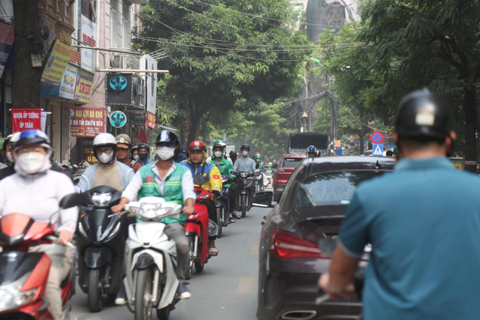
The movement of PM10 and PM2.5 concentrations during the day in Hanoi also fluctuates due to the impact of traffic flows. PM10 and PM2.5 levels increase markedly in the morning peak hours (from 7am to 8am) and afternoon (from 6pm to 7pm), drop to the lowest at noon (from 1pm to 2pm) and at night (from 11pm to 1am).
"The increase in dust concentration is only instantaneous, at a specific time," Mai Trong Thai stressed.
|

Currently, with just 10 monitoring stations (including two fixed stations and eight sensor stations) in the city, it is difficult to evaluate the whole air quality throughout the city unless there is a complete and synchronized system, Thai added.
He noted that instant data (at some time with abnormally high value) at an automatic air monitoring station is not sufficient to assess the level of air pollution in Hanoi city in a day.
In order to assess the pollution level of a locality on a specific date, the 24-hour average value of that day must be taken as a representative index. To assess the level of pollution in a year, the representative index must be based on the continuous annual average value (24 hours during 365 days).
Therefore, to assess accurately and objectively, many factors should be taken into account, among them the most important ones are the network of monitoring stations, locations to take measures, monitoring technology, accuracy of equipment, among others.
Besides, the method of calculating air quality indicators and scales differs from one country to another, thus the comparison of pollution levels is not proper, Thai noted.
Moreover, the movement of PM10 and PM2.5 dust particles depends on different climate conditions. In winter, northeast monsoon bring dust and pollutants from surrounding areas to inner Hanoi, dry and cold weather along with high pressure increases the PM dust in the air.
In summer, due to the impact of southwest and southeast winds blowing into the sea or up to the north and rains that wash away dust and dirt in the air, the concentration of PM dust in Hanoi is also lower.
The concentration of PM10 and PM2.5 dust is the highest from October to March, lower in April and September and reaches the lowest in summer months (from May to August).
The movement of PM10 and PM2.5 concentrations during the day in Hanoi also fluctuates due to the impact of traffic flows. PM10 and PM2.5 levels increase markedly in the morning peak hours (from 7am to 8am) and afternoon (from 6pm to 7pm), drop to the lowest at noon (from 1pm to 2pm) and at night (from 11pm to 1am).
"The increase in dust concentration is only instantaneous, at a specific time," Mai Trong Thai stressed.