Hanoi
Dealing with Dust Pollution to Make Hanoi a Worth Living City
As Hanoi construction is expanding steadily to meet the target of 60% of Hanoi area urbanized by 2020, dust pollution is aggravating.
Dust pollution doubles the permissible standards
Hanoi dwellers are suffering not only from trash, waste water and noise pollutions but also “dust storm” generated by construction sites and factories smoke. For many years, the execution of housing projects in Le Van Luong road has led to a tremendous amount of dust which affects negatively the area air quality. Or heavy circulation of trucks carrying sand and bricks is wrecking the road in Thuy Linh dyke of Hoang Mai district and harassing the local inhabitants with cloud of dust.

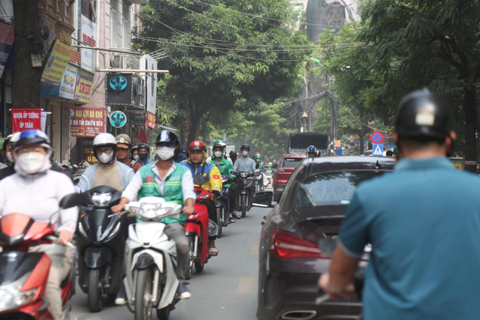
Cars and motorbikes are blamed to be the main pollution emitters, according to experts. Roughly five million motorcycles and five hundred thousand cars are in circulation in Hanoi and it is expected that by 2020, there will be 6.5 million motorcycles and approximately 600,000 to 700,000 cars. By 2030, the city’s vehicle fleet will comprise 7.5 to 8 million motorcycles and 1.9 million cars. These numbers show that without effective and drastic solutions, the environment will be ruined.
Professor Nguyen Trung Dung, Director the School of Environmental Science and Technology (Bach Khoa University), said that the high population density and the poor qualities of transportation vehicles are the reasons causing air pollution in Hanoi.
According to the report conducted by the non-profit organization Green Innovation and Development Centre (GreenID), the average Air Quality Index (AQI) of Hanoi in 2016 and the beginning of 2017 is 121, a level that is harmful to sensitive people. The particulate matter PM2.5 in average reaches 50.5 µg/m3, double the national standard and 5 times more than the average standard of the World Health Organization (WHO).
Creating sustainable living environment
As of 2016, Hanoi has conducted projects to improve the quality of living environment. This process included the installation of 10 air monitoring stations in 2016, and another 80 stations more to be installed in 2017 and 359 stations in 2020. On the other hand, the construction of Yen Xa wastewater treatment facility was already kicked start with a collecting system of 270,000m3 per day capacity. Another project to improve the environment of 80 craft villages has also been approved and to be funded by the private sector. The Hanoi People’s Committee is also planning to restrict and control private vehicles and expected to submit the plan to the City Council in the coming time.
“Hanoi’s effort in dealing with the pollution issues has not met the requirements”. Such is the statement from the Secretary of the Hanoi Municipal Party Committee Hoang Trung Hai at the annual meeting on environment with the City’s leaders . The resolution No. 11-NQ/TU dated May 31, 2017 issued by Hanoi Municipal Party Committee on “Improving environmental protection in Hanoi until 2020 and afterwards” once again confirms the City determination in raising the living standard and health of citizens, working toward the sustainable development of Hanoi.
However, some experts say Hanoi needs to quickly conduct consistent measures in dealing with major environmental challenges. Associate Professor Nghiem Trung Dung suggests the city agencies to control the gas emission more efficiently and revise the urban masterplan. Meanwhile, Doctor Nguyen Trinh Hoang Anh proposes the alternatives for coal-fired thermal power to reduce pollution in Hanoi.
The resolution No.11-NQ/TU sets the priority of protecting the surface water for sustainable use of this resource; improving efficiency in hazardous and solid waste management; reducing air and noise pollution, especially in urban area. – Secretary of Hanoi Municipal Party Committee Hoang Trung Hai.
Hanoi dwellers are suffering not only from trash, waste water and noise pollutions but also “dust storm” generated by construction sites and factories smoke. For many years, the execution of housing projects in Le Van Luong road has led to a tremendous amount of dust which affects negatively the area air quality. Or heavy circulation of trucks carrying sand and bricks is wrecking the road in Thuy Linh dyke of Hoang Mai district and harassing the local inhabitants with cloud of dust.
Professor Nguyen Trung Dung, Director the School of Environmental Science and Technology (Bach Khoa University), said that the high population density and the poor qualities of transportation vehicles are the reasons causing air pollution in Hanoi.
According to the report conducted by the non-profit organization Green Innovation and Development Centre (GreenID), the average Air Quality Index (AQI) of Hanoi in 2016 and the beginning of 2017 is 121, a level that is harmful to sensitive people. The particulate matter PM2.5 in average reaches 50.5 µg/m3, double the national standard and 5 times more than the average standard of the World Health Organization (WHO).
Creating sustainable living environment
As of 2016, Hanoi has conducted projects to improve the quality of living environment. This process included the installation of 10 air monitoring stations in 2016, and another 80 stations more to be installed in 2017 and 359 stations in 2020. On the other hand, the construction of Yen Xa wastewater treatment facility was already kicked start with a collecting system of 270,000m3 per day capacity. Another project to improve the environment of 80 craft villages has also been approved and to be funded by the private sector. The Hanoi People’s Committee is also planning to restrict and control private vehicles and expected to submit the plan to the City Council in the coming time.
“Hanoi’s effort in dealing with the pollution issues has not met the requirements”. Such is the statement from the Secretary of the Hanoi Municipal Party Committee Hoang Trung Hai at the annual meeting on environment with the City’s leaders . The resolution No. 11-NQ/TU dated May 31, 2017 issued by Hanoi Municipal Party Committee on “Improving environmental protection in Hanoi until 2020 and afterwards” once again confirms the City determination in raising the living standard and health of citizens, working toward the sustainable development of Hanoi.
However, some experts say Hanoi needs to quickly conduct consistent measures in dealing with major environmental challenges. Associate Professor Nghiem Trung Dung suggests the city agencies to control the gas emission more efficiently and revise the urban masterplan. Meanwhile, Doctor Nguyen Trinh Hoang Anh proposes the alternatives for coal-fired thermal power to reduce pollution in Hanoi.
The resolution No.11-NQ/TU sets the priority of protecting the surface water for sustainable use of this resource; improving efficiency in hazardous and solid waste management; reducing air and noise pollution, especially in urban area. – Secretary of Hanoi Municipal Party Committee Hoang Trung Hai.