Econ
Export targets 200 billion USD under the impacts of FTAs
The growth rate of export in the first half of the year has been very high with an increase of 18.8% in comparison to the same period of last year. This growth rate is also way higher than the targeted growth rate of 6 – 7%.
At this growth rate, Vietnamese export is expected to hit 200 billion USD for the year 2017.
Either domestic or foreign invested enterprises have registered export growth. The domestic enterprises, usually posted low growth rate in previous years, now has expanded 14.8%. Foreign invested businesses have exported 20.4% higher than last year’s period. Most of the commodities have registered growth, some recovering from the plunge such as mobile phones, accessories, oil, rubbery and rice. The growth rate is achieved in both unit price and orders.
Taking into consideration the result of first half of the year, if export growth rate in the last six months is maintained at 18.8%, the export of year of 2017 will hit 209.8 billion USD. However, this target is subject to various factors to be achieved in the last six months of the year. First of all, first quarter export only reached 44.64 billion USD, an increase of 15.1% (FDI businesses exported a value of 31.96 billion USD, an increase of 15%). The growth rate jumped to hit 53.08 billion USD, an increase of 22.1% in the second quarter, nearly doubling in the rate of the first quarter. In total, the first six months of 2017, Vietnam exported a total value of 97.72 billion USD, an increase of 18.8% in comparison to the same period of last year.
Another important factor is that Vietnam has signed a total of 10 free trade agreements, and 4 FTAs under negotiations. Most of the FTAs are with Vietnam’s major trading partners including ASEAN, EU, Japan, Russia, China, Korea and Australia.
The export of 27 out of 45 essential categories of commodities experienced a slight decrease in Quarter I. In Quarter II in particular and the first 6 months in general, the growth rate has increased, or even doubled last year’s period. The commodities jumping from decrease to increase are rice (potential signing big contract with the Philippines), mobile phones and accessories, bamboo , rattan and sea grass products.
If import growth is forecast to increase by 24.1% in the first six months of the year, the import would be around USD$216 billion. Accordingly, trade deficit will be about $6.2 billion, making the deficit ratio between export and import of under 3%. If the forecasts are correct, the export/GDP ratio will reach 94%, higher than the 86% of 2016. The opening of the economy will be larger. On the other hand, warnings for more direct and faster impacts of global market fluctuations on Vietnam need to be addressed.
Either domestic or foreign invested enterprises have registered export growth. The domestic enterprises, usually posted low growth rate in previous years, now has expanded 14.8%. Foreign invested businesses have exported 20.4% higher than last year’s period. Most of the commodities have registered growth, some recovering from the plunge such as mobile phones, accessories, oil, rubbery and rice. The growth rate is achieved in both unit price and orders.

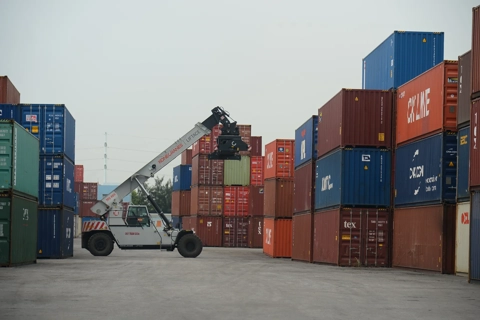
Rice export at Sai Gon port.
|
Another important factor is that Vietnam has signed a total of 10 free trade agreements, and 4 FTAs under negotiations. Most of the FTAs are with Vietnam’s major trading partners including ASEAN, EU, Japan, Russia, China, Korea and Australia.
The export of 27 out of 45 essential categories of commodities experienced a slight decrease in Quarter I. In Quarter II in particular and the first 6 months in general, the growth rate has increased, or even doubled last year’s period. The commodities jumping from decrease to increase are rice (potential signing big contract with the Philippines), mobile phones and accessories, bamboo , rattan and sea grass products.
If import growth is forecast to increase by 24.1% in the first six months of the year, the import would be around USD$216 billion. Accordingly, trade deficit will be about $6.2 billion, making the deficit ratio between export and import of under 3%. If the forecasts are correct, the export/GDP ratio will reach 94%, higher than the 86% of 2016. The opening of the economy will be larger. On the other hand, warnings for more direct and faster impacts of global market fluctuations on Vietnam need to be addressed.