Econ
Law on Support for Small- and Medium-Sized Enterprises embodies hope of Vietnamese SMEs
The Law on Support for Small- and Medium-Sized Enterprises (SME Law) will come into effect on January next year after it was passed by the National Assembly on June 12. Now it is the responsibility of the Ministry of Planning and Investment to formulate 4 guiding decrees to materialize the orientation of assisting Vietnamese SOEs.
SMEs make up 97% of Vietnamese business community. Despite making significant contribution to the state budget and creating jobs, SMEs are vulnerable due to shortage of capital, land access and problem with tax authorities.
According to the Deputy Minister of Planning and Investment Dang Huy Dong, the law which has been passed by the National Assembly is a precious gift for the business community in general and the SME community in particular. The law has identified its targets for supporting as well as outlined the services and support programs conforming each period and target. Also the law encourages the establishment of industrial clusters and supports the creation of sustainable value chain.
Dang Huy Dong added that individual business households making business registration will benefit from supports stipulated in Article 16 of this Law including land access, tax reduction and counseling, accounting training, among other benefits. Also under the law, the local authorities have to help SMEs rent land so that these businesses, facing capital shortage, will not have to finance land clearance; or Vietnamese distributors whose 80% of their commodities are made in Vietnam are entitled to support for expanding market.
The Ministry of Planning and Investment is working on the four decrees including the Decree on Guiding the Implementation of the SMEs Law, Innovation Support Decree, the Decree on Credit Guarantee for SMEs and the Decree guiding the operation of the SMEs Support Fund.
According to the Vice Chairman – Secretary General of the Hanoi Association of SMEs (Hanoisme) Nguyen Quoc Anh, SMEs are struggling to access land, human resources, market, technologies, and especially bank loans: “the lending procedures of the bank is very strict, and normally, enterprises have to adjust to these requirements before being able to access the loan”. Quoc Anh said and requested the banks to consider relaxing lending requirements.
Vice General Director of Vietnam Prosperity Bank (VPBank) Nguyen Thanh Long said that lending and timely payment are the most important criteria for accessing loan in any banks. Bearing this in mind, during the lending procedures, VPBank encourages enterprises to pay their debts timely and in accordance with the signed contract. In case enterprises having difficulties in debt payment or even debt with 10 day arrears are elegible for borrowing . At the same time, VPBank is designated by the Ministry of Planning & Investment as trustee of SME Development Fund (SMEDF) (along with other 3 banks), in which enterprises operating in fields of agro – forestry – fisheries, start-ups, waste water treatment, manufacturing are eligible to receive support. VP bank is simplifying procedures for enterprises to access loan. SMEs could get loans even without mortgage, only by proving that they are operating normally. The SME Law is an important legal basis to provide funds for SME. Representatives of banks affirmed that this is too good of an opportunity to approach these kind of potential customers.
The Chairman of ACB Japan Company Pham Duc Kien: Faciliating access to preferential capital
The law will create a stable investment environment according to the market standards. At the same time, it will provide a fair environment for both state enterprises and SMEs, private enterprises in particular. Besides, enterprises will have more autonomy. What enterprises can do, the state does not have to interfere to avoid direct competition.. Moreover, the state has to consider enterprises as targets to be served not controlled. As a result, the differences between the state enterprises and private ones will reduce.
The Chairman of BOD of Bigsun Vietnam Investment Joint Stoke Company, Duong Van Dan: Hope for supporting resources
I hope that when decrees are passed, income taxe on SMEs will be reduced. This can really help enterprises work well since the beginning. Besides, SMEs are currently enterprises with small scales, small assets and no collateral for banks. Therefore, their competitiveness is still low with backward technology. As a result, assistance for resources, capital, funding and governmental policies are needed for the development of enterprises.
According to the Deputy Minister of Planning and Investment Dang Huy Dong, the law which has been passed by the National Assembly is a precious gift for the business community in general and the SME community in particular. The law has identified its targets for supporting as well as outlined the services and support programs conforming each period and target. Also the law encourages the establishment of industrial clusters and supports the creation of sustainable value chain.

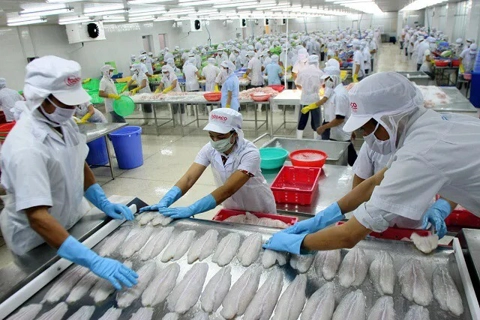
Operation at Ha Yen JSC. In Nam Tu Liem Industrial Complex.
|
The Ministry of Planning and Investment is working on the four decrees including the Decree on Guiding the Implementation of the SMEs Law, Innovation Support Decree, the Decree on Credit Guarantee for SMEs and the Decree guiding the operation of the SMEs Support Fund.
According to the Vice Chairman – Secretary General of the Hanoi Association of SMEs (Hanoisme) Nguyen Quoc Anh, SMEs are struggling to access land, human resources, market, technologies, and especially bank loans: “the lending procedures of the bank is very strict, and normally, enterprises have to adjust to these requirements before being able to access the loan”. Quoc Anh said and requested the banks to consider relaxing lending requirements.
Vice General Director of Vietnam Prosperity Bank (VPBank) Nguyen Thanh Long said that lending and timely payment are the most important criteria for accessing loan in any banks. Bearing this in mind, during the lending procedures, VPBank encourages enterprises to pay their debts timely and in accordance with the signed contract. In case enterprises having difficulties in debt payment or even debt with 10 day arrears are elegible for borrowing . At the same time, VPBank is designated by the Ministry of Planning & Investment as trustee of SME Development Fund (SMEDF) (along with other 3 banks), in which enterprises operating in fields of agro – forestry – fisheries, start-ups, waste water treatment, manufacturing are eligible to receive support. VP bank is simplifying procedures for enterprises to access loan. SMEs could get loans even without mortgage, only by proving that they are operating normally. The SME Law is an important legal basis to provide funds for SME. Representatives of banks affirmed that this is too good of an opportunity to approach these kind of potential customers.
The Chairman of ACB Japan Company Pham Duc Kien: Faciliating access to preferential capital
The law will create a stable investment environment according to the market standards. At the same time, it will provide a fair environment for both state enterprises and SMEs, private enterprises in particular. Besides, enterprises will have more autonomy. What enterprises can do, the state does not have to interfere to avoid direct competition.. Moreover, the state has to consider enterprises as targets to be served not controlled. As a result, the differences between the state enterprises and private ones will reduce.
The Chairman of BOD of Bigsun Vietnam Investment Joint Stoke Company, Duong Van Dan: Hope for supporting resources
I hope that when decrees are passed, income taxe on SMEs will be reduced. This can really help enterprises work well since the beginning. Besides, SMEs are currently enterprises with small scales, small assets and no collateral for banks. Therefore, their competitiveness is still low with backward technology. As a result, assistance for resources, capital, funding and governmental policies are needed for the development of enterprises.