Oxfam: Vietnam’s green transition leaving no one behind
As Vietnam aims to become a high-income nation by 2045, it must reinforce its people-centered development model by fostering partnerships, reducing inequality and ensuring inclusive, sustainable growth that leaves no one behind, according to Oxfam Vietnam.
Vietnam’s green transition has laid its first bricks with ambitious frameworks, but true success depends on inclusiveness and equal access to opportunities for all, especially the most vulnerable, said Vu Thi Quynh Hoa, National Director of Oxfam Vietnam, in an interview with The Hanoi Times.

Vu Thi Quynh Hoa, National Director at Oxfam Vietnam. Photo: Oxfam
A people-centered path to Vietnam’s green transition
Over the past 30 years of working alongside Vietnam for a more equal and sustainable society, how does Oxfam assess the country’s journey toward sustainable development?
Over the past three decades, Vietnam has undergone a remarkable transformation. Once a low-income country, it has risen to middle-income status, sustaining robust economic growth while dramatically reducing poverty and improving living standards.
In 2024, Vietnam’s GDP reached around USD 476.3 billion, ranking 35th in the world. These milestones reflect bold policy reforms, consistent government efforts, strong partnerships, and the country’s ability to adapt and integrate into a rapidly changing global economy.
Vietnam has also sought to balance growth with sustainability. Vietnam has aligned its development path with global commitments, from the Sustainable Development Goals and Net Zero pledges at COP26 to the second Green Growth Strategy and international initiatives on poverty reduction, environmental and ocean protection and development cooperation.
Yet new challenges are emerging. Despite rising incomes, the GINI index highlights persistent divides between urban and rural areas, regions, and social groups. Rapid technological shifts and climate change also risk leaving behind vulnerable populations, including the poor, women, ethnic minorities, informal workers, the elderly, and other disadvantaged communities.
Looking ahead, safeguarding the gains of the past 30 years will require addressing inequalities head-on. As Vietnam pursues its ambition of becoming a high-income country by 2045, it will need to deepen its commitment to Vietnam’s people-centered development model, strengthening partnerships, narrowing disparities, and ensuring that progress is inclusive and sustainable, leaving no one behind.
Green and circular economies are considered key pillars of sustainable development. Vietnam has recently made several commitments and acted in this area. How does Oxfam assess these efforts and achievements?
Drawing on global lessons, Oxfam views Vietnam’s Green Growth Strategy and Circular Economy Roadmap as ambitious and forward-looking. These frameworks weave together circular economy principles, digital transformation, and innovation, backed by international collaboration and social equity. The direction is clear and indeed it is aligned with global trends.
Vietnam’s proactive stance on green transition goes beyond policy commitments. The country has advanced practical initiatives grounded in local realities, from promoting sustainable agri-food systems linked to environmental protection, to expanding vocational training and reskilling programs that help workers adapt to the green economy and empowering social organizations and communities to play a greater role in the process.
This people-centered approach, grounded in the principle of a just and sustainable transition, ensures that no one is left behind.
But the success of this transition will hinge on the private sector. Micro and small enterprises, which make up about 94% of businesses in Vietnam, are key to driving innovation and creating green jobs. Yet many struggle with limited technical capacity, scarce financing and gaps in information. Without timely policies to support vocational training, job transitions and social protection, especially in sectors dominated by informal and low-skilled workers, the green shift risks deepening inequality and eroding hard-won gains in poverty reduction.
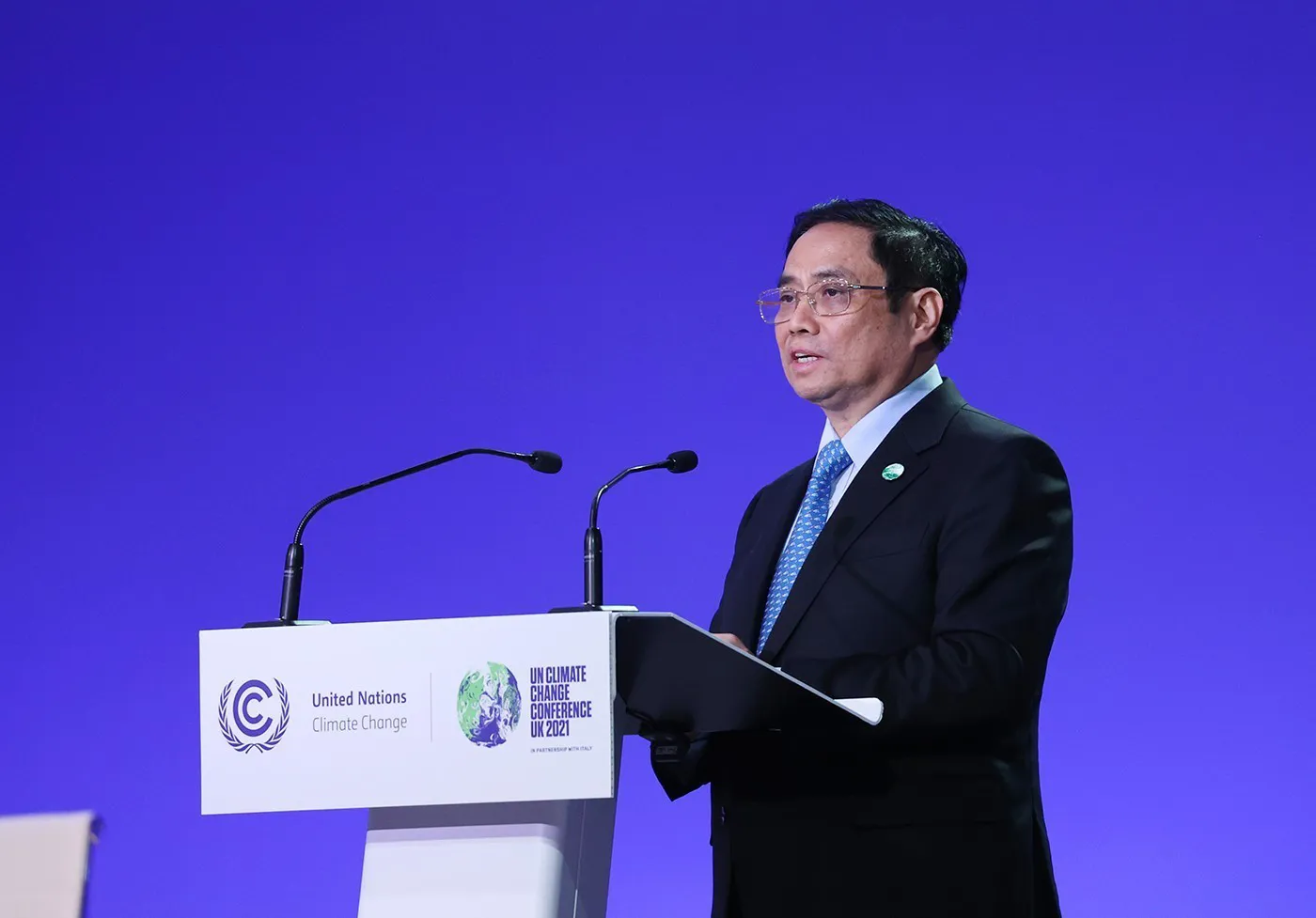
Prime Minister Pham Minh Chinh speaks at the 26th United Nations Climate Change Conference (COP26), held in Glasgow, UK in 2021. Photo: VNA
Regarding Vietnam’s Net Zero target by 2050, what green priorities should the country focus on, according to Oxfam?
The green transition must also be inclusive, just and sustainable, anchored in strong social protection, livelihood security, skills development, and equitable access to opportunities for all, especially the most vulnerable.
In this context, Oxfam is collaborating with local partners across several Vietnam's provinces to expand vocational training and green job opportunities for ethnic minority women and other marginalized groups. The goal is to empower them to build on their strengths and indigenous knowledge, participate actively in the green economy, and co-share the benefits fairly.
These initiatives are helping women enter sectors traditionally dominated by men, such as science and technology, the digital economy and climate-smart agriculture, while connecting them to women-led business networks. Such efforts not only enhance gender equality but also align with Vietnam’s Green Growth Strategy Phase II and reinforce its Net Zero commitment under COP26.
Inclusive policies for a just transition
Recent initiatives promoting green production and consumption include the introduction of Extended Producer Responsibility (EPR) and the Deposit Return System (DRS). How can Vietnam encourage public and business participation in these efforts and the broader green economy, according to Oxfam?
From Oxfam’s experience, inclusivity and equity must be at the core of policy design and implementation. That means ensuring participation and benefits for all stakeholders, from large corporations to small businesses, cooperatives and informal waste collectors.
Vietnam counts tens of thousands of informal waste workers, most of them migrant women who form the backbone of the recycling chain. Yet they often endure unsafe working conditions, lack labor protections, and earn unstable incomes dependent on large buyers.
As formal systems expand, these workers risk losing their livelihoods. Many also face limited access to healthcare, housing and education for their children, compounded by gender-based stigma that portrays women as “secondary” workers.
“If EPR and DRS focus only on formal actors, these women will be left behind,” Oxfam warned. Hence, the organization calls for a dual approach: providing skills training, safer jobs, and livelihood transitions, while also protecting informal workers’ rights and addressing the structural barriers they face.
For businesses, especially micro, small, and women-led enterprises, Vietnam needs a balance of ‘push’ and ‘pull’ measures: mandatory standards to ensure compliance, coupled with incentives such as technical support, access to green finance and opportunities to build sustainable brands.
Oxfam’s experience in Vietnam shows that when businesses, communities, cooperatives, and social organizations work together under enabling policies, the circular economy can deliver not only environmental gains but also social justice and gender equality.
What should Vietnam consider when applying international green standards to its local context?
A key takeaway from global experience is that green standards must integrate both environmental and social dimensions. Only then can the transition yield ecological, social, and economic gains, making it effective, equitable and sustainable.
In Vietnam, this means recognizing the adaptive capacity of micro and small enterprises, cooperatives, farmers, fishers, and informal workers. Without sufficient technical assistance, financing, and capacity building, these groups risk being pushed out of value chains by standards they cannot meet.
Equally important is the inclusion of community voices, from small businesses, informal laborers, ethnic minority groups and women, whose perspectives ensure that standards reflect on-the-ground realities rather than becoming barriers that limit access to essential goods for low-income populations.
Above all, green standards must be tied to fair responsibility-sharing across the value chain, turning them into drivers of transformation rather than obstacles to inclusion.
Can Oxfam share successful green growth and sustainability initiatives it has implemented in Vietnam, and its future directions?
Since the 1990s, Oxfam has worked alongside the Government of Vietnam and local communities through programs, research, and international knowledge exchange, whilst always ensuring that vulnerable groups at the center of our work towards inclusive and sustainable poverty reduction.
Sustainable growth has long been a cornerstone of Oxfam’s work in Vietnam. In forestry, we have supported FSC-certified forest management and payments for ecosystem services. In agriculture, Oxfam was among the first international organizations to promote low-carbon rice production.
In fisheries, Oxfam has advanced sustainable practices through ASC certification for shrimp and clam farming, alongside the introduction of renewable energy in aquaculture and seafood processing. In energy, we have raised awareness among communities and businesses about energy efficiency and use of renewable energy sources to reinforce Vietnam’s energy transition goals.
These experiences lay a solid foundation for Oxfam’s future priorities in Vietnam’s green transition. Among these priorities are initiatives to scale up women-led green economy models; the expansion of vocational training and workforce development for vulnerable groups; the development of climate-resilient, low-emission agricultural value chains; and the strengthening of ESG practices across industries and supply chains.
With effective collaboration among social organizations, businesses, communities, and local governments, Vietnam has the chance to shape a green transition that is inclusive, just and sustainable.
Thank you for your time!