Chairmanship of ASEAN Education turned over to Vietnam
Vietnam says it will successfully perform its role to build a more resilient education system in the region.
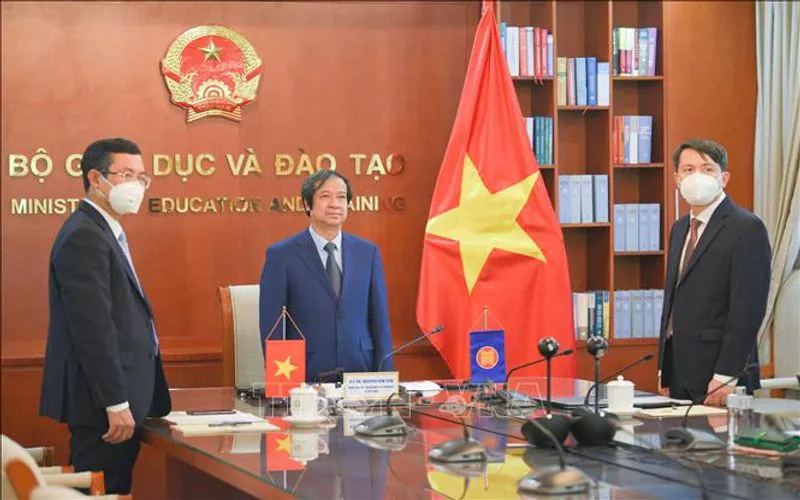
The chairmanship of the Association of Southeast Asian Nations (ASEAN) Education for 2022-2023 was turned over to Vietnam’s Ministry of Education and Training from the Philippines at a ceremony on March 16.
Addressing the event, Vietnamese Minister of Education and Training Nguyen Kim Son congratulated the Philippines’ Department of Education for its successes in the role for 2020-2021 in spite of numerous challenges caused by the Covid-19 pandemic.
Son stressed that the pandemic has negatively affected the education sector, causing school closures and difficulties in online learning and teaching.
“However, ASEAN member nations have gone to great lengths to overcome unprecedented challenges and minimize negative impacts of the pandemic,” said the minister.
He called on ASEAN members to join hands in resuming education activities and make the ASEAN education system’s resilience better in the new context.
“This is a transition period that requests learners, schools, and parents to be ready to adapt to any form of learning, including in-person and online. Currently, an urgent priority is to develop a more resilient education system that can withstand and recover from future crises,” Son noted.
Vietnamese Minister of Education and Training Nguyen Kim Son (middle) speaks at the ceremony. Photo: VNA |
He expressed his hope that Vietnam will receive support from ASEAN members and partners during its presidency. "Education should be based on the principles of collaboration and solidarity,” the minister added.
For his part, ASEAN Secretary-General Lim Jock Hoi said he believed that Vietnam will successfully perform its role to build a more resilient education system in the region.
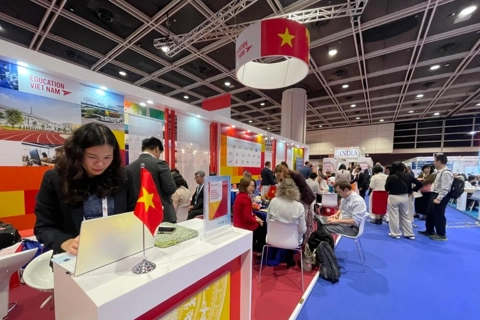
After the taking-over ceremony, Vietnam’s Ministry of Education and Training coordinated with the Cambridge Partnership for Education and the ASEAN Secretariat to co-host a conference to discuss solutions for rebuilding the education system.
“In the recovery period, so as to adapt to the Covid-19 pandemic, we not only focus on the recovery but also need to draw on experiences to better prepare for future crises,” Minister Nguyen Kim Son emphasized.
Given that ASEAN countries have been making efforts to build a more resilient education system, the minister proposed a number of specific efforts such as reinforcing the school system, preparing face-to-face and online blended learning models, improving learners’ self-study and self-development capacity.
He noted that the conference would be a great opportunity for ASEAN member countries to exchange experiences and practical lessons on the recovery process in the field of health and safety. The conference's outcomes are expected to support countries in the region in developing initiatives to overcome the impacts of the pandemic on the education system.
The ministers and representatives also focused their discussion on three main themes: learning loss and accelerated learning, access to education, and building resilience in education systems.
Jane Mann, managing director of the Cambridge Partnership for Education said that Covid-19 was not the first time that Southeast Asia had to handle education disruption, and in many cases, governments and communities have responded to this pandemic with speed and strength.
She stressed that the conference will explore how we can create cross-regional partnerships to build quality, effective and resilient education systems that work for all children.
For his part, ASEAN Secretary-General Dato Lim Jock Hoi highlighted that in going forward, the blending of digital technologies with traditional offline approaches to learning would be critical.
It is key for the ASEAN education sector to strike a balance between the appropriate use of digital learning while retaining the best features of traditional education, Lim said.
Deputy Minister Nguyen Van Phuc, a representative of Vietnam’s Ministry of Education and Training, said that amid the pandemic, there is no single form of learning that can completely solve the issue of learning deficits.
"To partially solve the issue, Vietnam’s education sector has been flexible in organizing online teaching, using learning management systems and learning websites to enhance student interaction and opportunities," Phuc said.
"This is the time we need to think about restructuring education in a broader picture, in a new context of a volatile and challenging world, not only caused by the disease but also other political and social factors. This sets out an education that must really focus on all policies and initiatives to create independent, self-reliant and brave of global citizens, contributing to the development of the country and the world," Phuc noted.
After the conference, the Organizing Committee will develop a policy summary report, which will be used for educational policy-making in ASEAN countries and the UK.