Celebrating 990th anniversary of holy land Nghe An
Over time, Nghe An region has witnessed upheavals of Vietnamese history. Historical documents and traces in the region have proved that fact.
The name of “Nghe An” region was heard for the first time in 1030 under the reign of Ly Kings. However, scientists have found objects dated back to the Stone Age (2.6 million years ago to about 3,300 BC) in Quynh Van Archaeological Site, Quynh Luu District while the ones found in Vac Village, Thai Hoa Town, dated back to Dong Son Civilisation (800-200BC).
It means that 6,000 years ago, early humans of the region resided in the coastal area of Quynh Van and over 2,000 years ago, primitive people lived in today’s Vac Village, the western mountainous area of the province.
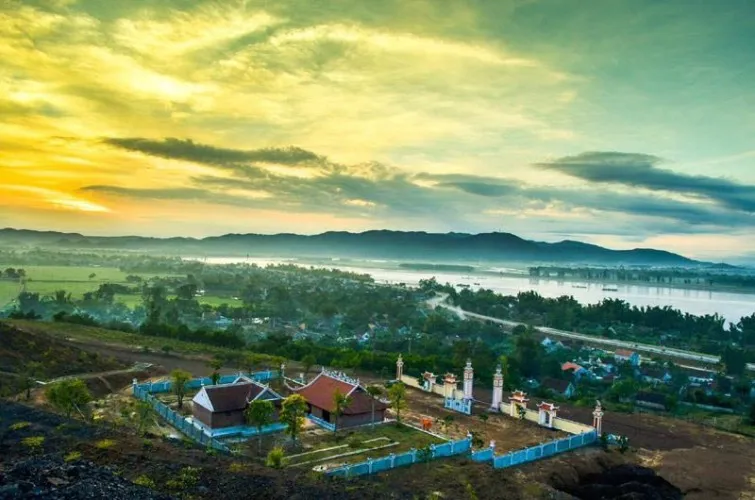
A view of Hong Mountain and Lam River from Quyet Mountain and Quang Trung Temple. Photo kinhtedothi.vn |
Archaeological evidence and historical documents have shown that primitive people resided in the region a long time before it was named Nghe An officially.
Over time, Nghe An region has witnessed upheavals of Vietnamese history. Historical documents and traces in the region have proved that fact.
A book on Hung Vuong Era compiled by scholar Nguyen Co under King Le Thanh Tong reign (1460-1497), translated by Prof Ngo Duc Tho, reads: “Hoan Chau region hosted Hung Bao Thuu Linh range with 199 mountains, which was called Ngan Hong under King Le Thanh Tong’s reign.
The region, which was bordered by Cua Hoi Sea, included communes of Noi Thien Loc, Ta Thien Loc, Tinh Thach; Thien Loc District; Duc Quang Capital, in Nghe An Region.
Kinh Duong Vuong, the first king of Hung Vuong Era chose Ngan Hong region as the capital. He then moved the capital to Ngu Linh - Phong Chau region. He founded the Hung Vuong Era (2879 BC - 258 BC), which lasted through 18 [generations of] kings.
Ngan Hong Region (in today’s Hong Linh Town, Ha Tinh Province) became the first capital of Van Lang State – the founding State in the history of Viet Nam.”
King Zhao Tuo (203-137BC) from the north tried to invade the [following] u Lac (today’s Viet Nam) many times and were all defeated by King Thuc Phan An Duong Vuong (of u Lac).
King Zhao Tuo then sent his son, Zhong Shi, to u Lac to get married to My Chau, a daughter of King An Duong Vuong, as a reconciliation gesture, but with a scheme to steal u Lac’s military secret. General Cao Lo (also known as Cao Thong), who sensed Zhao Tuo’s plot, asked King An Duong Vuong not to accept. Yet the King refused to take his advice.
Being disappointed, Cao Lo lived a recluse life in Nho Lam Village, in today’s Dien Tho Commune, Dien Chau District (in today’s Nghe An). He opened a blacksmith workshop and taught the handicraft to locals, who then considered him as the founder of blacksmithing.
Cao Lo created Lien Chau crossbow, which was then used as a holy weapon to fight against northern invaders.
A book by a historian of the Song Dynasty says: “King Zhao Tuo brought his army to fight King An Duong Vuong, who was supported by Cao Thong. Cao Thong created a kind of magic crossbow that can kill thousands of soldiers in one shot...
King Zhao Tuo withdrew and sent his son Zhong Shi to negotiate with King An Duong Vuong.
Then, the magic crossbow was stolen by Zhong Shi. King Zhao Tuo invaded u Lac. King An Duong Vuong and his daughter fled from Co Loa Citadel (in today’s Ha Noi) to seek shelter in Nghe region. At the foot of Mo Da Mountain (in today’s Dien An Commune, Dien Chau District), King An Duong Vuong killed his daughter with a sword and committed suicide by Cua Hien (La Nham) Sea.
Then, locals built Cuong Temple by the foot of Mo Da Mountain dedicated to the King and the princess.
Holy pillar
Lam Thanh Mountain in Nghe An involves a story about Ma Yuan (14BC-49AD), a military general from ancient China, who brought his army to fight the two Trung Sisters’ (40-43) Uprising. He ordered the installation of a bronze pillar at the mountain. The pillar was carved with the phrase: “If the pillar breaks, Giao Chi (today’s Viet Nam) will be destroyed”. The mountain was then named Dong Tru Son (Bronze Pillar Mountain).
The book titled “Ha Tinh Dat Van Vat Hong Lam” (Land of Culture Ha Tinh) by Thai Kim Dinh records a folk tale: A couple in Trung Ca Village (in today’s Trung Thinh Village, Thinh Loc Commune, Can Loc District, Ha Tinh Province), were singers and traditional medical practitioners. Every day, the couple climbed up the mountain to pick medical herbs. When they saw the bronze pillar, they broke it by a saw. They then threw the pillar into nearby Lam River. Admiring their work, locals then built a temple dedicated to them and worshipped the husband as the village’s genie.
Legends say that the bronze pillar had magic power. Northern invaders many times overwhelmed the country. But they must stop by the mountain, on the north bank of Lam River. In April 1285, Sogetu, a general of Mongol invaders chased the Tran royal family members in the mountain. The Mongol army camped in the region for two years. Sogetu looked for the bronze pillar but he couldn’t find it. In April 1287, when the enemy army was weaker as they ran out of food and could not bear local heat, the Tran’s army attacked and defeated the Mongol troops.
Also in the Bronze Pillar Mountain, Nguyen Hue (Quang Trung) (1753-1792) recruited 10,000 soldiers and marched to Thang Long Citadel to fight against Qing invaders. Legends say that the bronze pillar was replicated in Thang Long Citadel as the historic Dong Da Hill in today’s Dong Da District in Ha Noi.