Di Trach Festival in memory of King Ly Nam De
Di Trach Commune is located on an ancient land with a long-standing cultural tradition, including the traditional festival dedicated to King Ly Nam De who established the foundation for truly independent Vietnamese state.
The Hanoi Times — Beginning March 9, the three-day festival in Di Trach Commune, Hoai Duc District, Hanoi, will feature many traditional cultural activities to commemorate King Ly Nam De (503-548).
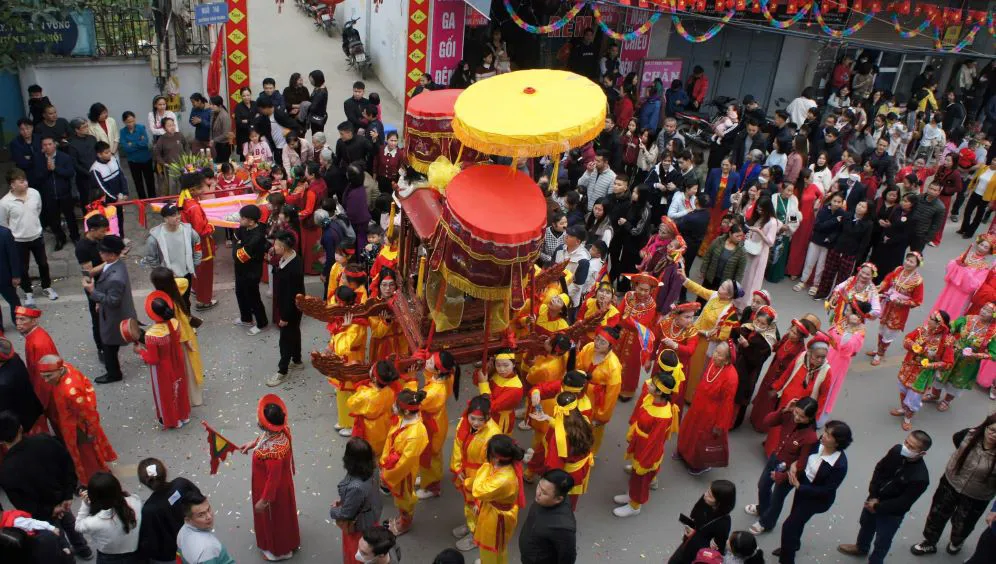
The Di Trach Commune Festival is dedicated to King Ly Nam De. Photo: The Vu/The Hanoi Times
In 542, Ly Nam De successfully overthrew the Chinese governor of Jiaozhou Province in northern Vietnam and seized Long Bien, the provincial capital. He declared himself emperor two years later. He ruled over a vast territory that, according to the earliest surviving Vietnamese historical records (13th-14th centuries), included most of present-day northern and central Vietnam. His authority was respected throughout the Red River Delta in the north and south to the borders of the Champa kingdom. He named his newly founded empire Van Xuan (the state would last for "a thousand springs").
Although short-lived, Ly Nam De's kingdom formed the nucleus of the future Dai Viet (former name of Vietnam).
Legend has it that King Ly Nam De's youth was spent in the land west of Hanoi, stretching from the To Lich River to present-day Son Tay. When he died, he was worshipped in many places, including the village of Di Trach.
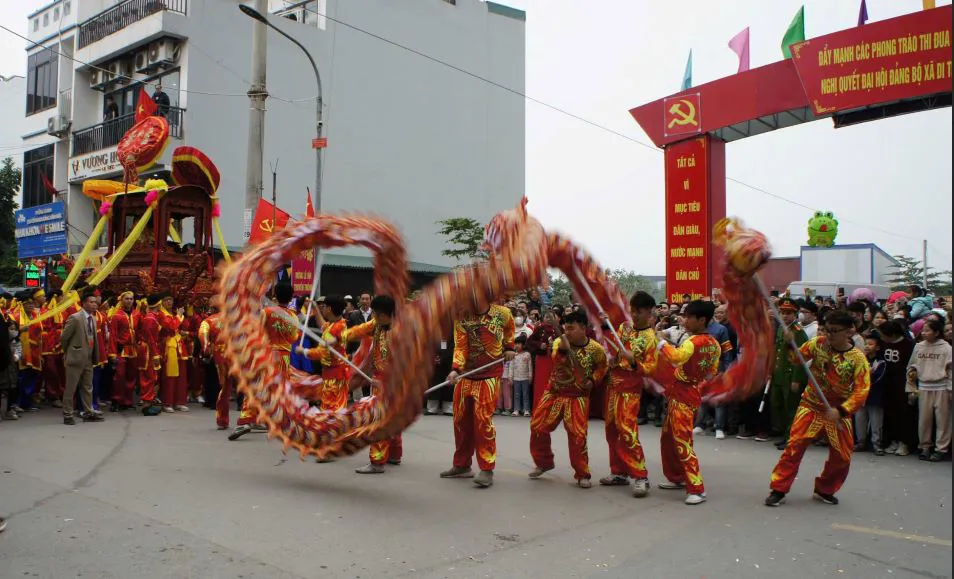
People enjoy the dragon dance at the Di Trach Festival. Photo: The Vu/The Hanoi Times
This land is famous for Di Trach Communal House, which worships King Ly Nam De and was classified as an architectural and artistic relic in 1990.
Di Trach Communal House is located on a large, high plot of land and consists of a front hall, a back hall, and a tubular structure connecting the two.
The back hall has four doors carved with flowers, leaves, dragons, turtles, clouds in the artistic style of the early 18th century.
In the rear chamber, there are three altars, the central one bears the phrase: "Son of Heaven, Ly Nam De Thanh De", dedicated to the emperor, while the two side altars are for the worship of his queens.
In the Di Trach Communal House, there are still 11 royal decrees from the Le dynasty (1783) to the Nguyen dynasty (1924). In addition, the temple also preserves many valuable artifacts such as village covenants, altars, horizontal lacquered boards, parallel sentences, palanquins, bronze bells, and others.
Di Trach Festival is held from the 10th to the 12th of the second lunar month at the communal house in the area of Den and Ai villages. It includes an incense offering ceremony, procession around the village, singing and dancing at the communal house.
In recent years, the festival has been restored by the people in the village with many traditional rituals.
This year, the festival is held on a grand scale, with a procession of the king's palanquin and solemn worship rituals, human chess, wrestling, Quan Ho (love duet) singing, and many cultural and sports activities.