Log in
Business

Efficient resource utilization may help Vietnam GDP grow 9 – 10%

The public capital must be allocated based on market principles, said an expert.

More efficient utilization of resources would help Vietnam achieve annual GDP growth of 9 – 10%, equivalent to that of Japan and South Korea during their economic booming periods, according to Nguyen Dinh Cung, former director of the Central Institute for Economic Management (CIEM).

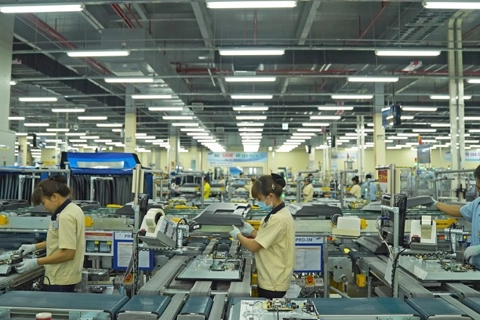
 Illustrative photo.

Efficient allocation and utilization of resources should be the core issue during Vietnam’s economic restructuring, said Cung in an interview with the governmental portal.

Cung added the incremental capital-output ratio (ICOR) showed signs of improvements, but remained at modest level of 6, while that of South Korea and Japan at their similar phases of development was only at 4 and 3, respectively.

ICOR explains the relationship between the level of investment made in the economy and the consequent increase in GDP. The higher the ICOR, the lower the productivity of capital or the marginal efficiency of capital. 

Cung referred to a recent article written by Prime Minister Nguyen Xuan Phuc that stressed the government must give priority to the development of market for the sale and rental of land-use rights for farmland.

Cung said it is essential for Vietnam to have a legal framework for the operation of land-use rights market, instead of focusing on the real estate market.

“Vietnam has to make laws to capitalize land-use rights of farmers, taking them into the market, not just issuing land acquisition orders or administrative measures.”

Cung stated a well-developed land-use rights market is the best instrument to protect farmers’ benefits, particularly at a time of rampant bureaucracy in the country.

Failure to comply with market principles would be a major barrier to the land grouping policy, Cung continued.

Cung also said state-owned enterprises (SOEs) are holding huge state capital under disposal, adding market-based motivation and rightful benefits of related parties are key to utilize this resource efficiently.

Another key issue for Vietnam is to build trust from the business community towards the judicial system. Following the latest Doing Business of the World Bank, Vietnam has not seen any improvement in criteria of enforcing contracts and resolving insolvency.

Last but not least, Cung said Vietnam should be aware and grasp opportunity arising from new business models of the Fourth Industrial Revolution.

Vietnam should have incentive policies to nurture creativity, and timely address restriction and shortcomings that may emerge.

“The state must send a strong message that the citizen could do anything not forbidden by the law, instead of waiting for regulation to roll out the new business models.”

“We should not be too afraid of new business models, as those harmful to the society would not survive,” the senior economist added.

Reactions:
Share:
Trending
Most Viewed
Related news
Hanoi advances hi-tech industry, with Hoa Lac as its key growth engine

Hanoi advances hi-tech industry, with Hoa Lac as its key growth engine

Hanoi is accelerating its shift toward a modern industrial model built on high technology and innovation, with Hoa Lac emerging as the core destination for investment and high-quality human resources.

Hanoi pushes SME–large enterprise linkages to drive sustainable supply chain growth

Hanoi pushes SME–large enterprise linkages to drive sustainable supply chain growth

Experts have said that the city can strengthen its competitiveness by deepening cooperation among the Government, large enterprises, and small businesses, especially through more effective supply-chain linkages.

Hanoi’s Hi-tech & Industrial Parks: achievements and outlook

Hanoi’s Hi-tech & Industrial Parks: achievements and outlook

Hanoi’s hi-tech and industrial parks are emerging as key drivers of the capital’s economic transformation, attracting high-value investment, advancing innovation and strengthening supply chains as the city sets its sights on becoming a leading regional technology and manufacturing hub.

Vietnam honors 50 transparent listed companies as stock market reaches new milestones

Vietnam honors 50 transparent listed companies as stock market reaches new milestones

Vietnam honored 50 listed companies for excellence in transparency at the 2025 Vietnam Listed Company Awards, which spotlighted standout annual reports, corporate governance and sustainability disclosures amid rising foreign investor interest and growing alignment with international reporting standards.

Vietnam to tighten biometric authentication for new bank cards next year

Vietnam to tighten biometric authentication for new bank cards next year

Bank card issuers must conduct a face-to-face meeting and match the biometric data of individual customers or the legal representative of organizational customers with their identity documents.

Make in Vietnam forum spotlights breakthroughs shaping digital future in the country

Make in Vietnam forum spotlights breakthroughs shaping digital future in the country

Vietnam will host the seventh National Forum on Vietnamese Digital Technology Enterprises on December 25 in Hanoi, highlighting policy directions, strategic technologies and progress under the “Make in Vietnam” initiative as the country pushes toward a stronger digital economy.

Hanoi and Moscow seek new economic momentum as partnership marks 75 years

Hanoi and Moscow seek new economic momentum as partnership marks 75 years

At the Moscow–Hanoi Business Forum, leaders from both capitals said 75 years of Vietnam–Russia ties provide a strong foundation to deepen economic and investment cooperation, especially in technology, trade and urban development.

Vietnam manufacturing maintains strong momentum despite storms disrupting supply chains

Vietnam manufacturing maintains strong momentum despite storms disrupting supply chains

Vietnam’s manufacturing sector continued to expand in November, marking the fifth straight month of improvement, even as severe storms caused supply-chain delays and slowed production, according to S&P Global.