Five priorities of Vietnam c.bank under new governor
The banking sector should be a pioneer in the digital transformation process, Prime Minister Nguyen Xuan Phuc has said.
Prime Minister Nguyen Xuan Phuc has outlined five priorities for the State Bank of Vietnam (SBV) under the leadership of newly-appointed Governor Nguyen Thi Hong, the country’s first female central bank governor in the history.
The SBV's first female governor Nguyen Thi Hong and Prime Minister Nguyen Xuan Phuc. Photo: Quang Hieu. |
.jpg)
Firstly, the SBV is tasked to continue to tame inflation, stabilize macro-economic conditions and the valuation of the Vietnamese dong (VND).
This is the top priority for the SBV and also one of the government’s achievements over the past few years, stated Mr. Phuc at a meeting on November 16, referring to efforts in keeping inflation from 18% in 2011 to below 4% in recent years.
According to Mr. Phuc, a stable macro-economic environment and low inflation rate are essential to ensure rapid and sustainable economic development.
Secondly, the SBV should continue to manage monetary policy in a flexible manner to support production and the business community to access preferential loans.
Mr. Phuc requested the central bank to consider lowering lending rates further as many banks are still profitable at a time when businesses are on the brink of bankruptcy or facing losses.
This year, banks should not aim at high profit targets as a way to share difficulties with the people and enterprises, he noted.
Due to the Covid-19 impact, credit growth is estimated at a modest rate of 7% year to date. The PM stated there are potential fields with high demand of capital such as hi-tech farming, e-commerce, manufacturing, telecommunications, education and healthcare, among others.
Along with lending activities, banks could support enterprises in terms of business strategy to ensure mutual benefits for all parties involved, which is key for sustainable credit development, added Mr. Phuc.
To support economic development, Mr. Phuc urged the SBV to ensure sufficient capital for effective business fields and sectors, especially for projects using high technologies or to promote digital economy.
Mr. Phuc requested the SBV to continue freezing, waiving and restructuring debts for enterprises and customers in the central region that are struggling for recovery following recent storms and flooding.
Thirdly, the SBV is tasked with supervising banks’ operations and ensure the safety of the banking system.
Fourthly, the SBV should make more efforts to restructure credit institutions and resolve bad debts, especially at weak banks. In this regard, Mr. Phuc suggested that the SBV should have specific instructions for each commercial bank during the 2021 – 2025 period, with a vision to 2030.
Mr. Phuc expected with healthy development of the banking sector, the country would soon have banks of regional reputation.
Fifthly, the PM requested banks to step up the modernization efforts and be pioneer in applying IT and conducting digital transformation.
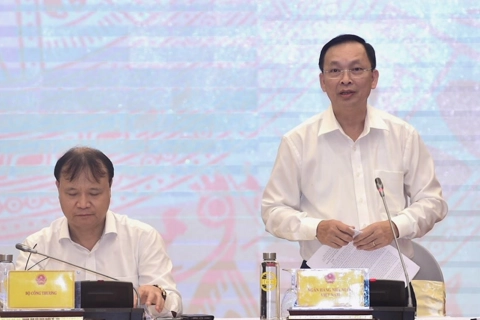
At the meeting, Governor Nguyen Thi Hong said in the coming time, the central bank would continue to promote non-cash payment, which has become an inevitable trend.
The ultimate target would be for the banking sector to become an effective channel of capital supply for the economy while diversifying services to meet growing demand of enterprises and the people.