Travel
Hang Ngang street - A street of silk and crepe
Hang Ngang street which has been a silk in the old time is now an attractive tourist destination in Hanoi`s Old Quarter.
Hang Ngang Street formerly belonged to Dien Hung guild, Huu Tuc ward and then its administration was changed to Dong Tho ward, Tho Xuong district.
Hang Ngang Street came into being long before the French colonial time, the French later called it Rue des Cantonnais meaning “the Cantonese street”. It was changed to its Vietnamese name which is Hang Ngang Street since 1945.
Since the Le dynasty, the Chinese were allowed to settle in Thang Long capital city. Those from the Chinese Guangdong province lived in the streets of the ancient Guangdong colony namely Hang Buom and Hang Ngang streets. Those from Fujian province settled down in the ancient the Fujian colony which now comprises Lan Ong, Cua Dong streets. The residents in Hang Ngang street are mostly the Chinese migrants from Guangdong who were formerly called “Viet” and therefore, old geography books called this street “Viet Dong”.
The origin of the name Hang Ngang has not been identified. It is said that in ancient times, two barriers was set up on opposite ends of the street and closed at night by the guard, which explains the name of the street.
In his “Vu Trung Tuy But” (Book Written in the Rain) book, scholar Pham Dinh Ho of the 19th century wrote: "Dien Hung and Dong Lac guilds are on the street of Hang Ao, selling silk and crepe products." Therefore, presumably before the Chinese people inhabited here, in Hang Ngang street (i.e. Dien Hung guild) and the first section of Hang Dao street (i.e. Dong Lac guild), Vietnamese people had sold clothes and “yem” (traditional silken bra in Vietnam)as Dong Lac communal house also known as Hang Yem communal house.
Previously more than half the population of Hang Ngang street were the Chinese migrants. Many changed their way of dressing according to Vietnamese customs, so the Vietnamese people called them Minh Huong (Vietnamese originating from the country of the Minh dynasty).
Until the early 20th century, there were many silk stores owned by the Minh Huong relatives: Phan Duc Thanh at No. 2, Phan Thai Thanh at No. 4, Phan Hung Thanh at No. 26, Phan Van Thanh at No. 40, Phan Du Thanh at No. 56, Phan Hoa Thanh at No. 60.. Big silk shops of the Vietnamese are Trinh Phuc Loi at No.7, Loi Quyen at No. 27. Afterwards the son of Trinh Phuc Loi named Trinh Van Bo moved to the house No. 48 in the same street.
The Chinese migrants in Hang Ngang Street also opened teahouses selling "Tau" tea such as Sinh Thai, Chinh Thai and Ninh Thai. Tea was stored in porcelain jars, tins or wrapped by paper with labels in Chinese. Most of the tea was produced in the Vietnamese province of Phu Tho but packed in Hang Ngang street and branded Vu Di Son and Fujian.
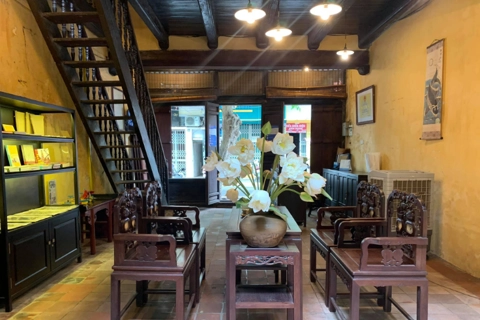
Nowadays, this street still retains the house associated with the glorious revolutionary history of the country. The house No. 48 with the door opening to No. 35 Hang Can Street was the place the president Ho Chi Minh drafted the Declaration of Independence. This house was originally owned by Mr. Trinh Van Bo and Mrs. Hoang Minh Ho, the wealthy merchants at the time. President Ho Chi Minh and other Party Central Committee officials worked and lived on the second floor. In that building, Uncle Ho presided over the first meeting of the Party Central Committee in Hanoi, decided on a number of important issues including organizing the meeting for introducing the line-up of the Provisional Government to the people and drafting the Declaration of Independence, a document playing a very important role in the history of national construction and defense. This house now becomes an important revolutionary relic and was recognized as a national monument in 1979.
Hang Ngang Street came into being long before the French colonial time, the French later called it Rue des Cantonnais meaning “the Cantonese street”. It was changed to its Vietnamese name which is Hang Ngang Street since 1945.
 The house at No.48 Hang Ngang, a revolutionary relic |
The origin of the name Hang Ngang has not been identified. It is said that in ancient times, two barriers was set up on opposite ends of the street and closed at night by the guard, which explains the name of the street.
In his “Vu Trung Tuy But” (Book Written in the Rain) book, scholar Pham Dinh Ho of the 19th century wrote: "Dien Hung and Dong Lac guilds are on the street of Hang Ao, selling silk and crepe products." Therefore, presumably before the Chinese people inhabited here, in Hang Ngang street (i.e. Dien Hung guild) and the first section of Hang Dao street (i.e. Dong Lac guild), Vietnamese people had sold clothes and “yem” (traditional silken bra in Vietnam)as Dong Lac communal house also known as Hang Yem communal house.
Previously more than half the population of Hang Ngang street were the Chinese migrants. Many changed their way of dressing according to Vietnamese customs, so the Vietnamese people called them Minh Huong (Vietnamese originating from the country of the Minh dynasty).
Until the early 20th century, there were many silk stores owned by the Minh Huong relatives: Phan Duc Thanh at No. 2, Phan Thai Thanh at No. 4, Phan Hung Thanh at No. 26, Phan Van Thanh at No. 40, Phan Du Thanh at No. 56, Phan Hoa Thanh at No. 60.. Big silk shops of the Vietnamese are Trinh Phuc Loi at No.7, Loi Quyen at No. 27. Afterwards the son of Trinh Phuc Loi named Trinh Van Bo moved to the house No. 48 in the same street.
The Chinese migrants in Hang Ngang Street also opened teahouses selling "Tau" tea such as Sinh Thai, Chinh Thai and Ninh Thai. Tea was stored in porcelain jars, tins or wrapped by paper with labels in Chinese. Most of the tea was produced in the Vietnamese province of Phu Tho but packed in Hang Ngang street and branded Vu Di Son and Fujian.
Nowadays, this street still retains the house associated with the glorious revolutionary history of the country. The house No. 48 with the door opening to No. 35 Hang Can Street was the place the president Ho Chi Minh drafted the Declaration of Independence. This house was originally owned by Mr. Trinh Van Bo and Mrs. Hoang Minh Ho, the wealthy merchants at the time. President Ho Chi Minh and other Party Central Committee officials worked and lived on the second floor. In that building, Uncle Ho presided over the first meeting of the Party Central Committee in Hanoi, decided on a number of important issues including organizing the meeting for introducing the line-up of the Provisional Government to the people and drafting the Declaration of Independence, a document playing a very important role in the history of national construction and defense. This house now becomes an important revolutionary relic and was recognized as a national monument in 1979.