Hanoi announces entry fees for historic sites
Starting today, January 2, two historical landmarks in Hanoi's Old Quarter will charge admission to raise funds for the preservation of the city's cultural heritage.
The Management Board of Hoan Kiem Lake and the Hanoi Old Quarter has announced that the entrance fee for the Ancient House at 87 Ma May Street and the Cantonese Assembly Hall at 22 Hang Buom Street will be VND20,000 or US$0.86 per person. However, children and persons with disabilities will be admitted free of charge. Senior citizens, students and pupils will receive a 50% discount.
| The Cantonese Assembly Hall at No.22 Hang Buom Street, Hoan Kiem District, Hanoi. Photo: Lan Tran |
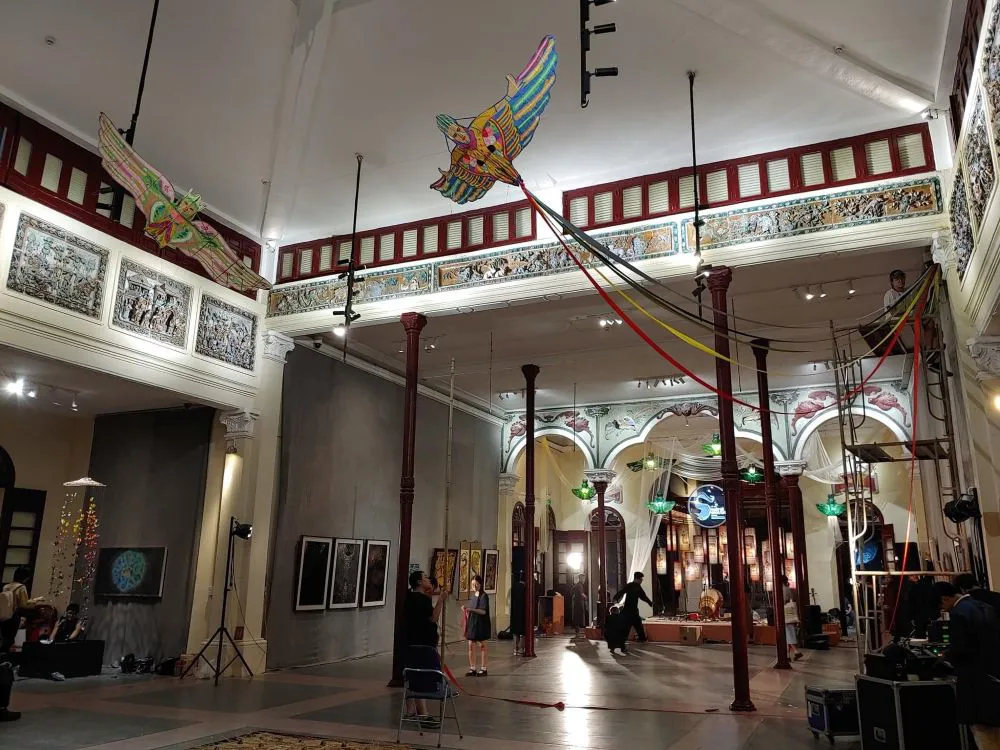
The Cantonese Assembly Hall, located at 22 Hang Buom Street in Hoan Kiem District, is a hidden gem in Hanoi's Old Quarter. Its architecture reflects a unique blend of Vietnamese, Chinese and French influences. Founded nearly 400 years ago by the Cantonese community that settled in Ha Khau Ward, Huu Tuc Canton (now part of Hang Ngang, Hang Buom, Hang Bo and Lan Ong streets), the hall is a testament to the region's rich cultural heritage.
The 1,800-square-meter historic building dazzles tourists with its spaciousness and well-preserved construction, which retains many of its original features. The original design of the hall can be seen in the various pieces that make it up.
Historically, the hall served as a religious center for the Chinese expatriate community, as well as a place for trade, negotiation, and arbitration of commercial disputes.
After the reunification of Vietnam in 1975, the hall was converted into a kindergarten in 1978. Restoration work began in 2018, and by the end of 2021, the Arts and Culture Center at 22 Hang Buom Street was officially inaugurated, serving as a venue for exhibitions and cultural events.
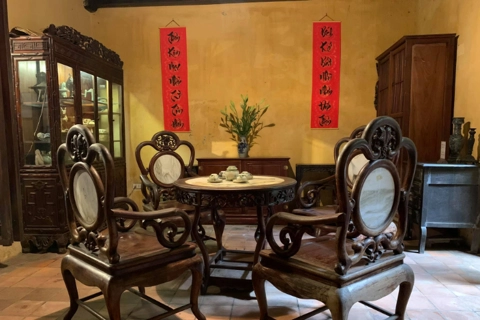
| The interior of an ancient house at 87 Ma May Street in Hoan Kiem District. Photo: Huy Trung |
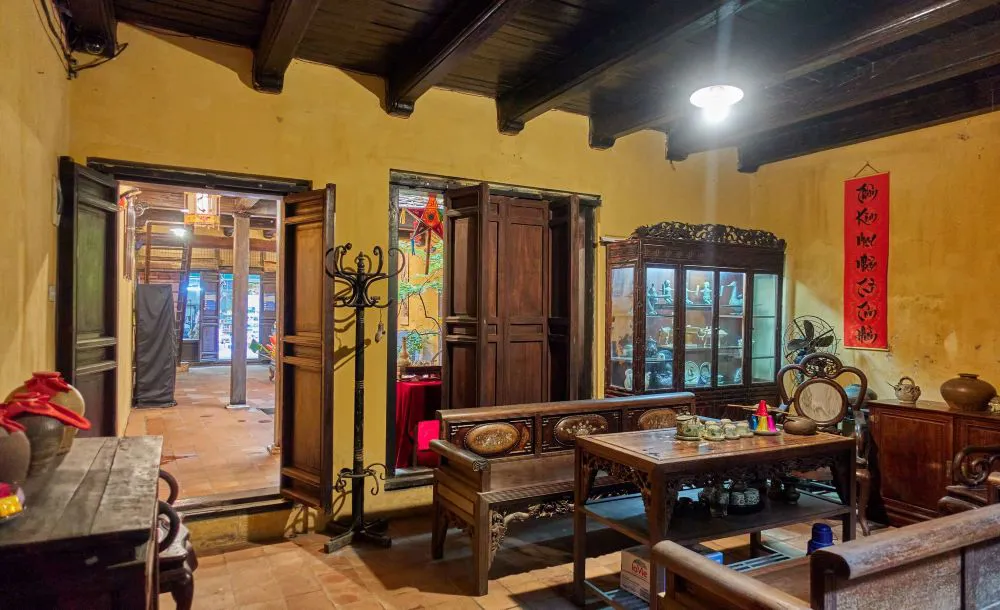
The Ancient House, located at 87 Ma May Street in Hoan Kiem District, is one of only 14 preserved ancient houses from the late 19th century in Hanoi. This house serves as a representation of Hanoi's traditional architecture and provides a glimpse into the daily life of Hanoians at that time.
With a total area of 157.6 square meters, the house has changed hands several times over the years. From 1954 to 1999, it was home to five different families. Its tubular design, typical of Hanoi's old houses, is narrow but deep, with an ingeniously designed layout that accommodates rooms, mezzanines, and courtyards for the convenience of its residents.
Constructed mainly of wood, the house remains refreshingly cool in the summer and warm in the winter. Restoration work began in 1998 and was completed in 1999 through cooperation between Hanoi and Toulouse, France. In 2004, the house was declared a national heritage site by the Ministry of Culture, Sports and Tourism.
Today, the Ancient House at 87 Ma May Street continues to offer visitors a glimpse of the iconic tubular architecture and traditional lifestyle of the Old Quarter.