Skillful hands: get-rich-quick secret of Ha Thai lacquer craftsmen
The village is famous for a variety of lively and sophisticated lacquer products, which have met the requirements of customers in and out of the country.
Ha Thai lacquer village is one of the well-known traditional craft localities in Hanoi and it is worthy to make a visit here to explore how skillful are the hands of Hanoians when making handicraft products.
Some 20 kilometers south of Hanoi center and located in Duyen Thai Ward of Thuong Tin District, Ha Thai traditional craft village is famous for making lacquerware and high-quality products. It has established a firm position among the famous craft villages in Vietnam, with most of its products being exported.
The village is not the cradle of the trade but famous for its contingent of talented, skilled, and creative craftsmen, said artisan Nguyen Thi Hanh, one of the “lordly trees” of the lacquer painting guild.
Delicate lacquer products are made in Ha Thai village. Photo: Nguyen Mai |
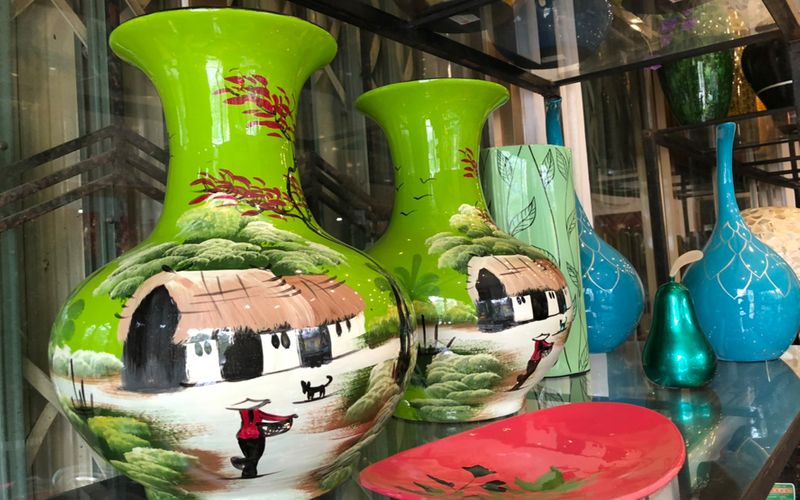
“Ha Thai lacquer wares are special, thanks to their artisans’ skill to carve the lacquer pieces to create smooth and vivid patterns in the products. Apart from the traditional technique passed down from their ancestors, Ha Thai craftsmen have created new colors with numerous shades which add value to their products,” Hanh told The Hanoi Times.
Ha Thai is a popular lacquer brand thanks to its high quality and beautiful designs. The Ha Thai lacquer is not only gorgeous, shiny, and durable but also shows the creativity of talented craftsmen.
“The village is also famous for a variety of lively and sophisticated lacquer products, which meet the requirements of customers both inside and outside the country,” Hanh said.
She added that for many years, Ha Thai has been a prestigious address among foreign customers. The local craftsmen have found their own way to export their products to many countries in the world such as the UK, France, Russia, the US, Spain, Australia, Italy, Japan, South Korea, and among others.
The village produces millions of lacquer items with patterns featuring the natural scenery and culture of Vietnam. Its products have been put on shows at many domestic and international handicraft and fine art exhibitions and fairs.
Foreigners visit a lacquerware shop in Ha Thai village. Photo: Phuong Linh |
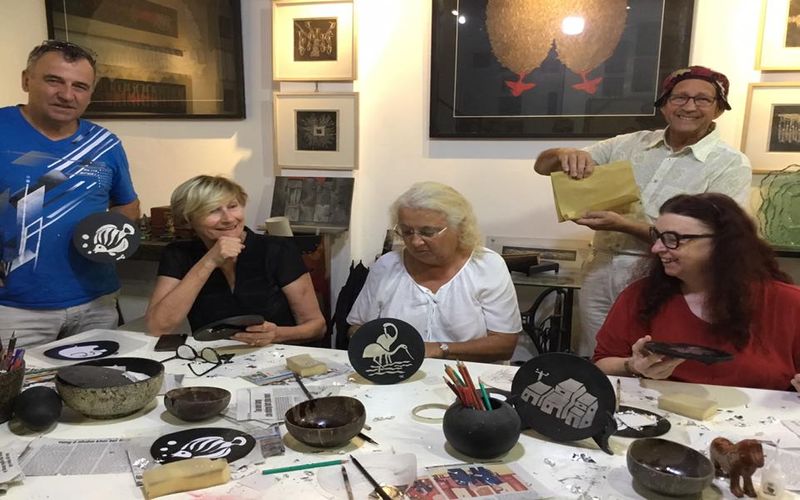
Inlaid with eggshell and pearl, Ha Thai lacquer products come in thousands of designs and models. Among the most common are boxes, trays, vases, pots, albums, lamp-shades, plates, and paintings. Each product is not only pleasing to the eye but also useful and durable.
"Besides traditional products, Ha Thai craftsmen have also created thousands of new ones, which meet the requirement of customers inside and outside the country, such as bowls, plates, vases, and paintings," artisan Nguyen Thi Hanh said.
Job generation
The village has nearly 800 households, 90% of which are engaged in lacquer art employing thousands of laborers, according to Do Van Hung, Vice Chairman of Duyen Thai Ward People's Committee.
Hung noted that the total revenue from lacquer manufacture and trade in Ha Thai is estimated at VND25 billion on average (over US$1 million) and per capita income reaches nearly VND50 million (US$2,173) per year.
Chairman of Ha Thai Lacquer Village Association Do Hung Chieu said that the most flourishing period of the craft village was the period 1995 - 2008. At that time, households had to work day and night to complete orders from Western Europe and North America.
A shopper is introducing traditional products of Ha Thai lacquer village to tourists. Photo: My An |
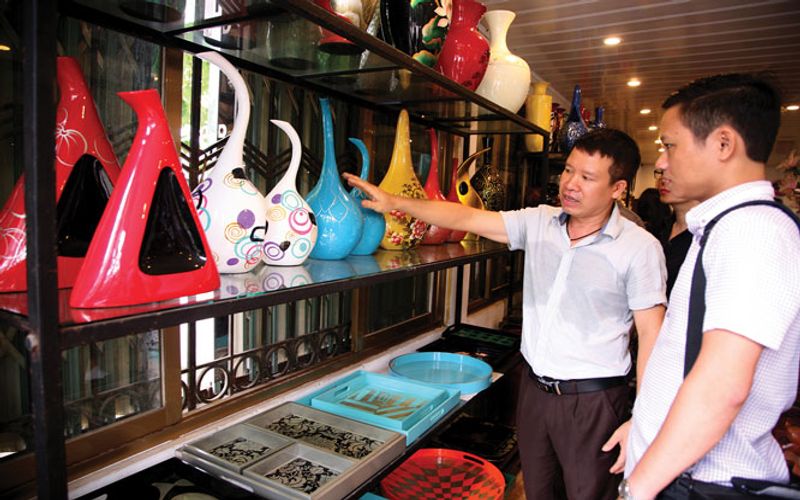
Before the Covid-19 pandemic, tourists flocked to Ha Thai to learn about traditional crafts and buy local products as a souvenir during their trip to Hanoi.
The local lacquer products currently account for about 50% of the goods sold in souvenir shops in Hanoi's Old Quarter. That is the motivation for Ha Thai villagers to remain loyal to the traditional trade, Chieu said.
In a phone interview with The Hanoi Times, Chieu stressed that during the production process, quality control is carefully and strictly performed at every step. "Only when quality is accepted at one stage of production, we move on to the next."
He said the village's lacquer exports have met the requirements of those in the mid-upper segment, with exclusive designs.
“With the unique and high-quality products, we have been obtained very good comments from our customers in the homeland and overseas markets,” he added.
The material, spiritual and cultural values of its lacquerwares have helped Ha Thai become one of the two craft villages in Vietnam selected by the Japan International Cooperation Agency (JICA) to pilot the model of sustainable development of artisanal villages.
Along with the tradition of an artisanal village of more than 300 years, Ha Thai now enjoys a new vitality and has established a firm foothold among Vietnam's famous craft villages, with most of its products exported to many countries in the world.
“In the coming time, we will make craft village development one of the socio-economic growth indicators,” Vice Chairman Do Van Hung told The Hanoi Times.