Hanoi step up efforts to complete urban rail network
Hanoi will complete the formulation of standards and norms for the city's urban railway lines in accordance with the Capital Law.
Hanoi is committed to accelerating the development of the urban railway network by expediting site clearance, removing bottlenecks, and providing advantageous conditions for contractors, according to Duong Duc Tuan, Vice Chairman of the Hanoi People's Committee.
The official stressed that the development of the mass transit system, especially the urban rail network, will serve as the "backbone" of the city's urban transport with the aim of curbing traffic congestion and pollution and contributing to building a smart, green, clean and liveable city.
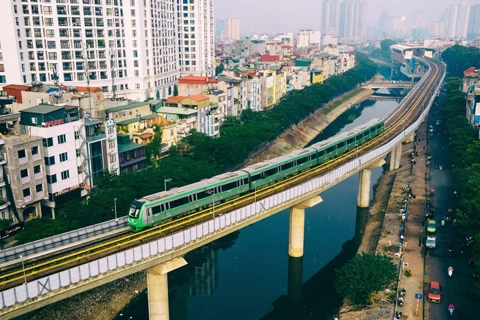
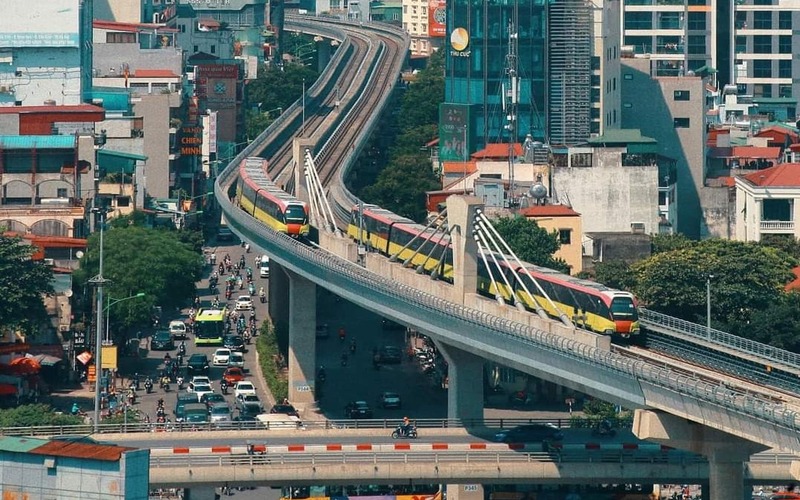
The elevated section of the Nhon-Ha Noi Station metro line, Hanoi's second urban railway, is helping to transform the city's transportation. Photo: Anh Kiet/The Hanoi Times |
"In the long term, Hanoi will closely coordinate with the Ministry of Transport to complete the overall project of the capital's urban rail network, submit a resolution to the National Assembly to approve the overall investment policy, promulgate specific mechanisms and policies, and shorten the procedures and time for investment preparation," Tuan said.
Specifically, the city will complete regulations on the management and operation of urban railways and the implementation of transit-oriented development (TOD); procedures for the collection of fees in TOD areas; standards and norms for the City's urban railways by the Capital Law.
He said from now until 2035, Hanoi needs to build at least 200 kilometers of urban railways. This is a challenge that requires great determination to overcome. In particular, it requires the development of supporting industries and technologies for the operation of urban railways.
Le Trung Hieu, Deputy Director of Hanoi's Department of Planning and Investment, said Hanoi is stepping up efforts to complete its urban rail network in response to increasing traffic, which requires greater decentralization.
Hanoi aims to have 10 metro lines by 2035, covering about 410 kilometers, with a total investment of about US$37.2 billion. The target is part of the capital's transportation plan approved by the Prime Minister on March 31, 2016.
"The adjusted overall plan for the capital from 2036 to 2045 includes the construction of an additional 200 kilometers of urban rail, at an estimated cost of $18.2 billion. This would bring the total number of light rail lines to 14, extending about 616 kilometers by 2045," Hieu said.
Hanoi's goal is to develop a modern, synchronized urban rail network to meet growing commuter demand. The city aims for public transport to account for 50-55% of passenger traffic by 2035, rising to 65-70% thereafter. "To achieve these goals, the city has drawn up a comprehensive plan for the development of the urban rail network," he added.
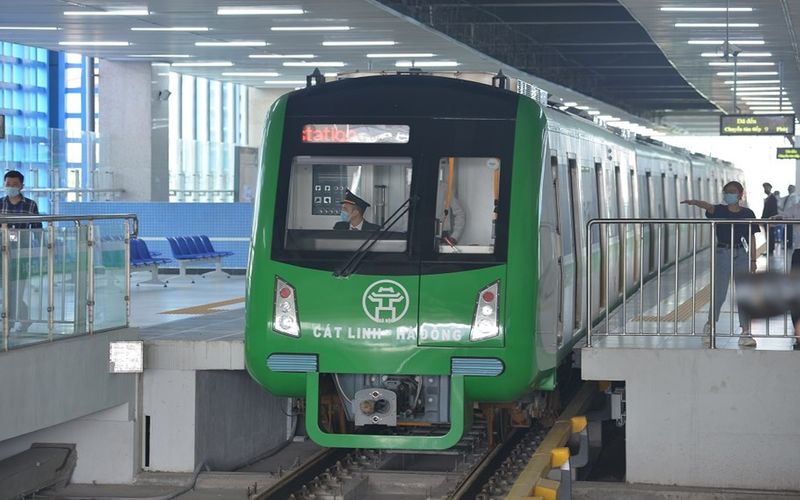
Cat Linh-Ha Dong, Hanoi's first metro line. Photo: Pham Cong/The Hanoi Times |
Hieu said that to attract private investors, the city will continue to refine policies, including infrastructure investment budgets, compensation for land clearance, and resettlement support. "This will include competitive bidding for private investors to procure locomotives, rolling stock, control systems, information technology, signaling systems, and electromechanical equipment as part of a comprehensive package."
In addition, measures will be taken to ensure consistency throughout the implementation of the urban railway project, allowing investors to obtain rights to use parts of the infrastructure and participate in the development of projects within the planned TOD areas, Hieu stressed.
He added that Hanoi will focus resources on completing the seven ring road projects, radial and regional roads. In addition, the city aims to shift to green and clean transportation methods and increase the share of public passenger transport to about 30% of Hanoi's total traffic by 2025-2026.
Hieu also noted that the city will replace the existing Kim Ma - Yen Nghia Bus Rapid Transit (BRT) line with a metro railway.
"The bus rapid transit line has turned into a regular, slow bus line. With adjustments to the general transportation plan, the city will replace the Kim Ma - Yen Nghia BRT line with urban railway line 11," Hieu said.
During a year-end conference in late December 2024, Nguyen Phi Thuong, Director of Hanoi's Department of Transportation, outlined the city's transportation development plans and long-term vision for Hanoi's urban rail network.
Hanoi has set an ambitious goal of building more than 410 kilometers of urban railway by 2035, with a total network of 15 lines running more than 616 kilometers by 2065.
"This initiative aims to transform the city's public transport system into a modern, efficient one capable of supporting growing traffic, marking a significant step in the modernization of the city's mass transit system," Thuong said.
So far, 21.5 km of this network is operational, including the Cat Linh - Ha Dong metro line (13 km) and the 8.5 km elevated section of the Nhon - Cau Giay metro line. This is only 4% of the planned total.
In 2017, Hanoi passed Resolution 04 to restrict motorcycles in urban districts by 2030. However, seven years later, the implementation of the resolution has proven challenging due to low public transport usage. Studies have shown that restricting motorcycles is only feasible when public transportation usage reaches 30-50%, which is currently only 19.5% in Hanoi.
"Only when Hanoi completes its plan to build 400 kilometers of railways by 2035 will it be possible to restrict motorcycles," Thuong said.