Log in
Hanoi

Hanoi urges improvements to retain top spot in governance index

Hanoi continues to enhance the use of information technology for administrative reform, focusing on data systems that support policy and decision making.

THE HANOI TIMES — Hanoi authorities have called on relevant agencies to improve key governance performance indicators, including SIPAS, PAR INDEX, and PAPI, to maintain the city’s position among the top-performing localities in the 2025 Public Administration Reform Index (PAR Index).

Chairman of the Hanoi People's Committee, Tran Sy Thanh, visits the Hanoi Public Administrative Service Center. Photo: Pham Hung/The Hanoi Times

In 2024, Hanoi achieved a PAR INDEX score of 92.57%, ranking third out of 63 provinces and cities for the third consecutive year. This represents an increase of 1.32 percentage points compared to 2023 and 2.99 percentage points compared to 2022. It was also 4.38 percentage points higher than the average score of centrally governed provinces and cities.

According to the 2024 Satisfaction Index of Public Administration Services (SIPAS), Hanoi achieved an 86.5% satisfaction rate, an increase of 2.93 percentage points from the previous year. The city ranked 11th out of 63 provinces and cities, climbing 10 places from 2023. Hanoi’s score exceeded the national average SIPAS score for 2024, which was 83.94%.

This year, the city aims to increase the overall satisfaction rate and ranking.

Hanoi's Provincial Governance and Public Administration Performance Index (PAPI) score is expected to remain in Group 2, which is classified as "Above Average." In 2024, Hanoi achieved a PAPI score of 43.7, ranking 29th out of 63 provinces and cities nationwide. This result placed the city in Group 2, the "Above Average" group. With this performance, Hanoi met its PAPI target, ranking second among the six centrally governed cities, behind Hue City, which joined the group in 2024.

To achieve these goals, relevant agencies are required to implement the key tasks outlined in the 2021–2025 administrative reform plans and the SIPAS and PAPI improvement plans for the same period. They must also follow the 2025 reform action plan, including any adjustments. Efforts will focus on enhancing the performance of key governance indicators – the PAR INDEX, the SIPAS, and the PAPI – by addressing underperforming criteria and improving assessment and measurement methods according to the Ministry of Home Affairs guidelines to ensure accuracy and predictive effectiveness.

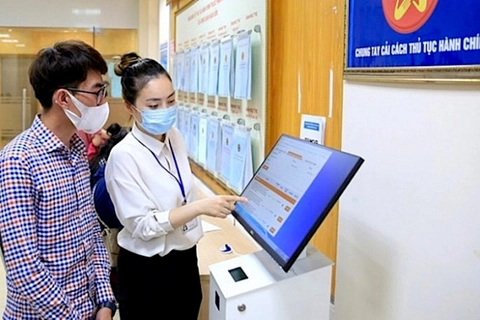
Citizens carry out administrative procedures at the One-Stop Service Division of Dong Da District.

Administrative leadership and oversight will also be strengthened, with clear accountability assigned to heads of departments, agencies, and local authorities.

Organizational reform of the administrative apparatus will be pursued, including restructuring administrative units at all levels and developing a two-tier local government model. Training and capacity building for civil servants, especially those responsible for performance indicators such as SIPAS, PAR INDEX, and PAPI, will be prioritized.

Training programs will target officials working in administrative reform, administrative procedure processors, and IT staff.

Moreover, Hanoi will maintain a public feedback channel for citizens and businesses to report on administrative regulations, focusing on reducing processing time and avoiding delay.

Departments, agencies, and local authorities are responsible for developing detailed implementation plans.

Source: Plan No.159/KH-UBND dated June 9, 2025 by the Hanoi People’s Committee

  • The PAPI Index is based on eight key dimensions, encompassing 28 component sub-dimensions, over 120 main indicators, as well as more than 550 survey questions. Each dimension is scored on a 10-point scale, for a maximum total score of 80. The eight dimensions include: 

    1) Citizen participation at the grassroots level, 2) Transparency in decision-making, 3) Vertical accountability toward citizens, 4) Control of corruption in the public sector, 5) Public administrative procedures, 6) Public service delivery, 7) Environmental governance, and 8) E-governance.

  • The PAR Index consists of eight evaluation areas:

    1. Administrative reform

    2. Leadership and management

    3. Administrative procedure reform

    4. Organizational structure reform

    5. Institutional reform

    6. Development of e-government and digital government

    7. Public financial reform

    8. Civil service regime reform

    9. Impact of administrative reform on citizens and socio-economic development The index includes 38 criteria and 88 sub-criteria, with a total evaluation score of 100 points. Of these, the Appraisal Council contributes 68 points, and sociological survey results contribute 32 points.

  • The SIPAS Index comprises 42 indicators reflecting public perceptions and evaluations, 51 satisfaction level indicators, and 10 indicators capturing citizens’ needs and expectations. The satisfaction indicators are assessed based on citizens’ perceptions of key public policy development and implementation that directly affects their lives, as well as their knowledge of and personal experience with public administrative service delivery.

Reactions:
Share:
Trending
Most Viewed
Related news
Online payments for public services soar

Online payments for public services soar

01 Jun, 17:51

It's reported that the method of paying for online public services through mobile money accounts will be expanded to increase convenience, simplicity and speed.

Hanoi gears up for a vibrant 2026 Countdown

Hanoi gears up for a vibrant 2026 Countdown

With the energy of thousands gathering in Hanoi downtown, the Countdown 2026 promises to be an unforgettable way for people to welcome the New Year.

Hanoi launches AI-powered traffic control center for traffic violations

Hanoi launches AI-powered traffic control center for traffic violations

The system automatically detects common violations, significantly reducing the need for traffic police to be deployed directly on the streets while improving accuracy and transparency in traffic management.

Hanoi plans 10,000-hectare urban megacity with world-class stadium

Hanoi plans 10,000-hectare urban megacity with world-class stadium

The stadium’s design draws inspiration from Dong Son bronze drums and the Lac bird motif, symbolizing Vietnam’s aspiration to rise.

Hanoi greenlights Olympic sports city and Red River boulevard to drive next growth phase

Hanoi greenlights Olympic sports city and Red River boulevard to drive next growth phase

The approval of two landmark projects underscores Hanoi’s push to unlock new growth engines, reshape its urban structure and accelerate its ambition to become a green, smart and globally connected capital.

Hanoi targets 1,200 supporting industry firms by 2030

Hanoi targets 1,200 supporting industry firms by 2030

The city aims to enhance the competitiveness of the capital’s industrial sector by tightening cooperation with Vietnamese enterprises and multinational corporations operating in Vietnam.

Red River Boulevards shape Hanoi’s new growth axis

Red River Boulevards shape Hanoi’s new growth axis

The creation of a landscape boulevard can help Hanoi reconnect with its historic identity shaped by water and restore the river-based character that defined the city for centuries.

Hanoi moves to strengthen urban order and civility

Hanoi moves to strengthen urban order and civility

These include expanding public communication efforts, reorganizing and upgrading streets and sidewalks, maintaining a clean and orderly urban environment and carrying out strict inspections to address violations.

Hanoi honors 87 entities and buildings for using green energy

Hanoi honors 87 entities and buildings for using green energy

Enterprises adopted highly automated technologies in line with Industry 4.0 standards and all businesses in industrial parks, clusters, rural industries and craft villages will keep applying energy-efficient measures.