14TH NATIONAL CONGRESS OF THE COMMUNIST PARTY OF VIETNAM
Log in
Hanoi

Hanoians' tea culture - past and present

Drinking tea has long been a daily enjoyment of Hanoians regardless of social status or character.

In the old Vietnamese concept, a true man must know gambling/drink tea and read Kieu poem”. It can be seen that tea drinking is considered a common custom or even a culture in Vietnam.

Over time, tea drinking should not be treated like drinking other juices, but a typical kind of art in Vietnamese culture, as it gives drinkers the sense of relaxation amid hectic life.

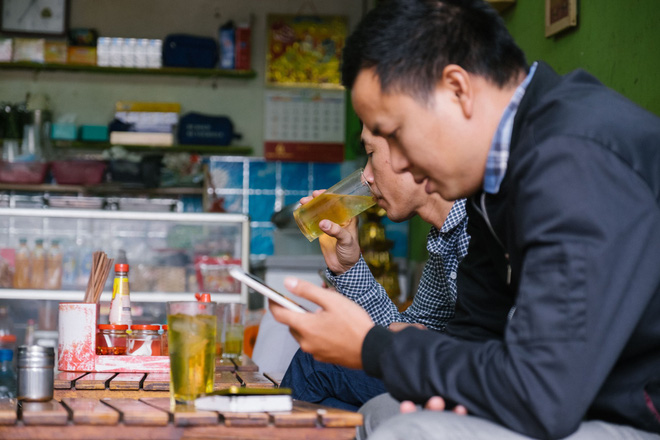
Stopping at a roadside tea bar and enjoying a glass of iced tea gives a sense of true refreshment/ Photo: Nhan Minh

According to professor Tran Ngoc "Vietnamese people are invited to drink tea not merely for refreshment, but to express a high culture, an expression of intimacy, a desire for harmony, a favor of conversation.

Vietnamese people are invited to drink tea to start a talk of peace, to discuss family and social affairs and love affairs, to feel the taste of earth, sky, plants and all things in the cup of tea.

By origin, many cultural researchers stated that Vietnamese tea drinking custom was adapted from China. According to scholar Vu Bang, Vietnamese tea has very basic differences with Chinese peer in the way of making, drinking and tasting.

There are two main types of tea. Fresh tea are original tea leaves boiled in water, drunk to refresh the physical and mental health. Dried tea is made from carefully selected leaves and buds, with many meticulous processing steps and stages.

Tea has become a popular drink for Vietnamese people in general and Hanoians in particular.

Sipping a cup of tea after the breakfast is proven to dissipate working stresses. Stopping at a roadside tea bar and enjoying a glass of iced tea gives a sense of true refreshment. Tea is also the first thing the host offers to welcome guests.

Hanoians drink tea anywhere anytime they like. But, there are three popular tea-drinking places for them: At home, in the office and a tea house or waterfront tea shops. Almost every family in Hanoi has a tea set. Whenever there is a visit, the polished tea-set shows respect and hospitality of the host to the guests.

Coffee shops opened all over Hanoi streets previously are now facing competition from teahouses. Each tea house has its own service fashion: Japanese teahouses with very formal rituals, Chinese teahouse with desserts and Vietnamese teahouse with simplicity of enjoyment. These in combination have enriched the tea culture of Hanoians.Unlike drinking tea at home or at large tea houses, people in Hanoi also tend to drink tea at roadside tea shop serving either white-collar workers, blue-collar workers, students or the elderly with the same casualness and informality so as for them to fully enjoy their cup of tea.

Hanoi people tend to drink tea in places where it’s most convenient for them to park the motorbike and feel comfortable, for example on the roadside.

In the heat of scorching summer, a glass of iced tea will dispel all fatigues. In the morning of cold winter, a cup of hot tea will make people think more about life.
Reactions:
Share:
Trending
Most Viewed
Related news
Hanoi unique coffee streets

Hanoi unique coffee streets

22 Dec, 15:49

Walking around Hanoi cafeterias, you will see a pristine soul of the city, no matter how much it has changed.

Work starts on US$612 million elderly healthcare complex in Hanoi

Work starts on US$612 million elderly healthcare complex in Hanoi

The complex project is designed as a multi-functional center with high-quality medical services, education and clinical training, scientific research and comprehensive elderly care.

Hanoi orders urgent action to tackle environmental pollution

Hanoi orders urgent action to tackle environmental pollution

Hanoi’s Party chief has called for urgent, comprehensive action to tackle environmental pollution, warning that delays are undermining urban sustainability and the city’s tourism appeal.

Huong Pagoda Festival 2026 embraces smart management for modern pilgrimage experience

Huong Pagoda Festival 2026 embraces smart management for modern pilgrimage experience

Blending centuries-old spiritual traditions with modern governance tools, the Huong Pagoda Festival is redefining how major religious events are organized in Hanoi, with technology now playing a central role in management and visitor services.

Hanoi Times Weekly podcast - January 17

Hanoi Times Weekly podcast - January 17

This week, we highlight major developments shaping Hanoi, including Vietnam’s first semiconductor chip plant, expanded global tech cooperation, cultural events, social housing targets, digital public services, innovation investment and job creation priorities across the capital.

Hanoi targets double-digit export growth with focus on high-value goods

Hanoi targets double-digit export growth with focus on high-value goods

As global trade conditions grow more complex, Hanoi is recalibrating its export strategy to move up the value chain, broaden market access and strengthen long-term economic resilience.

Metro ridership target rises as Hanoi pushes safer, smarter urban rail operations

Metro ridership target rises as Hanoi pushes safer, smarter urban rail operations

As Hanoi accelerates public transport reform, the city’s metro operator is setting higher ridership goals while focusing on safety, digital governance and service quality to support long-term urban mobility growth.

Hanoi advances Capital Region linkages through urban cluster model

Hanoi advances Capital Region linkages through urban cluster model

The approach is expected to create new momentum and development space for provinces in the Capital Region and neighboring areas, ease pressure on Hanoi and enable shared growth.

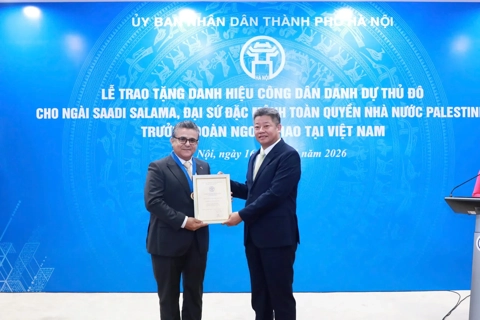
Hanoi honors Palestinian ambassador for decades of service and deep ties to capital

Hanoi honors Palestinian ambassador for decades of service and deep ties to capital

Over four decades of studying, working and living in Vietnam, Palestinian Ambassador Saadi Salama has witnessed Hanoi’s transformation from a struggling capital into a dynamic political, economic and cultural centre that has retained its distinct identity.