Norway strengthens support to Vietnam's sustainable marine aquaculture
Norway has helped Vietnam develop the first Fisheries Law, supported surveys of aquatic resources, and capacity-building projects in the fisheries sector for nearly 40 years.
Norwegian partners have intensified their support of Vietnam’s sustainable marine aquaculture through efforts that share expertise from a world-leading producer and exporter of seafood.
The seminar on June 5 in the central coastal province of Khanh Hoa is the latest move in the process in which the ocean nation has supported Vietnam over the past four decades.
Indeed, the event aims to create a platform for participants from the public, private sectors, and academia to discuss ways for Vietnam to develop marine aquaculture in a sustainable manner and the role of relevant stakeholders in that process.
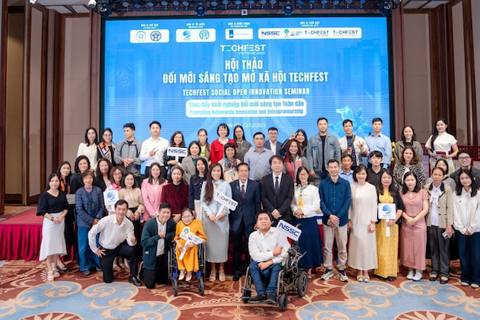
The seminar was organized by the Norwegian Embassy in Hanoi, Innovation Norway, Hanoi, in coordination with the Department of Fisheries (DFish) of the Vietnamese Ministry of Agriculture and Rural Development Vietnam (MARD), Vietnam Chamber of Commerce and Industry (VCCI), and Khanh Hoa Department of Agriculture and Rural Development.
| A Norwegian expert presented sustainable aquaculture models at the seminar held in Khanh Hoa Province on June 5. Photo: Embassy of Norway in Hanoi |

Lessons from Norway – a world-leading seafood producer and exporter
The importance of innovation and technological solutions in the industry’s growth and how to train skilled workers to meet the industry’s requirements were also parts of the seminar’s agenda.
Two special guest speakers from the Norwegian Directorate of Fisheries, Anne B. Osland and Erlend Hopsdal Skjetne, shared a lot of great insights into how the Norwegian Government developed policies, standards, and technical regulations for marine fish farms, how the licensing procedures go in line with the coastal planning taking into account the need to protect the marine environment and biodiversity.
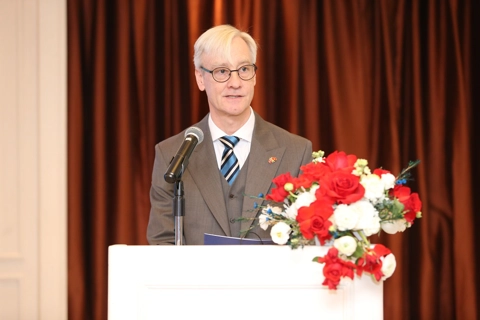
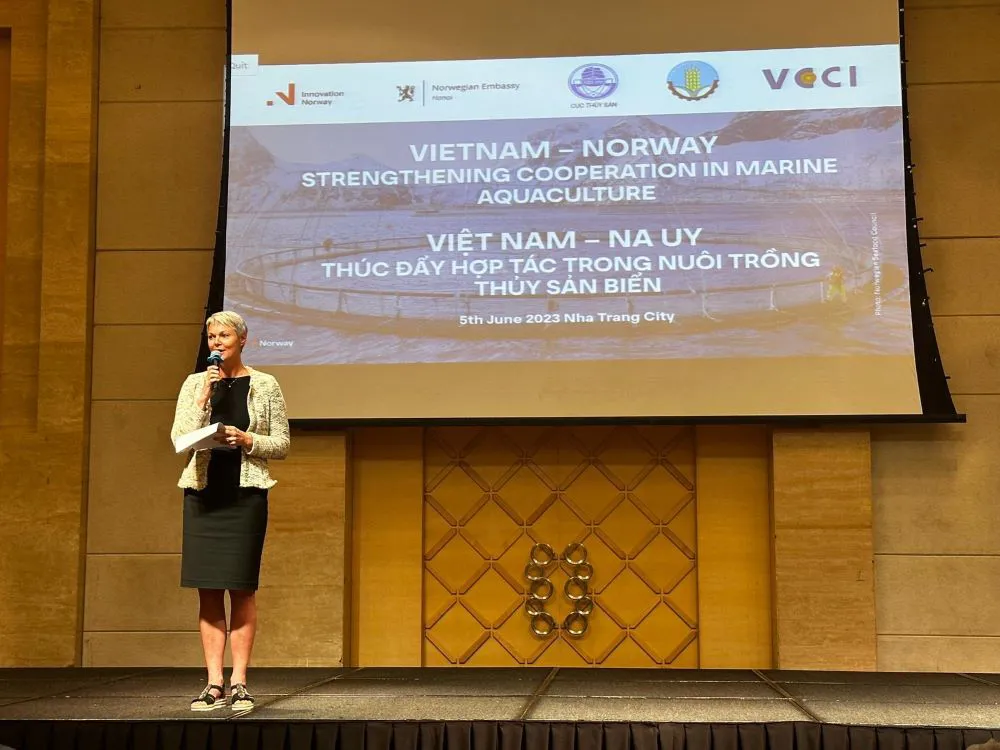
“This event gives new impetus to Norway-Vietnam bilateral cooperation in the fisheries sector and implements the Letter of Intent between MARD and the Norwegian Ministry of Trade, Industry, and Fisheries signed in 2021 for Enhanced Bilateral Cooperation in Marine Aquaculture Industry,” said Norwegian Ambassador to Vietnam Hilde Solbakken in her opening remarks.
A key success factor behind their story has been their ability to maintain an open and trust-based dialogue between government, industry, and research institutions. “This can be well illustrated through the stories we shared at the Seminar, which we hope practical examples of how we have done this in Norway,” Ambassador Solbakken noted.
| Norwegian Ambassador to Vietnam Hilde Solbakken delivers a speech at the seminar. Photo: Embassy of Norway in Hanoi |
Vietnam, despite its huge potential for marine aquaculture development, faces challenges in developing the marine aquaculture industry, including inconsistent infrastructure facilities, elementary equipment and instruments, shortage of skilled workers.
Tran Dinh Luan, MARD DFish Director General, said that as coastal nations, Vietnam and Norway share many similarities and interests. “Therefore, studying Norwegian experiences and success stories would provide us with suggestions to address the current challenges and build appropriate policies to grow a strong and sustainable marine aquaculture industry,” he noted.
According to Anne B. Osland, Head of the Aquaculture Licensing Section, Aquaculture and Coastal Management Department, Norwegian DFish, in the context of a shift toward sustainable aquaculture practices, the industry must focus on sustainable processes for Norway’s aquaculture industry to continue to grow. It starts with good planning and good policies, which, in turn, could help create an enabling environment for the industry to grow.
“Norway has a lot to share in terms of how we develop an enabling regulatory framework with strict regulations and standards for licensing aquaculture at sea or offshore aquaculture, how to run a site at sea to ensure both the site’s production capacity and minimize its impact on the marine eco-system, and so on,” she emphasized.
As a practical way for Vietnamese stakeholders, some Norwegian fish farms are open for public visits for informational and educational purposes, which showcases that coastal industries are not always conflicting but can be complementary and grow together. Participants in the seminar are offered an opportunity to join a field trip to visit the fish farm of Australis Vietnam Co. Ltd off Van Phong Bay, Khanh Hoa Province, to learn about industrial cage farming practices and automated facilities/systems that help reduce the carbon footprint from aquaculture business.
Vietnam has been implementing a Scheme on Marine Aquaculture Development till 2030 with a vision to 2045, which aims to develop consistent, safe, effective, sustainable, and eco-friendly marine aquaculture, produce branded products to meet domestic and foreign demand, generate jobs and improve the income of the local coastal communities.
Reducing exploitation and increasing aquaculture has also been defined by MARD as a policy to balance human needs and marine resources conservation, and sustainable development. Thus, a shift to offshore farming on an industrial scale, targeting exports and improving the quality and values of Vietnamese seafood products is inevitable.
| Anne B. Osland, Head of Aquaculture Licensing Section, Aquaculture and Coastal Management Department, Norwegian DFish, addresses the event. Photo: Embassy of Norway in Hanoi |

Results of cooperation
Norway and Vietnam have cooperated in the fisheries sector for nearly 40 years. Norway helped Vietnam develop the first Fisheries Law in 2003 and its implementing documents; supported surveys of aquatic resources; capacity building projects and activities in the fisheries sector.
Norwegian research institutions, including Tromsø University, University of Bergen and Norwegian University of Science and Technology (NTNU) have partnered with Nha Trang University to build a solid scientific research Center with high-quality education and competence in the marine sector.
Many leaders and experts in the Vietnamese fisheries industry have been trained in Norway and are now using their knowledge and expertise to contribute to developing Vietnam's fisheries industry. Norway also provided Research Vessels to support Vietnam in research activities in the fisheries sector.
Since 2019, the Confederation of Norwegian Enterprises (NHO) has been working with the VCCI to develop a set of job descriptions for some key positions in Vietnam’s marine aquaculture industry.
Interestingly, there are more than 10 Norwegian enterprises operating in Vietnam in this field, from providing equipment and technological solutions for industrial marine farming (Scale AQ), fish handling (MMC FP), vaccine (Pharmaq), aquafeed (Skretting) to salmon processing factory (MOWI), rest raw materials processing (Fjell Technology), equipment production (Slatlands) and seafood exporters.
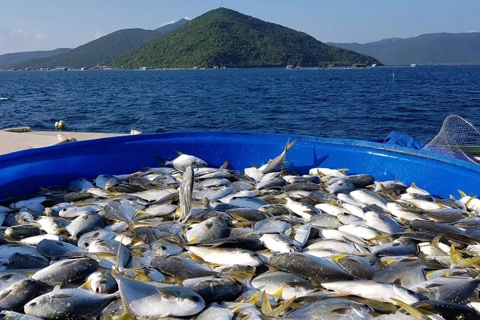
| Norway has helped Vietnam's fisheries sector for the past 40 years. Photo: Hiephoinuoibien.org |