Potential upgrade to emerging status may pull US$25 billion into Vietnam’s stock market
The local stock market's upgrade from the frontier to emerging status by 2025 remains critical to the country’s transformation into a high-middle-income country by 2035 and a high-income country by 2045.
Vietnam is expected to attract US$25 billion in foreign capital by 2030 once the stock market is upgraded to emerging status, said World Bank’s Senior Financial Sector Expert Ketut Ariadi Kusuma at a Government conference on the development of Vietnam’s stock market today [February 28].
| Prime Minister Pham Minh Chinh and delegates at the conference. Photos: Nhat Bac |

Vietnam aims for its stock market to be upgraded from the frontier to emerging status by 2025, a strategic move seen by Kusuma as a crucial step in Vietnam's transformation into a high-middle-income country by 2035 and a high-income country by 2045.
In particular, the World Bank’s expert suggested this upgrade would significantly boost Vietnam's capital market by enhancing accessibility for foreign investors. The expected outcome is a substantial market capitalization and attractive liquidity comparable to countries at similar development levels, potentially attracting $25 billion of new investments from international investors into Vietnam's market by 2030, according to World Bank estimates. Kusuma also noted that strong reforms in the insurance sector, investment funds, and improvements in the investment environment could generate up to $78 billion in capital for the capital market.
| World Bank’s Senior Financial Sector Expert Ketut Ariadi Kusuma. |

Vietnam is currently categorized as a frontier market by MSCI and FTSE Russell. FTSE Russell has placed Vietnam on the waiting list for an upgrade to the emerging market category.
Kusuma emphasized that resolving issues related to foreign investor ownership restrictions and accelerating the privatization of state-owned enterprises are essential conditions for Vietnam's upgrading.
He mentioned that if the ownership restrictions remain, Vietnam may only receive a maximum of $5 billion in net inflows. However, resolving this issue could potentially attract an additional $8-15 billion.
Supporting this view, the Counselor of the Embassy of South Korea in Vietnam Yoon Sang Key suggested that relaxing foreign ownership limits would increase the supply of stocks through non-voting depository receipts, in line with the state's management goals for each industry.
Apart from injecting capital, upgrading the market also improves the quality of goods.
Luu Trung Thai, Chairman of the Military Bank, highlighted that increasing the quality of listed stocks is crucial for upgrading. A high-quality market attracts foreign investors seeking profitability and investment opportunities.
| Counselor of the Embassy of South Korea in Vietnam Yoon Sang Key. |
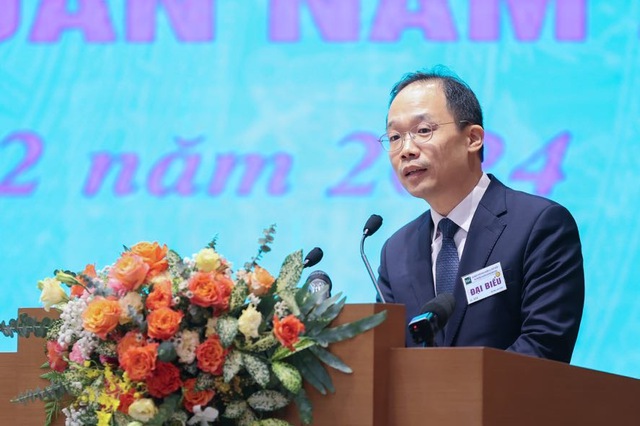
"Therefore, the market quality and, more importantly, the integrity of the Clearing and Settlement Center (CCP) is critical– a key focus as both FTSE and MSCI consider it a bottleneck in the upgrade process," said Thai.
At the conference, Prime Minister Pham Minh Chinh emphasized the Government's keen interest in the financial and stock markets. He reveals his personal daily routine of closely monitoring the stock market news at 12:40 pm to ensure timely policy responses and expresses concern when he is unable to follow the updates.
He added that weekly discussions with relevant leaders on market development solutions are a regular part of his schedule.
Chinh reiterated the goal of upgrading the stock market to emerging status by 2025, which will help attract $25 billion in foreign indirect investment annually.
To achieve this, he urged ministries to swiftly address obstacles with a commitment to implementation and to report on results by the end of June.
Encouraging foreign companies to list on local stock market
In addition to upgrading, diversifying the types of listed companies is seen as a strategy to mobilize additional resources. Deputy Minister of Planning & Investment Nguyen Thi Bich Ngoc noted that foreign-invested enterprises are interested in listing, and she urged regulators to promptly allow qualified FDI companies to list.
Yoon from the Embassy of South Korea in Vietnam suggested that authorities research and create conditions for foreign businesses and startups to be listed.
| Overview of the conference. |

Reflecting on the stock market's past, which witnessed a wave of FDI listings from 2003-2008, the Prime Minister acknowledged that the number of foreign companies listed subsequently declined, with some even delisting. Currently, only six FDI companies remain listed, and three companies trade on the UpCOM market. Recently, reputable large enterprises have expressed interest in listing on the Ho Chi Minh Stock Exchange (HoSE), such as CP Vietnam – a subsidiary of Charoen Pokphand Foods (Thailand).
In response to these proposals, Prime Minister Chinh instructed the Ministry of Finance and the State Securities Commission to immediately remove barriers and ease conditions for foreign investors. The Ministry of Planning & Investment will review and publish the maximum foreign ownership ratios for business sectors with conditional or restricted access to foreign investors.
Additionally, the State Bank of Vietnam will streamline the process for opening indirect investment accounts for foreign investors and explore suitable clearing and settlement tools, along with solutions to reduce interest rates for indirect investment loans.
In 2023, the stock market continued to confirm its role as an efficient capital mobilization channel for the economy, with the total capital raised reaching VND418 trillion ($17 billion), a 33.5% increase compared to 2022. Over the past decade, the market has been consistently expanding in scale and participants, mobilizing VND3,800 trillion ($154.2 billion) of medium and long-term capital for the economy. The market capitalization of the stock market has seen positive growth, rising from 0.22% of GDP in 2000 to over 33.5% of GDP in 2010 and more than 58% of GDP in 2023.
The government sets the goal of achieving a stock market capitalization equivalent to 100% of GDP by 2025 and 120% of GDP by 2030. The bond market debt is projected to reach a minimum of 47% of GDP by 2025, including corporate bond debt reaching at least 20% of GDP and a minimum of 58% of GDP by 2030, with corporate bond debt constituting at least 25% of GDP. The derivative market is expected to grow at an average annual rate of 20% to 30% from 2021 to 2030.
The number of securities trading accounts for investors on the stock market is projected to reach nine million accounts by 2025 and 11 million accounts by 2030, with a focus on developing accounts for institutional investors and professional investors and attracting the participation of foreign investors. The government aims to increase the proportion of government bonds held by non-bank institutional investors to 55% by 2025 and 60% by 2030.