Quality talent - a key for Vietnam's aviation recovery
Once the Covid-19 pandemic is over, the aviation industry needs to be well-prepared for taking off.
The preparation for building quality talent is a key for the sustainable recovery of Vietnam’s aviation industry, experts have said.
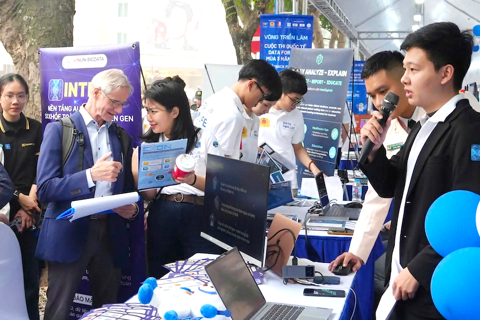
Both Vietnamese and Australian aviation experts and educators discussed and agreed at a forum held on July 13 that it is time for Vietnam to focus on training quality talent to fulfill the potential of this industry.
| Delegates at a forum entitled “Future careers in aviation in Vietnam” on July 13 in HCMC. Photo: RMIT University |

Speaking at a forum entitled “Future careers in aviation in Vietnam” hosted by RMIT University, Prof. Pier Marzocca, Associate Dean of Aerospace Engineering and Aviation, STEM College at RMIT University said it is essential for the sustainable recovery of aviation as Vietnam has the right people to support the management and operations of the entire aviation ecosystem.
“If Vietnam becomes successful in training its talent to reach international standards, in the near future, the country can achieve its aim to supply high-skilled labor in this field, first regionally, then globally,” he said.
Some experts said the aviation industry is essential to the growth of all economies, especially for Vietnam as a developing economy. In the age of globalization, the aviation industry facilitates the mobility of not only people but also imports and exports, as well as foreign investments, which are key for economic development.
Because of its unique nature, the aviation industry has suffered the most from the travel restrictions caused by the Covid-19 pandemic. However, it is forecast to be the first and the fastest to revive after the crisis as it is essential to economies worldwide.
The participants agreed that once the pandemic is over, the aviation industry needs to be well-prepared.
Industry leaders underlined an increasing demand for airport development and management staffing in the near future. Major plans for infrastructure overhaul are still underway and classified as being of national importance. Prominent among them is the construction of Long Thanh International Airport near Ho Chi Minh City (HCMC), scheduled to be completed in 2025.
Nguyen Chien Thang, Executive Vice President of the State-run Vietnam Airlines, observed that the huge investment in aviation infrastructure and the potential growth of maintenance, repair and overhaul (MRO) services indicated a strong demand for related jobs.
The Vietnamese aviation industry relies heavily on “imported” talent both for professional and management positions, which is deemed costly and wasteful for a country with a substantial working population like Vietnam.
Ho Ngoc Yen Phuong, Vice President of Vietjet said for many decades prior to 2011, aviation was a state-managed industry and its human resources were limited, with most of them having had previous experience or knowledge in the industry before being recruited. The establishment of private airlines and more open policies have created strong development in the industry and a burst in talent demands.
She added the aviation labor market has become bigger but not enough to afford its potential in terms of both inputs and outputs, especially when Vietnam aviation is still fast-growing.
“If pilots, cabin crews, aviation engineers and managers can get professional training in universities or aviation academies, that will not only create more job opportunities for young people but also support the development of the industry,” Phuong said.
To meet the demand, RMIT Vietnam will provide an international-standard bachelor’s program in aviation to be launched in this October.
Prof. Aleks Subic, RMIT Deputy Vice Chancellor (STEM) and Vice President for Digital Innovation is confident that, with 80 years of academic experience and worldwide reputation in aerospace and aviation education and research, the university is ready to seize this strategic opportunity to play a leadership role in the aviation industry development in the region.