Vietnam, Cambodia, Laos set joint economic targets by 2030
Three countries’ joint triangle development is considered a model for the rest of ASEAN.
Government leaders of Cambodia, Lao, and Vietnam (CLV) have discussed a joint master plan for socio-economic development in 2021-2030.
| Cambodia's Prime Minister Hun Sen (L), Vietnam's Prime Minister Nguyen Xuan Phuc (C) and Lao PDR's Prime Minister Thongloun Sisoulith at the 10th Cambodia-Laos-Vietnam Summit in Hanoi on March 31, 2018. Photo: Kham/ Pool/ AFP |
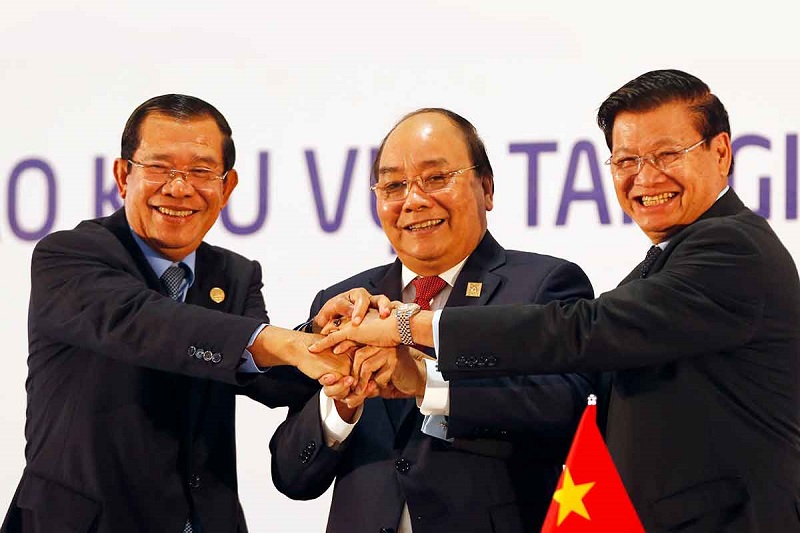
Vietnam’s Prime Minister Nguyen Xuan Phuc, Cambodia’s Prime Minister Hun Sen, and Thongloun Sisoulith, General Secretary of the Lao People’s Revolutionary Party and Prime Minister of Laos exchanged talks at a tri-lateral meeting held online on March 10.
The next 10 year plan covers specific projects and programs to connect the three economies from now throughout 2030, including tourism that is based on the motto “Three countries – One destination.”
Earlier in December 2020, the three leaders co-chaired a meeting on the Cambodia-Laos-Vietnam Development Triangle Area (CLV-DTA).
Back in 2018, the prime ministers of three neighboring countries met and endorsed an action plan to connect their economies until 2030.
The three leaders committed themselves to building “integrated, sustainable and prosperous CLV economies”, which would be located in the larger regional plan of the ASEAN Community Vision 2025, the ASEAN Post reported.
First established in 1999, the CLV-DTA initially covered just 10 border provinces within the three countries. In 2009, the three countries decided to add three more provinces from each country to make it a total of 13 provinces. At a summit in 2018, the three leaders agreed to gradually expand the triangle area to cover all the territories of the three countries.
| Leaders of the three countries at the meeting on March 10. Photo: Quang Hieu/VGP |
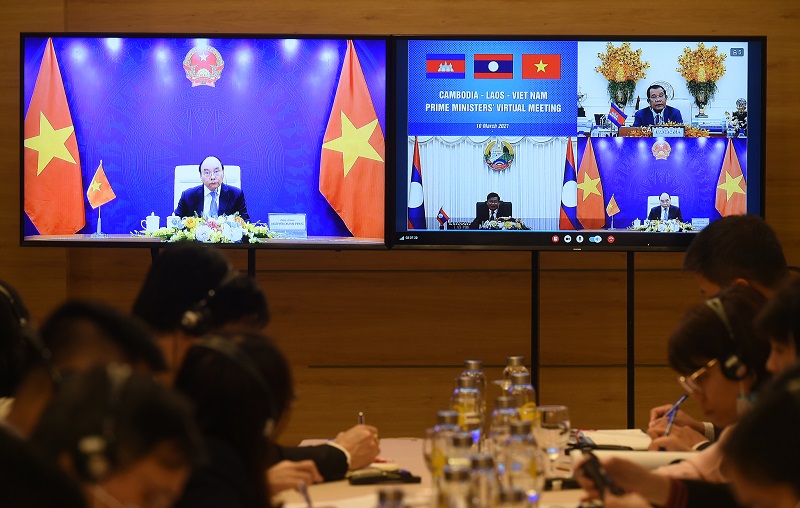
Over the past decade, all three countries’ economies have grown rapidly – Cambodia has seen a steady average growth of 7%, Vietnam has transformed from one of the poorest nations in the world to one of the wealthiest economies in the region, while Lao PDR has been described by the World Bank as one of the fastest growing nations in the region.
The reasons for growth vary from country to country, but the role of the CLV-DTA has been largely underrated.
The CLV-DTA has proved to be useful in developing partnerships too. According to a paper by Vannarith Chheang from the ISEAS-Yusof Ishak Institute, Japan has been the main supporter of the CLV-DTA, pledging US$1.5 billion to the partnership for the development of CLV countries in areas such as education, irrigation and infrastructure during its early days.
The good relationship between these countries has helped increase the inflow of investments among them. Vietnam for example, has invested nearly US$4 billion in Cambodia and more than US$5 billion in Laos.
Vietnam has also funded infrastructure projects in the two neighboring countries and granted numerous social projects.
Undeniably, the CLV-DTA also carries a geopolitical role, especially for Vietnam, the ASEAN Post’s Eijas Ariffin said, adding that it is the de facto leader of the triangle due to its political stature and its relatively advanced economy.
The role of the CLV-DTA isn’t just about economic cooperation but has expanded to cooperation over security as well as social and cultural development, the author noted.