Vietnam forecast to stay in top 10 remittance recipients in 2020
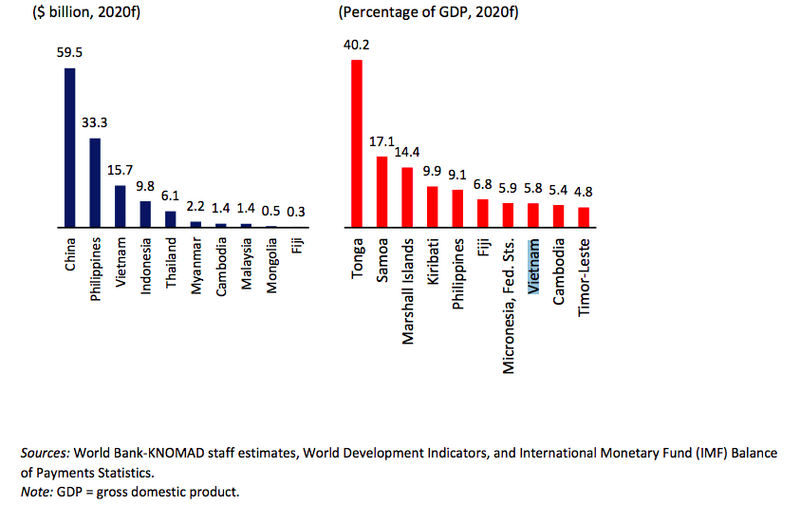
In the East Asian and Pacific region, Vietnam ranked third after China and the Philippines.
Vietnam is forecast to remain the ninth largest remittance recipient globally with an inflow of US$15.6 billion in 2020, slightly declining from US$17 billion received in 2019 and accounting for 5.8% of its GDP, according to the World Bank’s latest data.
This was a fourth consecutive year that Vietnam remains in the top 10 ranking in terms of inbound remittance, with the figure being US$13.8 billion in 2017 and US$15.9 billion in 2018.
| Top Remittance Recipients in 2020. Source: World Bank. |
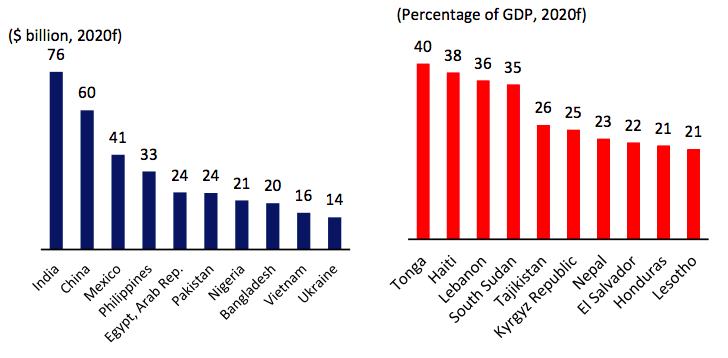
India claimed the top spot in the top 10 with an estimated of US$76 billion, followed by China with US$60 billion and Mexico with US$41 billion.
In the East Asian and Pacific region, in 2020, Vietnam is set to rank third after China and the Philippines (US$33.3 billion) – the world’s fourth largest recipient.
Top remittance recipients in the East Asian and Pacific region, 2020. |
According to the World Bank, remittance flows to low and middle-income countries (LMICs) are projected to fall by 7%, to US$508 billion in 2020, followed by a further decline of 7.5%, to US$470 billion in 2021.
As the Covid-19 pandemic and economic crisis continues to spread, the amount of money migrant workers send home is projected to decline 14% by 2021 compared to the pre Covid-19 levels in 2019.
The foremost factors driving the decline in remittances include weak economic growth and employment levels in migrant-hosting countries, weak oil prices; and depreciation of the currencies of remittance-source countries against the US dollar.
“The impact of Covid-19 is pervasive when viewed through a migration lens as it affects migrants and their families who rely on remittances,” said Mamta Murthi, Vice President for Human Development and Chair of the Migration Steering Group of the World Bank. “The World Bank will continue working with partners and countries to keep the remittance lifeline flowing, and to help sustain human capital development.”
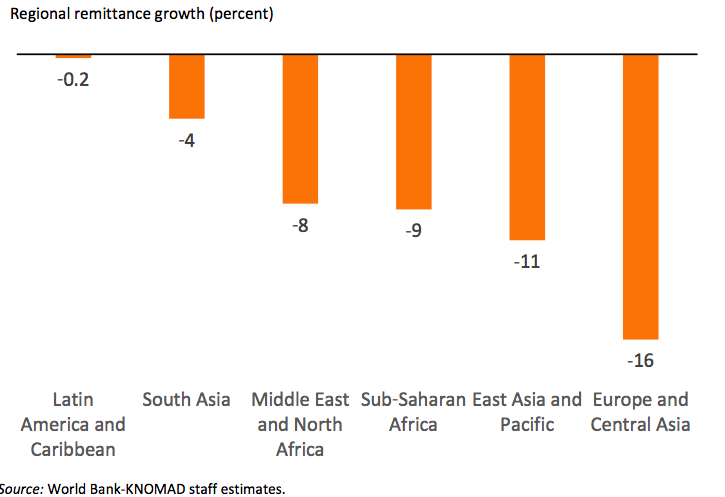
The declines in 2020 and 2021 will affect all regions, with the steepest drop expected in Europe and Central Asia (by 16% and 8%, respectively), followed by East Asia and the Pacific (11% and 4%), the Middle East and North Africa (8% and 8%), Sub-Saharan Africa (9% and 6%), South Asia (4%and 11%), and Latin America and the Caribbean (0.2% and 8%).
| Projected Growth of Remittances by Region, 2020. |
Importance of remittances to amplify in 2020
The importance of remittances as a source of external financing for LMICs is expected to amplify in 2020, even with the expected decline. Remittance flows to LMICs touched a record high of US$548 billion in 2019, larger than foreign direct investment flows (US$534 billion) and overseas development assistance (about US$166 billion). The gap between remittance flows and FDI is expected to widen further as FDI is expected to decline more sharply.
Migrants are suffering greater health risks and unemployment during this crisis,” said Dilip Ratha, lead author of the Brief and head of KNOMAD. “The underlying fundamentals driving remittances are weak and this is not the time to take our eyes off the downside risks to the remittance lifelines.”
This year, for the first time in recent history, the stock of international migrants is likely to decline as new migration has slowed and return migration has increased. Return migration has been reported in all parts of the world following the lifting of national lockdowns which left many migrant workers stranded in host countries. Rising unemployment in the face of tighter visa restrictions on migrants and refugees is likely to result in a further increase in return migration.
"Beyond humanitarian considerations, there is a strong case to support migrants who work with host communities on the frontline in hospitals, labs, farms, and factories,” said Michal Rutkowski, Global Director of the Social Protection and Jobs Global Practice at the World Bank.
According to the World Bank’s Remittance Prices Worldwide Database, the global average cost of sending US$200 was 6.8% in the third quarter of 2020, largely unchanged since the first quarter of 2019. This is more than double the Sustainable Development Goal target of 3% by 2030.
Despite being the cheapest, money transfer and mobile operators face increasing hurdles as banks close their accounts to reduce risk of non-compliance with anti-money laundering (AML) and combating terrorism financing (CFT) standards, stated the World Bank.
To keep these channels open, especially for lower-income migrants, AML/CFT rules could be temporarily simplified for small remittances. Further, strengthening mobile money regulations and identity systems will improve transparency of transactions. Facilitating digital remittances would require improving access to bank accounts for mobile remittance service providers as well as senders and recipients of remittances.