Vietnam raises cap on foreign ownership at domestic airlines to 34%
There will be no difference in the required minimum amount of capital for airlines providing international and domestic air transport services.
Instead of the previous limit of 30% of registered capital, foreign investors in the aviation sector can now own up to a 34% stake in a domestic airline, according to a new government decree.
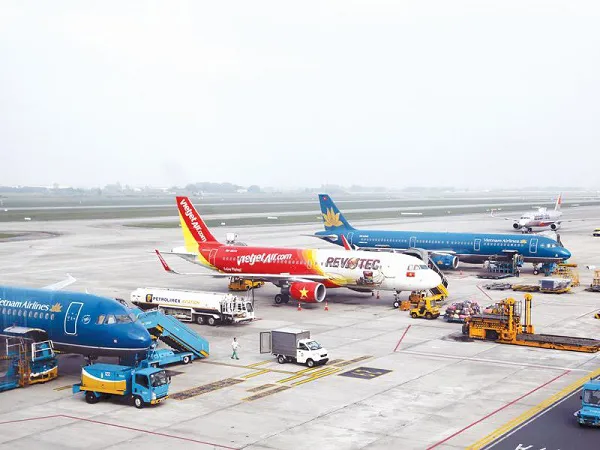
| Illustrative photo. |
Concurrently, there will be no difference in the required minimum amount of capital for airlines providing international and domestic air transport services, stated in the government’s Decree No.89 amending Decree No.92, issued on November 15, stipulating conditional business sectors or activities in the civil aviation industry.
The decree is scheduled to become effective on January 1, 2020.
Moreover, there must be at least one Vietnamese natural or legal entity owning the highest share of registered capital in a foreign-invested airline. In case a Vietnamese legal entity has foreign investment capital, the foreign holding must not exceed 49% of that entity.
Concerning the minimum amount of capital required for establishment and maintenance of an airline, the decree stipulates that an airline operating up to 10 aircraft must have at least VND300 billion (US$13 million).
In the previous decree, airlines providing international air transport services are required to have at least VND700 billion (US$30.2 million) in registered capital, while an airline operating domestic routes needs at least VND300 billion (US$13 million).
For an airline operating from 11 to 30 airplanes, the minimum capital base was VND1 trillion (US$43.25 million) required for an airline providing international services in the previous legislation, and VND600 billion (US$25.95 million) for an airline operating domestically.
However, the new decree recommends all airlines operating from 11 to 30 airlines must have at least VND600 billion (US$25.95 million), while airlines with over 30 airplanes are required to have a minimum registered capital of VND700 billion (US$30.2 million).
For an airline operating over 30 airplanes, the previous legislation required airline providing international routes to have at least VND1,300 billion (US$56.2 million), while VND700 billion (US$30.3 million) is required for an airline providing domestic routes.
Decree No.89 also removes the requirement on the transfer of stake and capital contribution in foreign-invested airlines to foreign investors which would only be proceeded two years after the issuance of aviation license.
For companies providing services at airports, the minimum capital requirement is VND30 billion (US$1.3 million). The rate of foreign ownership in such enterprises is at maximum of 30%.
Such requirement is much lower than previous legislation with minimum capital of VND100 billion (US$4.3 million) for enterprises providing services at domestic terminal, and VND200 billion (US$8.6 million) for those at international terminal.