Vietnam rejects accusations of building armed militia in East Sea
Vietnam said activities of Vietnamese functional forces absolutely comply with Vietnamese law and international law, especially the United Nations Convention on the Law of the Sea (UNCLOS) 1982.
Vietnam has rejected the news on China’s media that it is building armed militias.
China Daily recently reported that Vietnamese fishing boats are equipped with armed militias, claiming that Vietnam is building militias and self-defense forces at sea and this can contribute to escalating tensions in the South China Sea, potentially leading to confrontations.
| Spokesperson Le Thi Thu Hang of Vietnam’s Ministry of Foreign Affairs at the press conference on Jan 20. Photo: Thanh Nien |

In response, Spokesperson Le Thi Thu Hang of Vietnam’s Ministry of Foreign Affairs stated that the information is untrue and Vietnam vehemently denies it.
At the press conference on January 20, she stressed that “Vietnam adheres to the policy of national defense, security, peace, and self-defense.”
Activities of Vietnamese functional forces absolutely comply with Vietnamese law and international law, especially the United Nations Convention on the Law of the Sea (UNCLOS) 1982.
She went on to say that Vietnam always makes efforts to contribute to maintaining peace, stability, security, safety, cooperation, and development in the East Sea (referring to the South China Sea) in accordance with international law, including UNCLOS.
"Vietnam calls on countries in and from outside the region to make substantive contributions to the common drive," Hang said.
In April 2021, a Chinese military magazine and the South China Morning Post also made the same accusations, saying that Vietnam is building militias in the South China Sea.
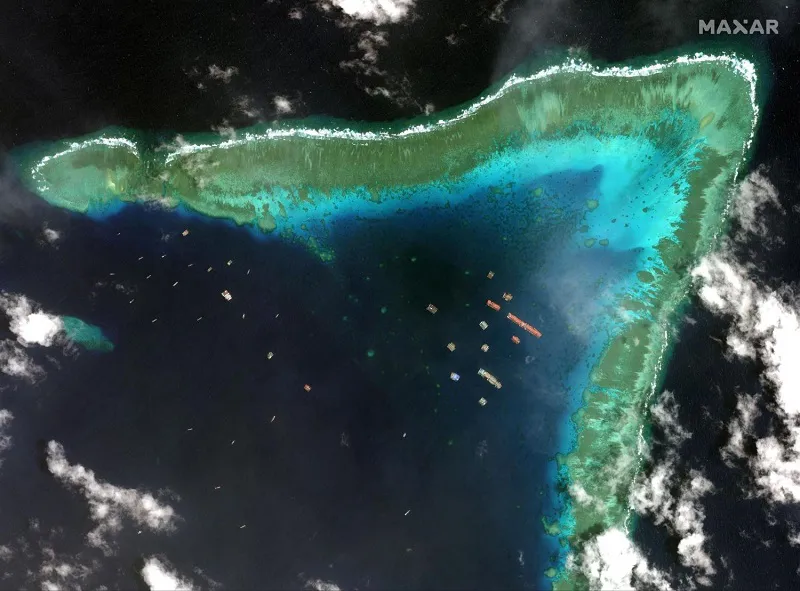
| An overview of fishing vessels was spotted in the Julian Felipe Reef on March 23. The Philippine Coast Guard spotted about 220 Chinese fishing vessels in the area sometimes. Satellite images: Maxar Technologies via Reuters |
China’s maritime militia
In reality, it’s China that has stepped up provocative activities in the South China Sea with the deployment of maritime militias to sneak into areas in this sea, camouflaged as fishermen.
China has never admitted the presence of these armed forces when being questioned. However, Western experts believed that the so-called maritime militias are an integral part of Beijing’s efforts to enforce its illegal sovereignty claims in the South China Sea.
According to the Washington-based Center for Strategic & International Studies (CSIS), China has shifted its focus toward asserting control over peacetime activity across the South China Sea since completing the construction of its artificial island outposts in the Spratly Islands in 2016.
A key component of this shift has been the expansion of China’s maritime militia – a force of vessels ostensibly engaged in commercial fishing but which in fact operate alongside Chinese law enforcement and military to achieve political objectives in disputed waters.
The tactics employed by the militia pose a significant challenge to those interested in maintaining a maritime order rooted in international law.
In its “Pulling Back the Curtain on China’s Maritime Militia” report released in November 2021, CSIS said China’s modern use of fishing militias dates back to at least 1974 when they were employed in seizing the Paracel Islands from Vietnam. Several developments in the 1980s, including the 1985 establishment of a militia force in Tanmen Township on Hainan and the establishment of China’s first bases in the Spratlys in 1988, would lay the groundwork for a more active militia in the following decades.
The militia’s involvement in aggressive operations increased in the 2000s when militia vessels physically interfered with the navigation of multiple US Navy ships. This continued into the early 2010s, where the militia would play a key role in China’s seizure of Scarborough Shoal in 2012, as well as the deployment of a Chinese oil rig into Vietnamese waters in 2014.
Since the completion of China’s artificial island outposts in 2016, militia boats have been deployed to the Spratlys in greater numbers and on a more constant basis than ever before.
Militias have accompanied Chinese law enforcement at several oil and gas standoffs with Malaysia and Vietnam and have participated in mass deployments at targeted features; nearly 100 militia boats deployed near Philippine-occupied Thitu Island in 2018, and approximately 200 gathered at unoccupied Whitsun Reef in the spring of 2021.
The militia as currently constituted in the South China Sea operates from a string of 10 ports in China’s Guangdong and Hainan Provinces. Remote sensing data indicates that roughly 300 militia vessels are operating in the Spratly Islands on any given day, CSIS emphasized.