Vietnam to resume international flights in Q4
Resuming international flights is part of Vietnam’s efforts to reopen the economy after the latest wave of Covid-19 has put brakes on production since April 2021.
Vietnam will relaunch regular international flights from 10 markets in the fourth quarter (Q4) this year while piloting a “travel bubble” for foreign visitors at the same time.
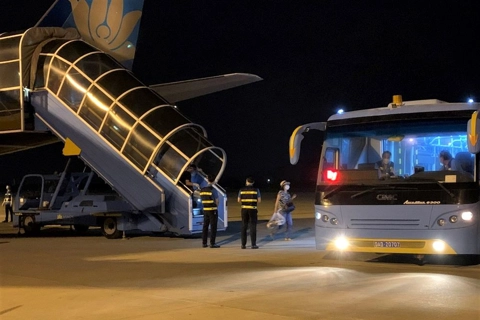
| Visitors arrive at Noi Bai International Airport. Photo: Cong Hung/ The Hanoi Times |
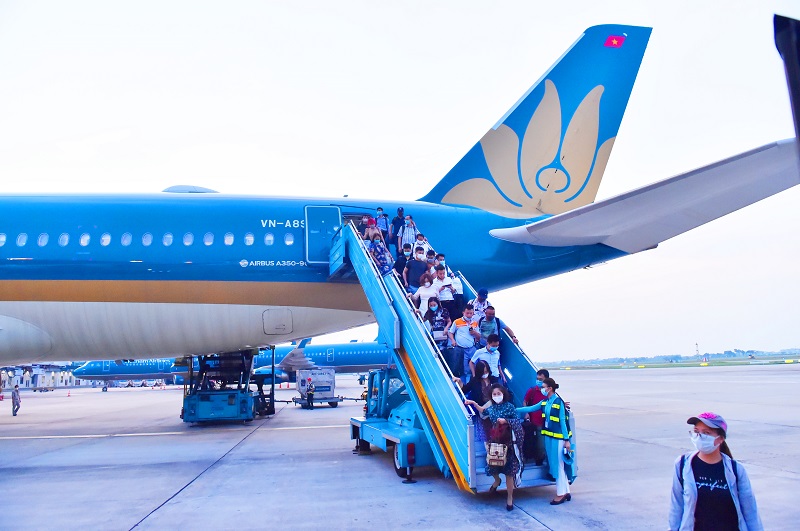
Visitors from Australia, China, France, Japan, Germany, Malaysia, Russia, Singapore, South Korea, and Thailand are eligible to enter the country that halted international flights since April 2020.
Incoming people need to show negative RT-PCR/RT-LAMP testing results within 72 hours before boarding, according to a document signed by the head of the Civil Aviation Authority of Vietnam (CAAV), Dinh Viet Thang.
No quarantine requirements are mentioned in the document, which was released on November 4.
The visitors will land in three airports namely Van Don in the north, Cam Ranh in the south, and Danang in the central region.
Flights to repatriate Vietnamese citizens will be organized under combo booking that covers flight tickets, testing, and hotel quarantine. Ten aforementioned markets are not destinations for repatriation flights.
Resuming international flights is part of Vietnam’s efforts to reopen the economy after the latest wave of Covid-19 has put brakes on production since April 2021. In a broader view, the country closed its borders to international visitors in April 2020. Since then, only repatriation flights and international flights bringing foreign diplomats and experts have been allowed.
To welcome international visitors, the country will reopen several tourist attractions in Q4. Five localities are selected destinations including Danang where is home to world-class beaches, Quang Nam is located UNESCO World Heritage Site Hoi An, Khanh Hoa – home to famous beach city Nha Trang, Quang Ninh that is home to World Heritage Ha Long Bay, and Kien Giang – home to Phu Quoc, the largest island and one of the famous tourism places in Vietnam.
CAAV expects to welcome combo flights with at least one flight/each destination per day or about a total of 4,000-6,000 visitors/day. From the second month, it would be two flights/each destination/day.
In the second phase that will take place from January 2022, scheduled international flights would be involved in the operations. There would be return flights between Vietnam and China, Hong Kong, Japan, South Korea, Taiwan, Thailand, Singapore, Malaysia, Laos, Cambodia, France, Germany, Russia, Australia, and the UK.
In this period, more airports would be allowed to welcome visitors, with Noi Bai in Hanoi, Tan Son Nhat in Ho Chi Minh City, Can Tho in the Mekong Delta City of Can Tho, and Phu Quoc in addition to three initial ones.
In the third phase, which will be counted from April 2022, both Vietnamese returnees and foreign visitors from scheduled international flights would be subject to vaccine passports plans and would not be quarantined.
Each airline would operate seven one-way flights/week.
In the fourth phase that will take place from July 2022, the number of regular international flights would be limitless.
Before Covid-19 flared up globally, Vietnam welcomed 18 million international tourists, earning VND726 trillion (US$31.56 million) in 2019.