Log in
Business

Vietnamese Gov't urged to cut business working week to 44 hours

The Labor Code stipulates that workers should not work more than eight hours per day and 48 hours per week under normal conditions.

For the second time in six months, a local trade union has petitioned the Government for a roadmap to reduce the working week for private sector employees from 48 to 44 hours, eventually to 40 hours.

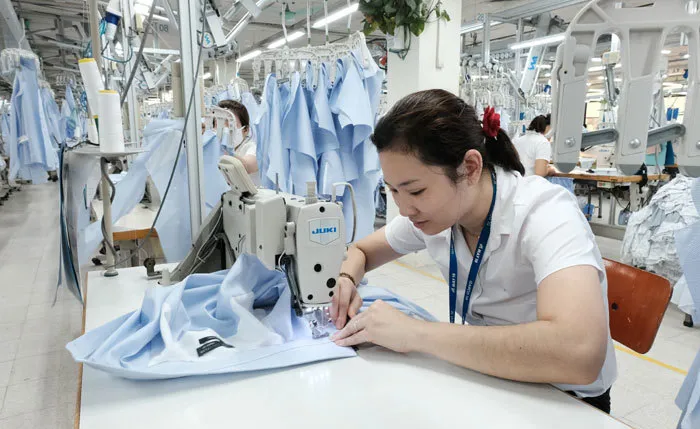
 Workers at Garment 10 Company. Photo: Thanh Hai/The Hanoi Times

The view was expressed by Dang Tuan Tu, Chairman of the Trade Union at Changshin Vietnam Company in Dong Nai at the National Labor Productivity Enhancement Forum on May 26, adding that this adjustment was aimed at aligning with regional standards and allowing workers more rest, health recovery, and family care.

According to Tu, boosting labor productivity requires businesses to invest in modern machinery and technology rather than merely extending working hours.

The proposal to reduce the working week for private sector workers has been raised several times over the past year. At the Trade Union Congress in December 2023, union representatives expressed that a roadmap to reduce working hours to 40 per week is a major aspiration for many workers.

During the National Assembly session in late October 2023, Deputy Pham Trong Nghia, a member of the Social Affairs Committee of the National Assembly, echoed this sentiment, citing a 1947 decree by President Ho Chi Minh, which set the working limit at 48 hours per week and no more than 100 hours of overtime per year.

The Labor Code stipulates that under normal conditions, employees should not work more than 8 hours per day and 48 hours per week. Employers can set daily or weekly working hours but must inform their employees. The State encourages businesses to adopt a 40-hour working week. This regulation has been maintained through several legislative changes, against a background of low productivity and income levels, leading to longer working hours for workers in order to improve their earnings.

Meanwhile, the public sector operates under a 40-hour working week, regulated by Prime Ministerial  Decision 188/1999. This regulation aims to improve the efficiency of public servants, confine administrative tasks to five days, and save on utilities and other costs borne by the state budget.

Statistics show that in 2011, Vietnamese workers produced an average of VND70.3 million (US$2,760) worth of goods, which increased to nearly VND188 million ($7,380) by 2023.

Labor productivity increased by 2.7 times between 2011 and 2023, but still lags behind other regional countries. According to the Occupational Safety Department's 2019 data, Vietnam has one of the highest working hours in Southeast Asia and the fewest public holidays. Specifically, Vietnamese workers typically work around 2,320 hours per year, less than those in the Philippines, Malaysia, and Thailand, but more than those in Singapore, Indonesia, Laos, and Cambodia.

 Labor productivity crucial metric to assess nation’s development level
At the forum, Prime Minister Pham Minh Chinh urged various ministries, sectors, and trade unions to refine policies and implement measures aimed at enhancing national labor productivity. He emphasized that labor productivity is a crucial metric for assessing and comparing the development levels of different countries, sectors, and regions. It also serves as a key driver for developing nations to escape the middle-income trap.
While labor productivity has increased significantly by 2.7 times from 2011 to 2023, Chinh noted labor productivity growth during the period still fell short of targets. In absolute terms, Vietnam's labor productivity in 2022 was only 11.4% of Singapore's, 24.7% of South Korea's, 26.3% of Japan's, 35.4% of Malaysia's, 64.8% of Thailand's, 79% of Indonesia's, and 94.5% of the Philippines'.

He highlighted several fundamental issues for sustainable productivity growth, such as infrastructure, the shift of labor from rural to urban areas, and the transition from informal to formal employment, which have not yet seen significant breakthroughs.

Chinh also warned that the complex and unpredictable international situation poses challenges to development, making it vital for Vietnam to focus on improving labor productivity.

To address this, he outlined a strategy centered on "three enhancements, three pioneers, and three breakthroughs".

Three Enhancements:

  • Improve the legal framework to create an investment-friendly environment.
  • Mobilize and use resources effectively for development.
  • Make strategic breakthroughs in human resources, especially high-quality personnel.

Three Pioneers:

  • Emphasize digital transformation and new economic sectors.
  • Promote international integration to leverage development opportunities.
  • Encourage competition to boost labor productivity.

Three Breakthroughs:

  • Focus on human resource development.
  • Advance science and technology.
  • Improve the working environment.

The Prime Minister also called on all levels of government and the Vietnam General Confederation of Labour to ensure the legitimate rights and benefits of workers, including fair wages, bonuses, and social welfare. He stressed the speedy implementation of the program to build one million social housing units to provide stable living conditions for workers.

Reactions:
Share:
Trending
Most Viewed
Related news
Inclusive innovation must give everyone equal voice, experts say at TECHFEST Vietnam 2025

Inclusive innovation must give everyone equal voice, experts say at TECHFEST Vietnam 2025

Open innovation is becoming a cornerstone of Vietnam’s development strategy, as policymakers, experts and international partners emphasize people-centered collaboration to tackle inequality, climate change and urbanization through inclusive, technology-driven solutions showcased at TECHFEST Vietnam 2025.

Vietnam attracts $400 million in venture capital as tech startups surge

Vietnam attracts $400 million in venture capital as tech startups surge

Vietnam’s startup ecosystem continues to expand rapidly, with strong venture capital inflows and fast growth in digital, AI and green technologies, reinforcing the country’s appeal to global investors.

Vietnamese policymakers push for early launch of gold exchange

Vietnamese policymakers push for early launch of gold exchange

A transparent gold exchange would not only offer a safe investment channel for the public but also provide a foundation for Vietnam to become a regional hub for jewelry manufacturing and exports.

Rosatom commits to advanced-technology Ninh Thuan 1 nuclear plant in Vietnam

Rosatom commits to advanced-technology Ninh Thuan 1 nuclear plant in Vietnam

Rosatom will transfer technology, localize nuclear products in Vietnam and support the development of the country’s nuclear science and industry for peaceful purposes.

Hanoi accelerates innovation reforms to become favorite destinations for investors, technology talents

Hanoi accelerates innovation reforms to become favorite destinations for investors, technology talents

Hanoi is pushing forward a wide range of innovation-driven reforms and investment initiatives as it works to become one of the world’s most attractive destinations for high-tech and strategic investors.

Vietnam mulls sharp rise in casino entry fee for locals

Vietnam mulls sharp rise in casino entry fee for locals

Such higher rates are intended to discourage individuals without adequate financial capacity from entering casinos.

Vietnam’s export strength in 2025 builds solid momentum for 2026 growth

Vietnam’s export strength in 2025 builds solid momentum for 2026 growth

With trade turnover nearing the US$900-billion mark, Vietnam enters 2026 with renewed confidence despite global volatility, rising trade barriers and shifting supply chains. Deputy Director of the Import–Export Department Tran Thanh Hai has outlined the drivers of this growth and the priorities for sustaining momentum next year.

Vietnam sets new trade record as import–export turnover nears $840 billion

Vietnam sets new trade record as import–export turnover nears $840 billion

Vietnam recorded its highest-ever trade performance in January-November as import–export turnover surged, driven by strong export growth and a continued trade surplus.