Vietnam’s 9-month fruit and veggie exports match last year's sales
Thanks to growth in major markets like China, the US, and South Korea, Vietnam’s fruit and vegetable exports are expected to set a new record this year.
Fruit and vegetable exports reached nearly $5.7 billion in the first nine months, up 34% from the same period last year and matching the entire previous year.
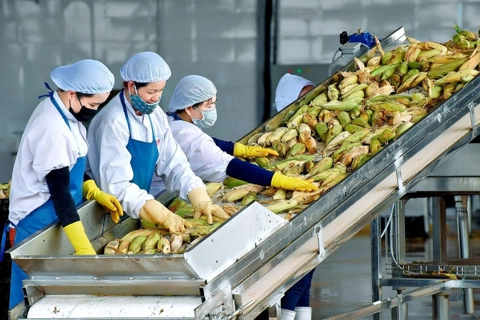
| Processing fruits for export at An Giang Agriculture and Fruits Import-Export Company. Photo: Vu Sinh/The Hanoi Times |
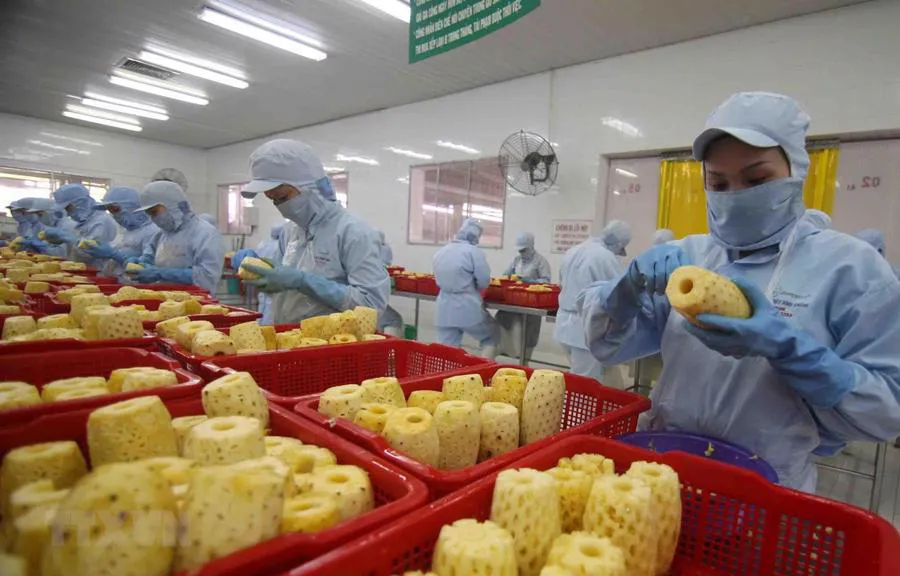
This information was recently released by the Vietnam Fruit and Vegetable Association. Fruit and vegetable export revenues are at an all-time high, with durian being the leading product, contributing $2.5 billion in value. Other fruits like dragon fruit, bananas, jackfruit, and mangoes also played a significant role in the export growth.
China remained the largest market, with import revenues surpassing $3 billion between January and September, a 36% increase over the same period last year.
The US, South Korea, and Thailand followed, with import values growing between 35-90%. Exporters noted that Vietnamese fruits and vegetables are gaining a stronger foothold in challenging markets like the US, China, and South Korea. Notably, Chinese consumers have shown increasing demand for Vietnamese durian, bananas, and mangoes. In the US, Vietnamese agricultural products have also enjoyed easier market access over the past nine months.
However, competition in the Chinese market is intensifying. Not only is China increasing imports, but it is also rapidly expanding its own production of key agricultural products that Vietnam traditionally exports. For example, after 10 years, China’s area under dragon fruit cultivation has surpassed that of Vietnam. As for durian, China is experimenting with growing 2,700 hectares in Hainan and seeking to develop domestic sources in regions with favorable climates.
Experts suggest that to address growing competition, Vietnamese businesses should focus on improving product quality, diversifying export markets, and strictly adhering to the protocols outlined in trade agreements. More importantly, businesses must proactively build strong linkages between farming regions and packaging facilities, alongside implementing traceability systems to ensure transparency where required. For frozen durian, investment in freezing technology, improved techniques, and enhanced product quality are critical to meeting international standards and increasing global market competitiveness.
The Department of Plant Protection under the Ministry of Agriculture and Rural Development has committed to working closely with local authorities, businesses, and packaging facilities to effectively implement the protocols for frozen durian, which will help boost exports in the coming time.
On August 19, Vietnam signed a protocol to export frozen durian and coconut to China. Additionally, at the end of August, the US officially approved the import of Vietnamese passion fruit, marking a new milestone for Vietnam’s agricultural sector.
According to Dang Phuc Nguyen, General Secretary of the Vietnam Fruit and Vegetable Association, thanks to growth in major markets like China, the US, and South Korea, Vietnam’s fruit and vegetable exports are expected to set a new record this year.
“It is projected that total export earnings for the year could exceed $7 billion, far surpassing the set target,” he said.