Vietnam’s strategy to enhance vocational education and training until 2030
Vietnam will focus on boosting the quality and efficiency of vocational training to meet the demand for skilled laborers for modern industrial production by 2030.
Vietnam is striving to raise its vocational education to the level of top regional countries by 2030, according to a decision approving a strategy to enhance the country’s vocational training in the 2021-2030 period, with a vision to 2045 signed by Deputy Prime Minister Vu Duc Dam.
The strategy aims to meet the diverse demands of the labor market and the higher requirements in human resources qualifications for national growth in the new period.
Under the project, in 2025, the scale and structure of the sector are expected to meet the demand for socio-economic recovery and development, with some training facilities meeting the standards of top ASEAN countries.
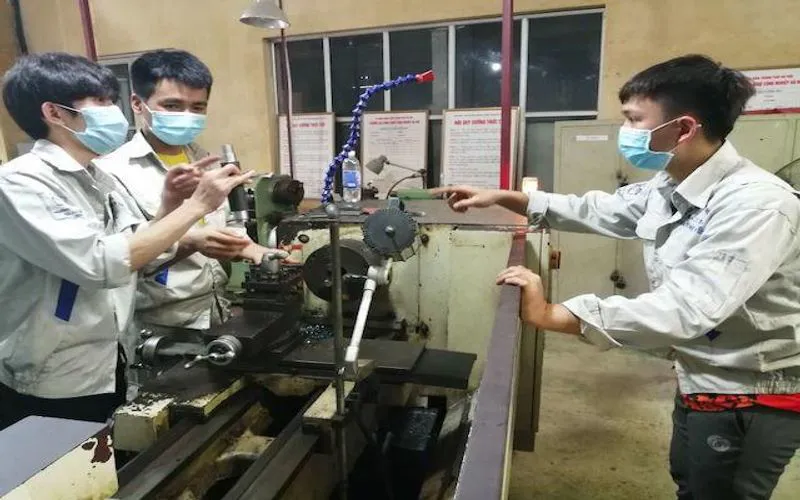
The Hanoi Industrial Vocational College cooperates with enterprises in training to improve the quality of output products. Photo: Thuy Truc |
The rate of trained laborers with certificates is expected to reach 30% of the workforce in 2025 and 35-40% in 2030. In 2025, about 40-45% of high school graduates are expected to take up vocational training.
Whereas, laborers acquiring information technology skills would make up 80% of the total workforce by 2025 and 90% in 2030.
Vietnam will focus on boosting the quality and efficiency of vocational training to meet the demand for skilled laborers for modern industrial production by 2030, while actively engaging in the international human resources training market.
With a view to gaining the targets, the strategy outlines eight groups of main tasks and solutions, focusing on accelerating digital transformation, modernizing training equipment, and reforming training curricula and methods, along with enhancing the quality of trainers, lecturers, and management officials in the vocational training sector.
Vietnam has deeply integrated into the world via many new-generation free trade agreements. There would be a change in labor demand as a result of a higher-quality workforce and fewer unskilled workers.
Therefore, it is essential to build a strategy on developing vocational education towards matching the labor market demand. Together with the period of demographic dividend, there is a golden chance for vocational education to develop both in quantity and quality.
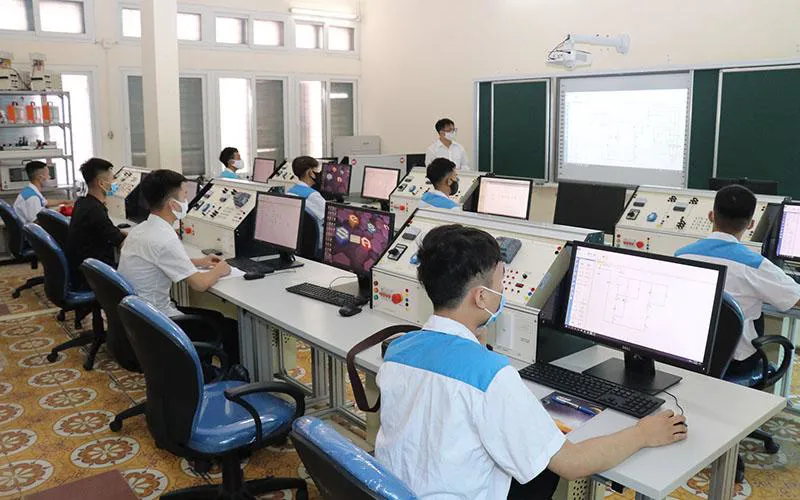
A technology application class at the Hanoi College of Electromechanical Engineering. Photo: Oanh Tran |
Besides the aforementioned decision, Deputy Prime Minister Vu Duc Dam recently approved a digital transformation program in the vocational training sector in the 2021-2025 period, with a vision to 2030.
The program is aimed at rolling out vocational training activities in the digital space, strengthening the application of information technology in vocational training, evaluating and managing activities, expanding vocational training access, and enhancing the quality of training activities, thus improving human resources quality and labor productivity.
In 2030, all trainers and management officials are expected to receive further training to improve their capacity to conduct vocational training activities in the digital environment. Meanwhile, 100% of lecturers and trainers are expected to be able to create digital teaching resource materials.
The program also aims to develop a national digital platform for vocational training, along with shared digital resources for training and learning activities in 2025.
In 2030, all the training facilities are expected to digitalize their training process, results and degrees.
The solutions outlined in the scheme include completing institutions and policies serving digital transformation in vocational training, developing training curricula to meet digital transformation requirements and expanding digital infrastructure, training equipment, and documents.
It also underlines the need to improve the capacity for trainers and management officials, along with the mobilization of resources for vocational training and international cooperation in the field.
The Hanoi People's Committee has set a plan of vocational training for 230,000 people each year. Under the plan, the municipal People's Committee set several goals, including the rate of trained workers will reach 75-80%, of which vocationally trained workers with degrees and certificates will reach 55-60% by 2025 and over 60% by 2030, the proportion of workers with information technology skills will reach 80% by 2025 and 90% by 2030. Regarding jobs for young people, 100% of youth will have access to information on careers and jobs by 2025 (creating jobs for at least 10,000 young people every year); 85% of young people will receive vocational education and job skills to adapt and integrate into the local and international labor market by 2025; reducing youth unemployment to less than 8%. The plan contemplated targets ensuring a safe working environment for employees, including the number of workers enrolling in social insurance will reach 50% by 2025 and 70% by 2030; 40% of workers will benefit from unemployment insurance by 2025 and 50% by 2030; healthcare of 95% of workers will be covered by health insurance by 2025 and over 95% by 2030. By 2025, 100% of students and high school graduates will be career-oriented; 40% of laborers will have access to job placement services in the same year and 45% by 2030. Besides, Hanoi will complete the application of software, data connection, shared systems, digitalization and standardization of the national database on labor, among others. |