Log in
Business

Visa duration for foreign investors in Vietnam to depend on investment size

In the previous version, the law stipulated the duration of an investment visa for investors is not longer than five years, which was considered flaw by the National Assembly’s Standing Committee.

The National Assembly on November 25 approved the revised Law on Entry, Exit, Transit, and Residence of Foreigners in Vietnam, in which the duration of a DT-typed visa for foreign investors now depends on the size of the investment.

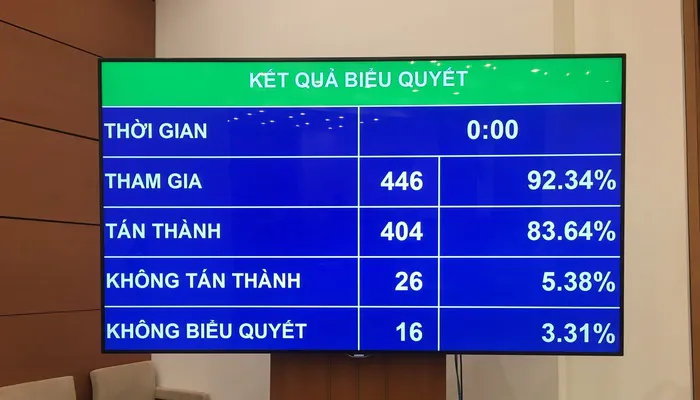
 The revised law received endorsement from 404 out of 446 of National Assembly deputies present, representing an approval ratio of 83.64%.

DT stands for investor or investment in Vietnamese.

The revised law received endorsement from 404 out of 446 of National Assembly deputies present, representing an approval ratio of 83.64%.

In the previous version, the law stipulated the duration of a DT visa is not longer than five years, which was considered flaw by the National Assembly’s Standing Committee.

Under the revised version, visa for foreign investors is now categorized into four types, namely DT1, DT2, DT3, and DT4.

DT1 would be issued to foreign investors in Vietnam and representatives of foreign organizations and businesses in Vietnam with capital contribution of over VND100 billion (US$4.3 million), or investing in the priority fields.

DT2 is granted to foreign investors and representatives of foreign businesses with capital contribution of VND50 – 100 billion (US$2.15 – 4.3 million), while investors with an amount of VND3 – 50 billion (US$130,000 – 2.15 million) are entitled for DT3. DT4 visa bearers are those pouring an amount below VND3 billion (US$130,000).

The duration for DT1 and DT2 does not exceed five years, DT3 for a maximum of three years and DT4 less than 12 months.

The National Assembly’s Standing Committee said the issuance of visa based on investment capital is considered an incentive to attract strategic investors and major projects. Moreover, this would prevent cases of investors with low investment capital from taking advantage of the law to stay in Vietnam for purposes other than doing business, causing negative consequences on the economy, society, and security of Vietnam.

The new regulation is also in compliance with the Law on Supporting for Small and Medium-sized Enterprises, stated the committee.

Additionally, the Investment Law does not specify the minimum investment, therefore, it is not necessary to state the minimum capital contribution for foreign investors under the DT4-typed visa.

The revised law now provides visa exemption to those investing in coastal economic zones as recommended by the government, as long as the zones meet conditions like those of international airports, or having defined geographical boundary.

The revised Law on Entry, Exit, Transit, and Residence of Foreigners in Vietnam is scheduled to become effective on July 1, 2020.

Reactions:
Share:
Trending
Most Viewed
Related news
Vietnam explores low-altitude economy as drones reshape agriculture and urban services

Vietnam explores low-altitude economy as drones reshape agriculture and urban services

From farmlands and delivery routes to traffic monitoring and emergency response, unmanned aerial vehicles (UAVs) are rapidly entering Vietnam’s economic life, opening new growth space as cities and provinces accelerate plans for the low-altitude economy.

Vietnam OCOP Festival 2025 honors products as program marks nationwide development milestones

Vietnam OCOP Festival 2025 honors products as program marks nationwide development milestones

The festival aims to promote and honor outstanding OCOP products and producers and to reaffirm Hanoi’s leading role as the country’s “pacesetter” in the One Commune One Product (OCOP) program.

Vietnam posts five-year high FDI disbursement as investor confidence strengthens nationwide 2025

Vietnam posts five-year high FDI disbursement as investor confidence strengthens nationwide 2025

Despite global economic and geopolitical headwinds, foreign capital flows into Vietnam accelerated in 2025, with investment increasingly concentrated in high value-added sectors, highlighting the country’s growing appeal as a stable, long-term destination for investors.

VN-Index set for 2,200-mark next year: JP Morgan

VN-Index set for 2,200-mark next year: JP Morgan

Vietnam’s appeal goes beyond the upgrade, driven by major economic reforms that are lifting business and consumer confidence, as well as improving profit prospects over the next three to five years.

Vietnam to launch smart agriculture innovation center in Lang Son

Vietnam to launch smart agriculture innovation center in Lang Son

The center is expected to bridge gaps in technology testing, connect farmers with researchers and markets and accelerate sustainable, high-tech agricultural development nationwide.

Hanoi urged to train 100,000 digital engineers through online academy

Hanoi urged to train 100,000 digital engineers through online academy

The Capital Strategic Technology Development Forum gathered a wide range of proposals from businesses, experts and investors on how Hanoi should shape its deep-tech development agenda in the coming decades with a long-term vision to 2045.

Inclusive innovation must give everyone equal voice, experts say at TECHFEST Vietnam 2025

Inclusive innovation must give everyone equal voice, experts say at TECHFEST Vietnam 2025

Open innovation is becoming a cornerstone of Vietnam’s development strategy, as policymakers, experts and international partners emphasize people-centered collaboration to tackle inequality, climate change and urbanization through inclusive, technology-driven solutions showcased at TECHFEST Vietnam 2025.

Vietnam attracts $400 million in venture capital as tech startups surge

Vietnam attracts $400 million in venture capital as tech startups surge

Vietnam’s startup ecosystem continues to expand rapidly, with strong venture capital inflows and fast growth in digital, AI and green technologies, reinforcing the country’s appeal to global investors.