A family meal: eating culture of Vietnamese
Eating is not only to survive but also a culture. A family meal shows he traditional culture of the people and the region.
Talking besides the food tray
The food tray is the symbol of a family meal. All members of the family gather around it and enjoy the dishes together. In the past, the rich used tray made of bronze while the poor used wooden or a bamboo tray. Today, they round trays are replaced by tables in many places.
A good tray of food was not defined by the quality of the dishes or nice decoration but the quantity of dishes, especially meat and fish. Thereby, all dishes are served at the same time, not one by one like in many Western countries.
In addition, different from the West where everyone has their own dish and eats individually, Vietnamese people have the culture of sharing all the food together.
| A meal of a Hanoian family in 1955. Photo collector: Pham Ngoc Minh |
Sitting position
In the Vietnamese meal, the sitting position is a very important cultural behavior. The best position is for the elders in the house to show the respect of the children. In the past, grandparents and fathers who were considered to take the important role in the family usually sat in another tray, which was put in a higher place in the house while the mothers and children were in another lower one.
Bon appetit
Vietnamese people usually have a “rule” of saying before and after eating. Consequently, it is mandatory for young people to invite older people to eat at the beginning of the meal. Young people only start eating after the oldest family member takes the first bite. When finished, they should also say that they are done and ask to leave.
All of this is to show the respect and good behavior and education of the young to the old in the family.
Enjoying the food
In the meal, Vietnamese do not eat too much or too little and neither too fast or too slowly, to enjoy the food as well as to show their education. Furthermore, they usually leave a little bit of food or drink as a sign for politeness as you are not a glutton.
Chopsticks
Like many other Asian countries, Vietnamese also uses chopsticks to pick the shared food in the tray. The use of chopsticks has formed a philosophy for couples and the solidarity. As chopsticks are always used in a pair, they are also a symbol of a couple which should be even for the shape and the size and always go together.
Meanwhile, a bunch of chopsticks is a symbol of community solidarity as one chopstick can be easily broken but it is not so for a bunch.
Moreover, there is a culture in using chopsticks as you must pick the food carefully to avoid falling anything and turn to use another side of the chopstick’s point to pick food and give to others.
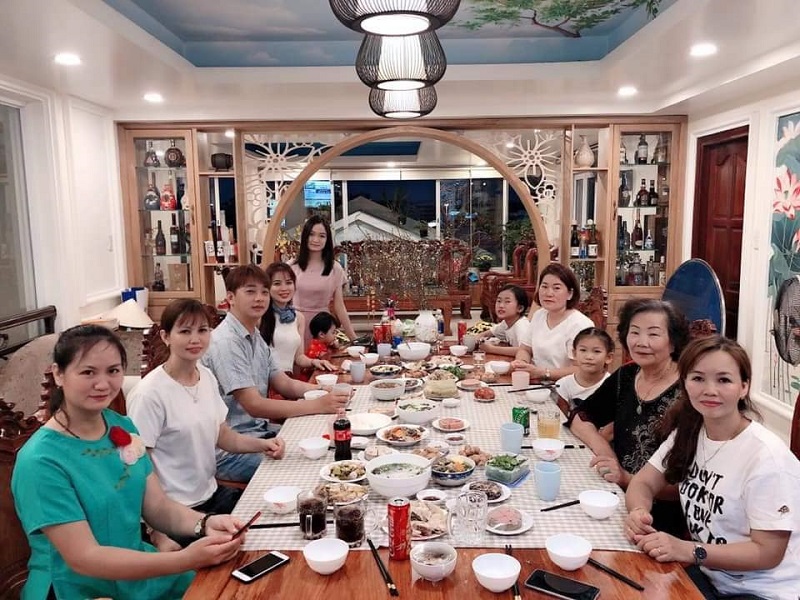
| A family-gathering meal before Tet holiday is a custom of Vietnamese. Photo: Diep Huong Dao. |
“Dessert” of tea
Different from the West, the traditional Vietnamese meal does not usually have dessert. After the meal is finished, they often have some green or black tea. In fact, tea is one of most indispensable parts of the daily life of many people.
They can have tea after breakfast, lunch or dinner. However, today, modern families also have more option to enjoy after the meal such as fruits, yogurt, cake, and sweet desserts.
Good conversation
Talking during the meal is very common as it is the time for all members to gather together to talk and share about their daily life. It is considered as a good time to be together and tighten the connection and love among members.
Moreover, stories of the family and knowledge of culture, customs, tradition, behavior, among others, are also shared and taught by grandparents, parents to children through meals, making it a very unique culture of each family. Many people still remember stories and advice of their family at meals when they are older and some members have passed away.
Meals also give a chance for friends and relatives to meet and enjoy time together, especially at weekends, holidays or festivals.