People with disabilities must be top priority within aid packages
Public trust and confidence underpin success in the Vietnamese Government’s Covid-19 responses, according to UNDP.
Aid packages should target the poor, the unskilled and seasonal laborers, those working in the service and tourism sectors, local and international experts recommended at a webinar on December 7.
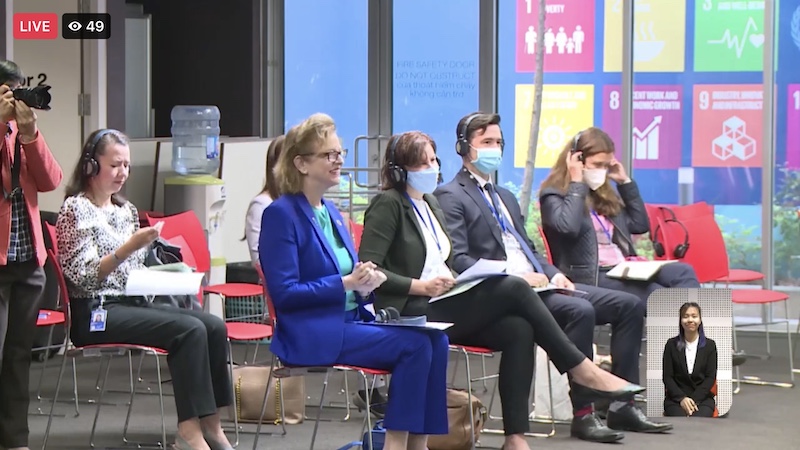
| Delegates at the webinar. Photos: Phi Khanh |
Dr. Phung Duc Tung, President of Mekong Development Research Institute (MDRI), gave the suggestion based on the results of the latest survey, which was conducted by the UNDP and the MDRI, with the support and partnership from the Australian Government’s Department for Foreign Affairs and Trade (DFAT).
This view was shared by local experts participating in the results announcement and the seminar related to the survey “Citizens' Opinions of and Experiences with Government Responses to Covid-19 Pandemic in Vietnam: Findings from 2nd Round Phone-Based Survey, 2021”.
As the pandemic this year is causing a more severe impact than in 2020, about 68% of surveyed people showed great concern about their personal health and 76% of them felt uneasy about their children’s education.
In comparison with the first survey last year, key findings of the survey this year showed
Covid-19 has created a negative impact on employment and income, with 77% of respondents reporting income reduction, especially the poor, ethnic minorities, unskilled, non-agricultural self-employed laborers, those working in the service sector, and those living in longer social distancing periods.
Tung said, on the accessibility and effectiveness of the Vietnamese Government’s VND26 trillion (US$1.13 billion) cash aid package, the proportion of people receiving the aid was low and the poorer had less access than the wealthier. Not enough information was provided on the aid package for the more disadvantaged people.
“Ethnic minorities, rural and poor people were less likely to know about the package than others. For those who have received the cash aid, delivery was regarded as timely and as informed, but administrative procedures to get access to the cash aid package was not simple,” he added.
| Screenshot from the survey. |
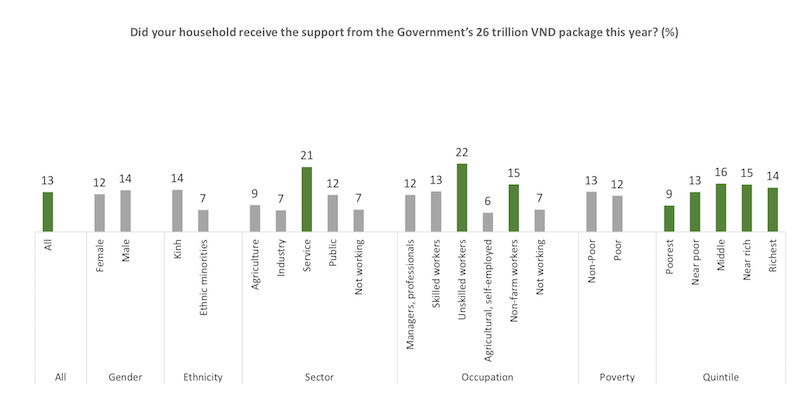
Pham Chi Lan, a local economist, said the report clearly showed the accuracy of citizens’ assessment in term of the aid package, which showed about 14% of households received support from the VND26 trillion ($1.13 billion) package.
She recommended the government needs to improve support policy so that aid reaches the right groups including the poor and people with disabilities, in a timely manner.
“The support packages should be enlarged so that the disadvantaged people can benefit fairly from it and get over the difficulties,” Lan said. “This also will increase consumption which in turn stimulate production and business activities of local businesses and spur economic development.”
The authors of the survey also suggested that citizens’ feedback and preferences on crisis responses are important for the government to review solutions. The survey showed a high but declining positive assessment by citizens of the government's handling of the pandemic compared to 2020.
More than 80% of the surveyed people rated the responses from the central/provincial Government as good or very good. They also showed strong support for strict containment measures and less support for closing open markets and schools.
In terms of electronic public services, local experts at the webinar agreed that the services should be reassessed and upgraded to be more user-friendly for the higher utility of contactless means to interact with the government. During the fourth wave of the pandemic, electronic public administrative services were not fully utilized as many still had to submit Covid-19 test results in order to be admitted to healthcare facilities.
The survey also highlighted, despite significant economic impacts, most Vietnamese people clearly prioritize health over the economy. As many as 83% of the respondents agreed that “the government’s highest priority should be saving as many lives as possible, even if it means the economy will sustain more damage and recover slowly”.
Speaking at the event, UNDP Resident Representative in Vietnam Caitlin Wiesen said the Vietnamese experience has demonstrated to the world that public trust and confidence underpin success in government responses.
“The year 2022 is coming with unforeseen challenges ahead of us because the pandemic is still with us and surging in many parts of the world,” she added. “But with the fast and impressive delivery of Covid-19 vaccination in Vietnam in recent months, together with citizens’ support for mask mandates and the Government’s agile responses, I believe that Vietnam is well-positioned to overcome the pandemic challenges and to recover soon.”
Cherie Russell, Development Counsellor of the Australian Embassy Vietnam said: “Through these survey results, we have an important opportunity to hear the voices and experiences of Vietnam’s citizens. This evidence then informs policy decisions and builds more trust within communities for the delivery of these policies.”
Using the computer-assisted telephone interviews (CATI) method, this intensive telephone survey was conducted from September 17 to October 15 with the participation of 1,501 respondents randomly selected from the 2019 population sample of the Vietnam Provincial Governance and Public Administration Performance Index (PAPI).
Its aim was to compare the views and experiences of permanent residents in all 63 provinces in 2021 with those in 2020 to understand changes before and during the Covid-19 pandemic.
|