ASEAN quotes UNCLOS for South China Sea claims in Hanoi statement
ASEAN said the 1982 UNCLOS sets out the legal framework within which all activities in the oceans and seas must obey.
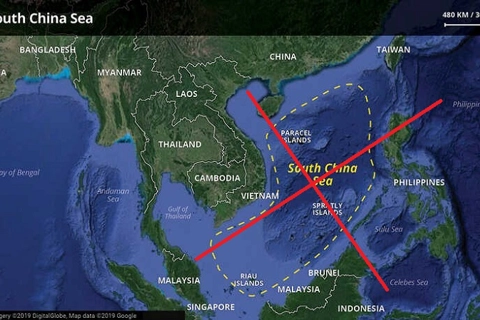
Ten member states of the Association of Southeast Asian Nations (ASEAN) has inserted the 1982 United Nations Convention on the Law of the Sea (UNCLOS) into its latest statement to reaffirm their shared commitment to maintain the regional peace, security, and stability.
Vietnam's Prime Minister Nguyen Xuan Phuc delivers speech at the 36th ASEAN Summit. Photo: VNA
| Vietnam's Prime Minister Nguyen Xuan Phuc delivers speech at the 36th ASEAN Summit. Photo: VNA |
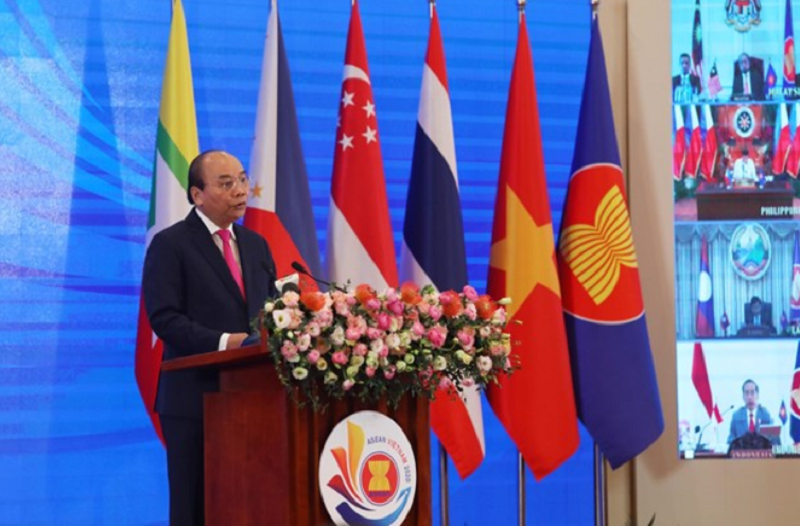
In Chairman’s Statement of the 36th ASEAN Summit held in Hanoi on June 26, including virtual sessions with the participation of heads of regional states/governments, the bloc emphasized that they reaffirmed their shared commitment to the peaceful resolution of disputes, including full respect for legal and diplomatic processes, without resorting to the threat or use of force, in accordance with the universally recognized principles of international law, including UNCLOS.
“We reaffirmed the importance of maintaining and promoting peace, security, stability, safety and freedom of navigation in and over-flight above the South China Sea and recognized the benefits of having the South China Sea as a sea of peace, stability and prosperity. We underscored the importance of the full and effective implementation of the 2002 Declaration on the Conduct of Parties in the South China Sea (DOC) in its entirety.
We were encouraged by the progress of the substantive negotiations towards the early conclusion of an effective and substantive Code of Conduct in the South China Sea (COC) consistent with international law, including the 1982 UNCLOS. We welcomed the completion of the first reading of the Single Draft COC Negotiating Text. We emphasized the need to maintain and promote an environment conducive to the COC negotiations, and thus welcomed practical measures that could reduce tensions and the risk of accidents, misunderstandings and miscalculation.
We stressed the importance of undertaking confidence building and preventive measures to enhance, among others, trust and confidence amongst parties; and we reaffirmed the importance of upholding international law, including the 1982 UNCLOS.”
“We discussed the situation in the South China Sea, during which concerns were expressed on the land reclamations, recent developments, activities and serious incidents, which have eroded trust and confidence, increased tensions and may undermine peace, security and stability in the region. We reaffirmed the need to enhance mutual trust and confidence, exercise self-restraint in the conduct of activities that would complicate or escalate disputes and affect peace and stability and avoid actions that may further complicate the situation, and pursue peaceful resolution of disputes in accordance with universally recognized principles of international law, including the 1982 UNCLOS.”
“We reaffirmed that the 1982 UNCLOS is the basis for determining maritime entitlements, sovereign rights, jurisdiction and legitimate interests over maritime zones, and the 1982 UNCLOS sets out the legal framework within which all activities in the oceans and seas must be carried out. We emphasized the importance of non-militarization and self-restraint in the conduct of all activities by claimants and all other states, including those mentioned in the DOC that could further complicate the situation and escalate tensions in the South China Sea.”
Emeritus professor Carl Thayer, the University of New South Wales, Canberra (UNSW Canberra) said the most important change in the Chairman’s Statement, representing a significant shift in ASEAN’s rhetoric, was the insertion of this sentence, “We reaffirmed that the 1982 UNCLOS is the basis for determining maritime entitlements, sovereign rights, jurisdiction and legitimate interests over maritime zones, and the 1982 UNCLOS sets out the legal framework within which all activities in the oceans and seas must be carried out.”
In other words, ASEAN rejects China’s claims to historic rights and China’s grouping of dispersed land features in the South China Sea into one unit, the professor said, noting that ASEAN has never stated this publicly.