Breaking traffic rules costs you a monthly payment? Play by the rules or accept the fines
Raising fines for traffic violations is an effective step toward restoring order in major cities and enhancing public awareness of road rules.
Published on The Hanoi Times' Words on the Street column, this story delves into Hanoi's bold measures to combat reckless driving and improve road safety. With hefty fines, no-tolerance enforcement, and a focus on improving public awareness, the city is reshaping its traffic culture.
Read on to find out how these changes are making waves on the bustling streets of Hanoi and challenging long-standing habits.
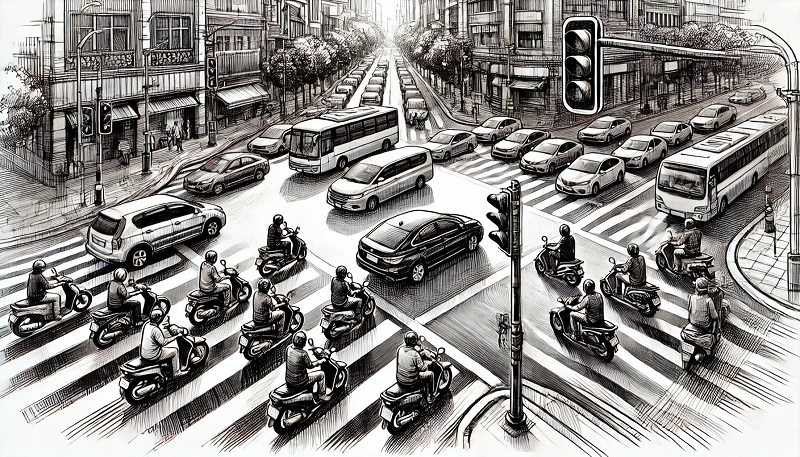
If you run a red light on a motorbike, you can be fined up to VND6 million ($235.7). A car driver committing the same offense would faint, as the maximum fine is a staggering VND20 million ($785.6).
For other violations, such as driving under the influence of alcohol, driving the wrong way on a highway, reckless driving, or causing a traffic accident, fines can be as high as VND70 million ($2,750).
It may sound unbelievable, but it's true. Just one traffic violation could cost you the equivalent of one or two months' salary.
Notably, these fines have increased significantly compared to before January 1, 2025. This is part of new traffic regulations introduced to raise public awareness and reduce accidents and congestion.
Traffic police and inspectors have been diligently monitoring and enforcing violations under the motto "no exceptions" in conjunction with the imposition of these more severe penalties.
According to the Hanoi Traffic Police Department, nearly 600 traffic violations were dealt with, resulting in fines totaling nearly VND1.7 billion ($66,780) on the first day of the new fines. Nearly 200 vehicles were impounded, along with nearly 400 driver's licenses and vehicle registration documents, and 19 driver's licenses were revoked.
The most common violations include running red lights (62 cases), driving the wrong way on restricted roads (20 cases), speeding (18 cases), illegal parking (72 cases), driving under the influence (138 cases), and not wearing a helmet (237 cases).
Thanks to these measures, the number of traffic violations in Hanoi and other areas has dropped significantly.
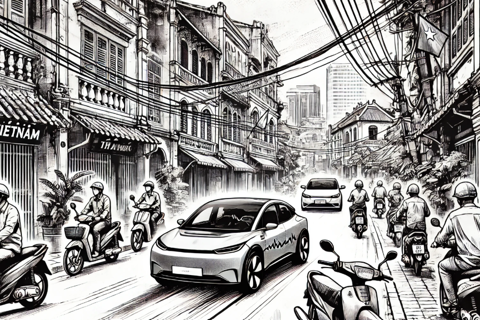
On January 2, the first working day after the New Year holiday, Hanoi's streets were bustling and crowded as usual. But there were almost none of the typical sights of people running red lights, stopping out of line, or riding on sidewalks.
This new “image” of Hanoi’s traffic has even been acknowledged by the media as a remarkable transformation.
For a long time, dangerous behaviors such as running red lights or weaving in and out of traffic have been disturbingly normalized by the majority of people.
When faced with traffic congestion, our first instinct is often to find a wide enough sidewalk to get around the jam rather than wait patiently in line.
We readily run red lights when they change from green to yellow, or speed through intersections with five seconds left on a red light. Some drivers will even blatantly go against the flow just to avoid driving 300-500 meters to make a proper U-turn.
Not long ago, traffic cameras at the Khuat Duy Tien-Nguyen Trai intersection in Thanh Xuan District recorded more than 160 vehicles running red lights in just two minutes.
Regardless of the reason, running red lights endangers others and increases the risk of accidents. If you break the law, you must face the consequences.
In the past, traffic police often had to turn a blind eye to certain violations due to high traffic density and limited manpower.
The government's current tough stance can be seen as a much-needed "bitter pill" for Hanoi - a highly effective solution, as there's nothing more effective than hitting violators where it hurts most: their wallets.
The blame game
While not everyone falls into this habit, many people, when caught by law enforcement, tend to offer excuses in hopes of leniency or a lighter fine.
"I live nearby, so I didn't think I needed to wear a helmet for a short ride," or "I was just picking up my kid from school, so I figured it was okay not to wear one," are common excuses heard from offenders.
Even public opinion has shown some toxicity toward the new fines. Critics argue that the fines are too high, far exceeding the average income of many citizens, and suggest that the government should reconsider them.
They also criticize the Hanoi authorities for poorly developing roads, which are now too small for a city of 10 million people.
But perhaps we've forgotten why these fines were higher in the first place: the general disregard for traffic laws has reached an alarming level.
While infrastructure may not yet meet the demands of a growing population, the least we can do is uphold the law.
We often demand that the government address every issue according to individual preferences, but we fail to remember that every society operates according to standards and a legal system.
As citizens, our first duty - before thinking of personal benefits - is to comply with these standards to protect the collective interest of society, in this case, road safety.
On the government side, investing in better traffic light systems and upgrading infrastructure should be a priority. The problem of malfunctioning signals or abrupt changes from green to red - essentially a trap for drivers - needs to be addressed.
Authorities should also adopt more humane ways of dealing with violations, encouraging drivers to understand and respect the law. More equitable and balanced resolutions may result from letting drivers explain their situations and using technology to show evidence of infractions.
At the heart of the matter, however, we as road users need to raise our own awareness. From a young age, we're taught the basic rules of the road by our teachers. There's no reason why we should disregard these lessons as adults.
More importantly, let's not just obey the rules of the road when law enforcement is present.
Let's not make compliance a mere form of appeasement. Let's drive with heart and mind - because road safety is everyone's responsibility.