Econ
Central key economic region seeks to boost cooperation
Provinces in the country’s central key economic region must promote the linkage and cooperation with each others, instead of competition as currently, to boost the growth of the whole region.
The suggestion was made at a recent conference on linking the economic and industrial zones at the central key economic region, which was attended by representatives from ministries, sectors, experts and the leaders of five provinces and cities belonging to the region including Thua Thien – Hue, Da Nang, Quang Nam, Quang Ngai and Binh Dinh.
According to the Council for the Central Key Economic Region, the region, which includes four economic zones and 19 industrial parks, has set up for 10 years, but no sound progress toward cooperation for mutual benefit has been made.
Economic zones and industrial parks within the central provinces had been more interested in competing with one another so far this year, said Nguyen Van Cao, chairman of the council for the period of 2017-2018.
A report by the Vietnam Institute for Industrial Policy and Strategic Studies said that the economic zones in the five central provinces that make up the Central Key Economic Region have functioned in similar industries, thus competition between them is understandable.
Dam Minh Le, deputy head of the Authority for Dung Quat Economic Zone and Industrial Parks in Quang Ngai, said that the Dung Quat Economic Zone in Quang Ngai and Chu Lai Economic Zone in Quang Nam were good examples of the failing cooperation within the region.
At first, Dung Quat and Chu Lai were intended to be one economic zone, but the two couldn’t connect as the bridge connecting them had so far not been available, he said.
According to experts, in order to resolve this situation, the government must directly intervene.
Tran Dinh Thien, former director of the Vietnam Institute of Economics and a member of the Government Economic Advisory Group, said that the government should allow the region to have some power as an institution, so that it has a better ability to make decisions for itself.
Thien said the central key economic region is merely a name as it had no tangible ability to make decisions, adding that while the government formed the key economic region with the intention of increasing cooperation, it has in the meantime licensed economic zones in each locality individually.
Each locality has an economic zone and they are affected by GDP growth pressure, leading to the need for competition, he said.
Thien concluded that the potential and industrial infrastructure in each of the five localities of the central key economic region were not equal. As such, any cooperation pact would mean that one region must sacrifice for the others.
This problem could be solved by further integrating the region, and creating one solid institution to steer regional cooperation, he said.
Meanwhile, Huynh The Du, from Fulbright University Vietnam, said that the first thing that is required is to upgrade the infrastructure and services for all central provinces in the region so that the five provinces sharing the same long coastline could jointly invest in the port and logistics industry to serve the region’s economic development.
The central key economic region was established in 2008, accounting for 8.45 percent of the total area of Vietnam. The region has favorable conditions to form an economic corridor connecting the North and South Vietnam and a gateway of the East-West economic corridor connecting Myanmar, Laos, Cambodia and Vietnam to international maritime routes through the East Sea.

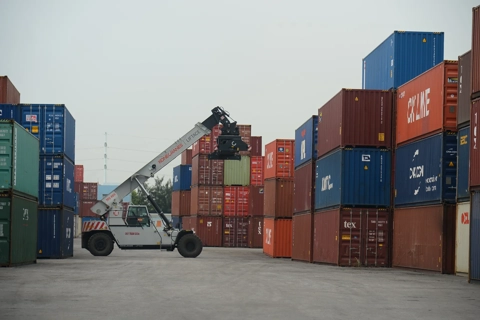
Chan May Port in Thua Thien-Hue Province’s economic zone
|
Economic zones and industrial parks within the central provinces had been more interested in competing with one another so far this year, said Nguyen Van Cao, chairman of the council for the period of 2017-2018.
A report by the Vietnam Institute for Industrial Policy and Strategic Studies said that the economic zones in the five central provinces that make up the Central Key Economic Region have functioned in similar industries, thus competition between them is understandable.
Dam Minh Le, deputy head of the Authority for Dung Quat Economic Zone and Industrial Parks in Quang Ngai, said that the Dung Quat Economic Zone in Quang Ngai and Chu Lai Economic Zone in Quang Nam were good examples of the failing cooperation within the region.
At first, Dung Quat and Chu Lai were intended to be one economic zone, but the two couldn’t connect as the bridge connecting them had so far not been available, he said.
According to experts, in order to resolve this situation, the government must directly intervene.
Tran Dinh Thien, former director of the Vietnam Institute of Economics and a member of the Government Economic Advisory Group, said that the government should allow the region to have some power as an institution, so that it has a better ability to make decisions for itself.
Thien said the central key economic region is merely a name as it had no tangible ability to make decisions, adding that while the government formed the key economic region with the intention of increasing cooperation, it has in the meantime licensed economic zones in each locality individually.
Each locality has an economic zone and they are affected by GDP growth pressure, leading to the need for competition, he said.
Thien concluded that the potential and industrial infrastructure in each of the five localities of the central key economic region were not equal. As such, any cooperation pact would mean that one region must sacrifice for the others.
This problem could be solved by further integrating the region, and creating one solid institution to steer regional cooperation, he said.
Meanwhile, Huynh The Du, from Fulbright University Vietnam, said that the first thing that is required is to upgrade the infrastructure and services for all central provinces in the region so that the five provinces sharing the same long coastline could jointly invest in the port and logistics industry to serve the region’s economic development.
The central key economic region was established in 2008, accounting for 8.45 percent of the total area of Vietnam. The region has favorable conditions to form an economic corridor connecting the North and South Vietnam and a gateway of the East-West economic corridor connecting Myanmar, Laos, Cambodia and Vietnam to international maritime routes through the East Sea.