14TH NATIONAL CONGRESS OF THE COMMUNIST PARTY OF VIETNAM
Log in
Business

E-payment key to promote Vietnam’s internet economy

Vietnam must grasp opportunities from the internet economy, which is estimated to have a combined value of US$100 billion in Southeast Asia, and is on track to increase by three-fold in the next five years, said a government official.

A stronger push for e-payment would not only boost liquidity in the economy, prevent money laundering and corruption, but also promote the internet economy, according to Deputy Prime Minister Vu Duc Dam.

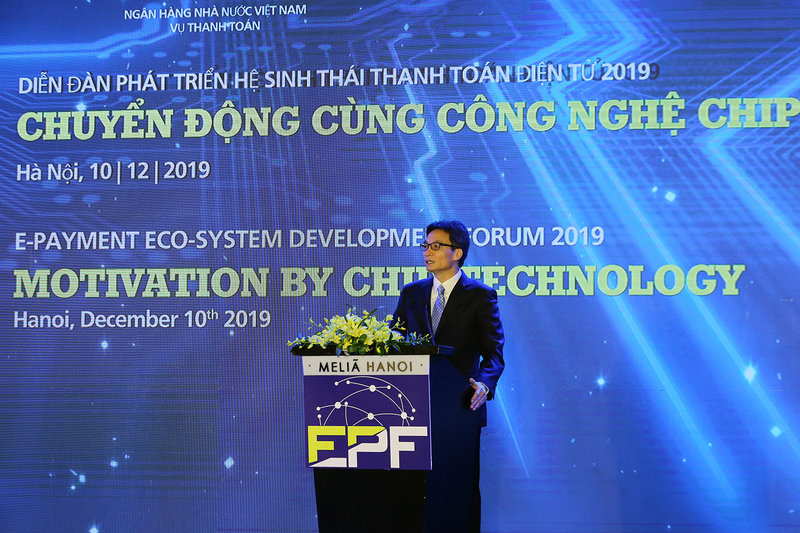
 Deputy Prime Minister Vu Duc Dam at the forum. Source: VGP. 

Vietnam must grasp opportunities from the internet economy, which is estimated at a combined of US$100 billion in Southeast Asia, and is on track to increase by three-fold in the next five years, Dam said at a forum discussing the development of e-payment ecosystem in Vietnam on December 10.

Statistics from the State Bank of Vietnam (SBV), the country’s central bank, revealed that as of September 30, transaction value via points of sales (PoS) increased 36.5% year-on-year, while the number of bank cards hit 96.4 million and the number of ATM machines 19,000.

These are considered a solid foundation for greater use of e-payment methods, such as mobile banking or internet banking. However, there remain challenges for a transition from swipe cards to chip cards in Vietnam, stated the SBV, adding one of the main reasons is the huge investment cost.

Nevertheless, Vietnamese banks are determined to turn to chip cards, in turn synchronizing payments for various services such as education, healthcare, or insurance, among others.

As of present, over 20 banks and six companies in Vietnam are providing chip cards. By the end of the first quarter in 2020, such figures are expected to increase to 26 banks and 10 companies.

SBV Vice Governor Nguyen Kim Anh said e-payment towards a cashless society is an inevitable trend in the Fourth Industrial Revolution, creating multiple impacts of boosting economic growth and inclusive financial strategy through wider access of banking – finance services to the public.

The SBV targets more legal support for banks and payments using high technologies, particularly digital banking and payments, said Anh.

Deputy PM Dam said the use of IT would help improve state management in a more transparent and efficient manner, while encouraging the participation of the people into social management activities.

According to Dam, the ultimate goal of e-payment is to create chances for the people to further involve in the banking sector. Moreover, this also ensures higher level of safety and privacy of customers’ information.

The government has instructed the sectors of taxation, insurance, telecommunications, and electricity to apply non-cash payment while education and healthcare are scheduled to apply the method before 2020, stated Dam.


Reactions:
Share:
Trending
Most Viewed
Related news
Hanoi’s banking sector pushes for non-cash payment

Hanoi’s banking sector pushes for non-cash payment

31 Oct, 17:04

A network of 90,000 of points of sale (POS), electronic funds transfer at point of sale (EFTPOS), and electronic data capture (EDC) is established, while over 2,780 ATMs are installed across Hanoi.

Vietnam commits 3% budget to turbocharge AI and data economy

Vietnam commits 3% budget to turbocharge AI and data economy

At least 3% of state budget spending will fund digital transformation, accelerating Vietnam’s shift toward a data-driven and AI-powered economy.

From labor-intensive to high-tech: Hanoi retrains for global edge

From labor-intensive to high-tech: Hanoi retrains for global edge

Raising the skill standards of high-tech workers is emerging as a decisive factor in strengthening Hanoi’s competitiveness as the capital accelerates its shift toward a knowledge-based industrial economy.

Hanoi craft villages resume production early, aiming for growth in 2026

Hanoi craft villages resume production early, aiming for growth in 2026

After the Lunar New Year break, Hanoi’s traditional craft villages have quickly resumed production, fulfilled orders and prepared for new markets while blending heritage craftsmanship with modern technology to strengthen competitiveness and sustain growth in 2026.

Vietnam stock market poised for post-Tet gains

Vietnam stock market poised for post-Tet gains

The post-Tet period often presents attractive opportunities for investors in the following months.

Spring Fair draws 500,000 visits, elevates Vietnamese brands nationwide

Spring Fair draws 500,000 visits, elevates Vietnamese brands nationwide

Drawing large crowds and strong commercial momentum, the 2026 Spring Fair turned Hanoi into a vibrant showcase of Vietnamese products, culture and innovation, where shopping met heritage experiences and businesses forged valuable partnerships.

Firms seek clearer policy framework for new tech, digital platforms

Firms seek clearer policy framework for new tech, digital platforms

Hanoi’s tech firms are calling for clearer demand mechanisms and transparent evaluation as the city pilots its Technology Exchange and Digital Transformation Market to boost commercialization, innovation and digital growth.

Vietnam Airlines to open first nonstop Hanoi-Amsterdam route to enhance Europe ties

Vietnam Airlines to open first nonstop Hanoi-Amsterdam route to enhance Europe ties

The move aims to open a new gateway to Europe and advance the national flag carrier’s strategy to expand its European network.

Vietnamese goods reach rural areas through Tet fairs

Vietnamese goods reach rural areas through Tet fairs

Hanoi is intensifying communication and outreach for the “Vietnamese people prioritize using Vietnamese goods” campaign to boost consumption ahead of Tet, the country’s most important holiday.