EVFTA paves the way for Vietnam to join new supply chains post Covid-19
Vietnam’s National Assembly is set to ratify the deal at the upcoming gathering on June 8.
The EU – Vietnam Free Trade Agreement (EVFTA) clears the pathway for Vietnamese enterprises to access the European market and take part in new global supply chains formed in the post-Covid-19 era, according to Minister of Industry and Trade Tran Tuan Anh.
| The EVFTA would pave the way for Vietnam to join new supply chains post Covid-19. Photo: Ngoc Thuy. |
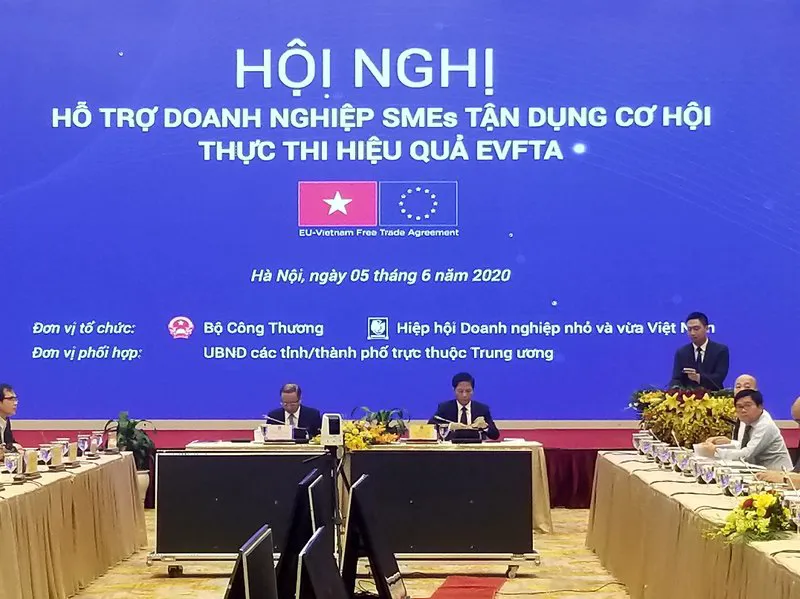
“Along with the Comprehensive and Progressive Agreement for Trans-Pacific Partnership (CPTPP), the EVFTA is the last puzzle in Vietnam’s international integration strategy,” Anh stressed at a conference on June 5.
While the EVFTA is expected to further boost Vietnam’s trade relations with the EU, its key partner even before the trade deal takes effect, the EVFTA’s significance also lies in the fact that the deal basically covers most of the sustainable development fields of a country, Anh stated.
“Strict requirements in the EVFTA are a favorable platform for developing countries like Vietnam to continue the reform process and perfect its legal environment, a key step in enhancing state management capability and taking the country forward,” Anh asserted.
According to Anh, not only in the aspect of state management, each economic component would have an opportunity to access international markets of high standards via the EVFTA and bring benefits for the business community.
Good international practices in the forms of strict requirements for product quality, environmental protection, food safety or laborers’ working conditions, among others, in the EVFTA would eventually help Vietnamese SMEs to improve their competitiveness if they can face up to these challenges, Anh said.
Need for local enterprises to understand EVFTA
Chairman of the Vietnam Association of Small and Medium Enterprises (SMEs) said from staying behind others in global economic integration, the EVFTA has now pushed Vietnam ahead of regional peers in the process, given the fact that deal is the second one the EU has signed with a Southeast Asian country and the first of its kind with a developing country in Asia, according to Nguyen Van Than.
Than expected the EVFTA to help Vietnamese SMEs, which account for 97% of total enterprises in Vietnam, overcome the hardship caused by the Covid-19 pandemic.
However, huge challenges remain for Vietnamese companies to gain from the deal, Than said, adding they have to change their mindset of doing business to meet the EU’s strict requirements, or face the risk of being sidelined from the European market, which is one of the biggest in the world with GDP of over US$18 trillion, accounting for 22% of global GDP, and has a population of over 500 million.
Than recommended local enterprises actively search for new opportunities from the EVFTA, as well as prepare for potential challenges.
“A lack of understanding of the deal would mean we are highly likely to lose even before starting a fight,” Than noted.
Additionally, Than raised the issue of enterprises’ lacking of funds to meet the deal's requirements.
In this regard, Minister Anh said he would work with the State Bank of Vietnam to provide more favorable framework for local SMEs to access banks’ loans.
The EVFTA, officially signed last June after six years of negotiations, has been dubbed “the most ambitious” FTA the EU has ever reached with a developing country, according to the European Commission. It not only includes the almost full elimination of bilateral tariffs, but also a substantial reduction of non-tariff barriers. Moreover, it includes provisions to protect intellectual property, labor, environmental standards, and fair competition, while promoting regulatory coherence.
On March 30, the European Council (EC) adopted a decision on the conclusion of the EVFTA following the ratification by the European Parliament on February 12. This decision clears the path, on the EU side, for the entry into force of the agreement.
Vietnam’s National Assembly is set to ratify the deal at a meeting on June 8. Once the process is completed, the agreement can enter into force 30 days after the mutual notification between Vietnam and the EU that legal procedures have been completed.
A Pre-Covid-19 study from Vietnam’s Ministry of Planning and Investment suggested the EVFTA and the EU – Vietnam Investment Protection Agreement (EVIPA) would help Vietnam’s GDP grow an additional 4.6% and boost the country’s exports to the EU by 42.7% by 2025.
Meanwhile, the European Commission estimated the bloc’s GDP would be added US$29.5 billion by 2035, along with additional growth of 29% in exports to Vietnam.
In 2019, bilateral trade turnover between Vietnam and the EU stood at US$56.45 billion, of which Vietnam exported goods worth US$41.54 billion and imported goods worth US$14.9 billion.