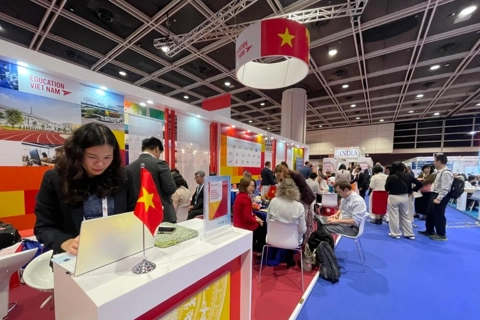
Foreign funds pour in partnerships in Vietnam education
On the occasion of the Teachers’ Day in Vietnam, Mr. Troy Griffiths, deputy managing director of Savills Vietnam, shares his view on investments in the education sector in this country.
Decree 86, which took effect from August 1, 2018, intended to boost the setup of international schools, as there was limited new development in recent years.
Before Decree 86 was issued, foreign investors encountered many difficulties, including the cap on local students of 10% (primary school) and 20% (secondary school). The international school business relies on foreign students' enrollments that highly correlate to FDI attraction.
Since the decree took effect, many other international schools have made the most of the opportunity and increased Vietnamese enrollments. The decree certainly encouraged foreigner investors to consider this appealing opportunity in the international school market.

It’s still very early to understand the impact, even though foreign interests have grown significantly. FDI in education from August 2018 when Decree 86 took effect to October 2019 totaled US$97 million. M&A activities, particularly acquisitions of shares in the education industry, accounted for the majority of FDI flow, 37%. Foreign investors are clearly interested in partnership strategies to minimize risk.
Education accounted for less than 2% of national FDI. High taxation, staff requirements, minimal capital required for foreign investment in addition to a complicated approval process are some of the barriers for foreign investors. The recent relaxation in Decree 86 has simplified and eased the requirements.
International schools’ tuition fees could be steep, particularly for Vietnamese household income. How is this reflected on enrolment demand for international schools in Vietnam?
There are limited ‘affordable’ international schools in Vietnam, but those schools with older, smaller campuses and basic facilities attract more with modest fees. Latest International School Fee Survey by ExpatFinder showed that the annual tuition fee of international schools in Vietnam averaged US$17,940, ranking 13th in the world and 5th in Asia. Countries and territories having higher tuition rates in Asia are China, Singapore, Hong Kong and Australia. The lowest entry started from US$5,000, still not classified as affordable. However, international schools will continue to be in demand particularly in Asia, as a stepping stone for their children to compete for spots in prestigious Western universities.
In addition, there is growing enrollment demand from expats’ children. Vietnam will attract more FDI inflow after signing many free trade agreements as well as evolving as an ideal alternative for multinational companies in the China-US trade tensions.
Increased foreigners and their families will create good demand for international education, especially in key FDI-attractive cities. In 2018, Vietnam has more than 320,000 foreign expatriates, increasing 8% per annum since 2008. A 2019 expat explorer survey by HSBC showed that Vietnam jumps from 19th to 10th position on leaderboard for "desired place to work and live" thanks to low cost of living and improved earnings.
Is there any other area of regulations that could be improved to attract more foreign investment in the education industry?
In 2018, the education sector had two important decrees: Decree 135 and Decree 86. They simplified conditions in education investment for both local and foreign investors.
Specifically, Decree 135 has simplified legal requirements, operation regulations and shortened the process of administrative procedures while Decree 86 lowered staff requirements and raised local enrolment levels.
However, certain barriers remain, such as Decree 86 still requires both business eligibility license and education operator license. Such procedures are different from other conditional investment where only business eligibility licenses are needed.
In addition, the legal entity has not been simplified by Decree 86. The education investor needs to establish school that is a legal entity; meanwhile to establish a school, the investor needs to establish a business and a legal entity. This process results in double legal entities, potentially creating an overlap of organizational structure.
How would you forecast the prospects from the FDI attraction in the education industry in Vietnam?
Foreign investment in education will continue to increase, with partnerships being a key strategy. Appealing market metrics continue.
The ExpatFinder’s 2018 survey reflects a surprising 19% average increase in tuition fee compared to 2017, with some countries seeing even greater rises. Tuition fees are expected to increase, pushed on by changes in the global workforces and costs of living. Forbes expects the exponential growth of the market to be worth US$89 billion by 2026. The booming demand for high-quality education in Asia is thanks to growing wealth and golden demographics.
Thank you very much!