Log in
Hanoi

Hanoi expects businesses' greater contributions to agricultural sector: Mayor

At present, the agricultural sector in Hanoi only meets 60% of the city’s demands for vegetables, 55% for meats and over 40% for seafood.

Hanoi expects greater contributions from the business community to the agricultural sector, which holds huge potential for development, according to Nguyen Duc Chung, chairman of the Hanoi People’s Committee.

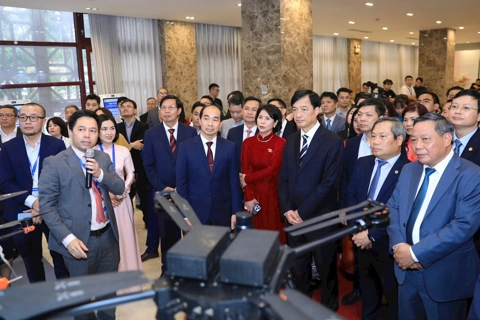
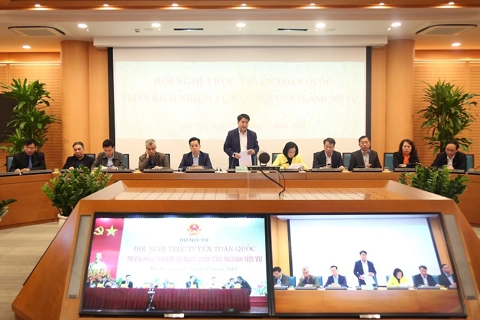
 Chairman of the Hanoi People's Committee Nguyen Duc Chung at the meeting. Source: Hanoi's portal. 

At present, the agricultural sector in Hanoi only meets 60% of demand of the city  for vegetables, 55% for meat and over 40% for seafood, while the growing number of tourists coming to the capital in the coming years would boost demand to a new height, said Chung at a meeting with the Hanoi Business Association on January 18, Hanoi’s portal reported.

Chung asked the association to realize its potential and further integrate in regional and international markets, in turn contributing a major part to Hanoi’s development.

In 2019, Hanoi achieved all 22 socio-economic development targets, eight of which exceeded the year’s estimates, including the GRDP growth rate, total investment, exports, voluntary social insurance coverage, poverty reduction, unemployment rate in urban areas, among others.

Notably, Hanoi’s GRDP reached a four-year high of 7.62% in 2019, exceeding the year’s target of 7.4 – 7.6%, while the city continues to hold the crown in foreign capital attraction nationwide.

Chung stressed the local business community has played a major part in the overall achievements of Hanoi in 2019.

According to Chung, Hanoi has been consistently adopting measures to support the development of enterprises. As of December 31, 2019, Hanoi has 286,000 enterprises, of which 176,000 were profitable and have become growth engines for Hanoi’s sustainable development.

“Hanoi acknowledges the efforts and significant contributions of the business community to its development and that of the country in general. In addition to high contribution to the state budget and job creation, local businesses have excelled in social responsibilities,” Chung stressed.

As the Fourth Industrial Revolution is playing out, Chung requested Hanoi’s enterprises to continue reforming and catch up with technological advances, which are key to enhance productivity and better meet demands from domestic and foreign markets.

Hanoi sets GRDP to grow at least 7.5% in 2020, resulting in income per capita of VND136 million (US$5,871), higher than the country’s GDP per capita of US$3,000 in 2016 – 2020 and an estimated of US$4,688 in 2021 – 2025.

Such high growth rates in 2019 and 2020 would help Hanoi achieve an average annual GRDP growth rate of 7.33% - 7.41% in the 2016 – 2020 period, which is in line with the city’s five-year socio-economic development plan.
Reactions:
Share:
Trending
Most Viewed
Related news
Hanoi aims 2020 GRDP growth of at least 7.5%

Hanoi aims 2020 GRDP growth of at least 7.5%

04 Dec, 15:23

This would result in income per capita of VND136 million (US$5,871), significantly higher than Vietnam’s GDP per capita of US$3,000 in 2016 – 2020 and an estimated US$4,688 in 2021 – 2025.

Hanoi looks to Seoul’s Han River revival for Red River transformation

Hanoi looks to Seoul’s Han River revival for Red River transformation

The revival of the Han River transformed Seoul’s urban landscape, improved residents’ quality of life and supported South Korea’s broader growth, the possible transformation for the Red River.

Hanoi set for special measures to unlock mega projects

Hanoi set for special measures to unlock mega projects

Such a move would help Hanoi launch major infrastructure projects and advance the city’s long-term development.

Hong Van Commune rises as Hanoi’s emerging model for community-based tourism

Hong Van Commune rises as Hanoi’s emerging model for community-based tourism

Blessed with natural beauty, strengthened by deep cultural heritage and supported by its residents, Hong Van Village is emerging as one of Hanoi’s most distinctive tourism destinations. From ecology and agriculture to handicrafts and festivals, this Red River village is shaping a dynamic vision of sustainable community tourism for the capital.

Hanoi unveils digital heritage journeys to connect tradition with modern urban life

Hanoi unveils digital heritage journeys to connect tradition with modern urban life

Hanoi has launched a new digital heritage program that brings centuries-old cultural assets into a modern, interactive format. By mapping key monuments and creating themed journeys, the city aims to help residents and visitors explore its deep-rooted identity through fresh, engaging experiences.

Hanoi launches two-wheel electric vehicles to expand green urban mobility

Hanoi launches two-wheel electric vehicles to expand green urban mobility

Hanoi has introduced two-wheel electric vehicles for the first time in its transport network, offering residents a new green mobility option and marking a key step in the city’s smart-transport development.

Thai AirAsia launches new Hanoi–Luang Prabang route to boost regional travel

Thai AirAsia launches new Hanoi–Luang Prabang route to boost regional travel

Thai AirAsia has opened a new direct Hanoi–Luang Prabang route using Fifth Freedom traffic rights, creating a faster and more convenient link between two major heritage destinations in Vietnam and Laos.

Hanoi orders strong air-pollution measures and warns schools to adjust schedules

Hanoi orders strong air-pollution measures and warns schools to adjust schedules

Hanoi has issued new directives requiring schools to restrict outdoor activities and consider suspending classes when air quality drops to hazardous levels, while launching a sweeping crackdown on pollution sources across the city.

Hanoi – Vientiane ties set pace for bilateral cooperation

Hanoi – Vientiane ties set pace for bilateral cooperation

The two sides have inked two city-level agreements and eight agreements covering areas such as Party building, economic and investment cooperation, agriculture, health, education and people-to-people ties.