Hanoi
Hanoi needs to learn international experience in urban solid waste management
Hanoi is advised to head the country in urban solid waste management to meet demand for circular economy development, based on technological diversification.
The development of circular economy, with a focus on recycling scrap and garbage, is considered a sustainable and eco-friendly way for development in Vietnam's big cities, especially in the capital city of Hanoi.
Deputy Minister of Natural Resources and Environment Vo Tuan Nhan made the statement at an international workshop in Hanoi on August 14.
This is the first international workshop held in the Ministry of Natural Resources and Environment's scientific and technological program of activities on urban solid waste management and circular economy development.
Addressing the workshop, Deputy Minister Vo Tuan Nhan said that the application of circular economy in urban solid waste management in some countries has brought remarkable results.
In Vietnam, solid waste in 2015 rose 1.6-fold from 2010. The volume is forecast to surge 2.37-fold by 2020 and 3.2-fold by 2025 while solid waste per capita will soar from 0.95kg per day in 2009 to 1.6kg by 2025, Nhan said.
He added that his ministry has asked Hanoi to be a pioneer in applying international experiences, to keep pace with the world’s advanced management methods and tools, as well as to learn and apply the leading technologies in urban solid waste treatment.
For his part, Dr. Sunil Herat from Australia’s Griffith University said the United Nations Environment Program has sent out a message that without actions, humans will spend a cost 5-10 times higher in the next decade to recycle wastes.
In 3R (reduce, reuse, recycle) sequence, he suggested adding another R which is ‘repair’, meaning that manufacturers should offer easy-to-repair products, thus making it easier to effectively reuse them and mitigating solid wastes.
Dr. Kim In Hwan, a policy expert from South Korea, said buried waste in his country dropped rapidly from 96% to 13% in 2013, while recycled waste increased sharply.
Food waste has been banned from direct burial since 2005, and is now recycled into animal feed, Kim stressed.
A Finnish representative said Finland is implementing the European Union's directives in sorting waste at source, recycling daily waste from households.
Besides, Finland also has built factories to extract nutrients from food waste and turn methane into electric power, the representative noted, adding that “Finland is willing to support Vietnam’s cities, especially Hanoi, in this field.”
"Hanoi must head the country in urban solid waste management to meet demand for circular economy development, based on technological diversification. The city needs to prioritize technology suitable with its economic conditions. The capital also needs to soon determine a route to end burying waste," Deputy Minister Vo Tuan Nhan told Hanoitimes.
Deputy Minister of Natural Resources and Environment Vo Tuan Nhan made the statement at an international workshop in Hanoi on August 14.
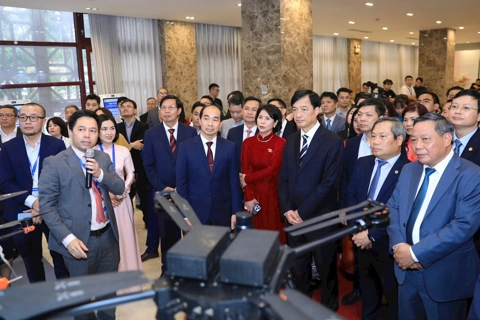
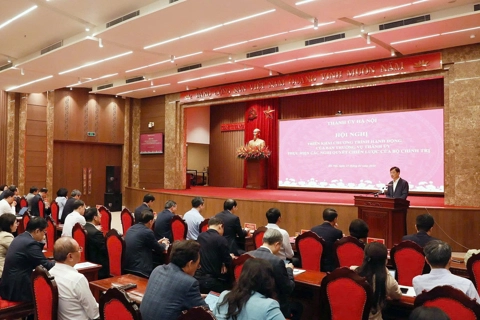
An overview of the international workshop. Photo: Nguyen Ngan
|
Addressing the workshop, Deputy Minister Vo Tuan Nhan said that the application of circular economy in urban solid waste management in some countries has brought remarkable results.
In Vietnam, solid waste in 2015 rose 1.6-fold from 2010. The volume is forecast to surge 2.37-fold by 2020 and 3.2-fold by 2025 while solid waste per capita will soar from 0.95kg per day in 2009 to 1.6kg by 2025, Nhan said.
He added that his ministry has asked Hanoi to be a pioneer in applying international experiences, to keep pace with the world’s advanced management methods and tools, as well as to learn and apply the leading technologies in urban solid waste treatment.
For his part, Dr. Sunil Herat from Australia’s Griffith University said the United Nations Environment Program has sent out a message that without actions, humans will spend a cost 5-10 times higher in the next decade to recycle wastes.
In 3R (reduce, reuse, recycle) sequence, he suggested adding another R which is ‘repair’, meaning that manufacturers should offer easy-to-repair products, thus making it easier to effectively reuse them and mitigating solid wastes.
Dr. Kim In Hwan, a policy expert from South Korea, said buried waste in his country dropped rapidly from 96% to 13% in 2013, while recycled waste increased sharply.
Food waste has been banned from direct burial since 2005, and is now recycled into animal feed, Kim stressed.
A Finnish representative said Finland is implementing the European Union's directives in sorting waste at source, recycling daily waste from households.
Besides, Finland also has built factories to extract nutrients from food waste and turn methane into electric power, the representative noted, adding that “Finland is willing to support Vietnam’s cities, especially Hanoi, in this field.”
"Hanoi must head the country in urban solid waste management to meet demand for circular economy development, based on technological diversification. The city needs to prioritize technology suitable with its economic conditions. The capital also needs to soon determine a route to end burying waste," Deputy Minister Vo Tuan Nhan told Hanoitimes.