14TH NATIONAL CONGRESS OF THE COMMUNIST PARTY OF VIETNAM
Log in
Hanoi

More public spaces needed in Hanoi to improve living standards

Public spaces in Hanoi are still far from meeting the world standard of 9 square meters per person.

Hanoi has been experiencing rapid urbanization for the past years with a lot of large-scale infrastructure works erected in the city. However, very few of them are public squares and parks, making a city’s public space planning imperative, Kinh Te & Do Thi quoted experts as saying.

Public spaces play an important role in improving urban residents’ life quality. However, Hanoi lacks spaces for planting trees and digging lakes. On average, each Hanoi citizen has only 3 square meters of public space, according to architect Dinh Dang Hai, an expert of HealthBridge Canada in Vietnam.

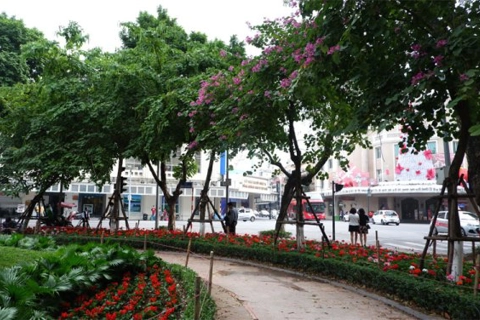
 Paster flower garden in Hai Ba Trung district. Photo: Thuy Anh

Thus, the average public space in Hanoi is still far from meeting the world standard of 9 square meters per person.

"Studies have shown that the shortage of public spaces in urban areas can increase obesity and traffic accidents," said the architect.

According to Hanoi’s general planning in 2011, the city’s green space would reach 9m2 per person.

Relocation of factories out of downtown

Most urban environmental experts believe that there are too many industrial factories in Hanoi’s densely-populated areas, putting pressure on the living environment.

Therefore, relocating factories out of Hanoi's residential areas is an urgent solution, especially given the incidents which have happened over the past one year, for instance, the fires at a bulb factory of Rang Dong Light Source and Vacuum Flask Joint Stock Company and a chemical factory in Duc Giang, Long Bien district.

According to a survey by the Working Group for People Participation (PPWG) in May and June 2020 with 512 people living in Hanoi, nearly 60% said that their living spaces were being affected by the factories’ operation, in which the level of toxic air pollution accounts for 80.52%. Especially, 98.49% of the respondents supported the decision to relocate polluting factories out of Hanoi’s downtown.

The Vietnamese government has adopted a policy of relocating contaminating industrial plants out of the central area and using post-relocation space for green spaces.

Architect Dinh Dang Hai said, not only in Hanoi, many big cities in the world have developed public spaces in the premises of production facilities after they are moved out of the inner city.

The problem here is the need to plan and the serious determination to implement it, taking into account the factor of green space. In particular, the government needs to mobilize the participation of the community in contributing ideas, as well as monitoring the implementation of the plans to make Hanoi a livable city.
Reactions:
Share:
Trending
Most Viewed
Related news
Hanoi tightens population management to protect voters’ rights

Hanoi tightens population management to protect voters’ rights

Senior city officials reviewed election readiness across six wards, focusing on voter registration, coordination among agencies and challenges caused by high population mobility.

Hanoi Museum welcomes Tet with Dragon Horse Heritage Exhibition

Hanoi Museum welcomes Tet with Dragon Horse Heritage Exhibition

As Tet approaches, one of the capital’s largest cultural institutions is reopening with expanded access and a renewed focus on public engagement.

Hanoi’s Old Quarter bursts into spring colors with flower market

Hanoi’s Old Quarter bursts into spring colors with flower market

As the Lunar New Year approaches, Hanoi’s Old Quarter awakens in full bloom as the 2026 Spring Flower Market weaves color, tradition and everyday rituals into a vibrant cultural tapestry for residents and international visitors.

DTMarket, HanoTEXD to turn Hanoi innovation into value

DTMarket, HanoTEXD to turn Hanoi innovation into value

The new platforms aim to turn research and digital solutions into market-ready values, linking government agencies, businesses and innovators while strengthening Hanoi’s technology trading infrastructure and advancing the capital’s transition toward a results-driven digital economy.

Hanoi, northern localities forge joint front against smuggling and counterfeit goods

Hanoi, northern localities forge joint front against smuggling and counterfeit goods

By formalizing interprovincial cooperation, nonrthern municipal and provincial administrations will close enforcement gaps, improve market oversight and respond more effectively to complex smuggling and counterfeit cases that span multiple localities and supply chains.

Hanoi seeks lessons from Chinese localities to shape long-term growth

Hanoi seeks lessons from Chinese localities to shape long-term growth

Hanoi looks to Beijing and Nanjing for urban planning lessons, focusing on congestion, pollution, heritage preservation and long-term sustainable growth strategies.

Hanoi weighs giant underground reservoir to tackle flooding

Hanoi weighs giant underground reservoir to tackle flooding

The reservoir is expected to have a capacity of around 125 million cubic meters and is proposed for construction during the 2036–2045 period.

Open-park push reshapes Hanoi public green spaces and everyday urban life

Open-park push reshapes Hanoi public green spaces and everyday urban life

In a bid to make green spaces more accessible and functional, Hanoi has started opening its parks to free public access, aligning urban design with goals for health, livability and social well-being.