Log in
Hanoi

Hanoi targets to have 700 products reaching “One Commune, One Product” standards in 2020

The city is among the top localities in deploying the “One Commune, One Product” (OCOP) program.

Hanoi targets to have 700 products certified as meeting the One Commune, One Product” (OCOP) standards by the end of 2020, according to a latest report from the Ministry of Agriculture and Rural Development (MARD).

 Hanoi targets to have 700 products certified as meeting the OCOP standards by the end of 2020.

According to the MARD, Hanoi is one of the leading localities in implementing the OCOP Program in the 2019-2020 period. As of May, the city has 300 products certified as meeting OCOP standards, equivalent to 17.6% of total OCOP products in the country. 

The city has also submitted six products for being labeled with five stars, the highest quality certification of the OCOP Program. 

As of the end of May, as many as 1.711 products from 32 provinces and cities have received star certifications at different levels, reaching 71.3% of the plan of acknowledging 2,400 products. 

The OCOP program promotes advantageous agricultural, non-agricultural, and service products in each locality based on value chains, which will be realized by private and collective economic sectors.

The program focuses on six groups of goods and services including food, beverages, herbs, souvenirs-furniture-decorations, fabrics-apparel, and rural tourism services. OCOP products are ranked into five levels, of which the five-star level is the highest and meets international standards.

In 2019, the Hanoi People’s Committee issued Decision No.3629 on the implementation of OCOP program in the city until 2020, aiming at consolidating the management system for the program; and providing training courses for all program managers, registered organizations, enterprises, cooperatives and households.

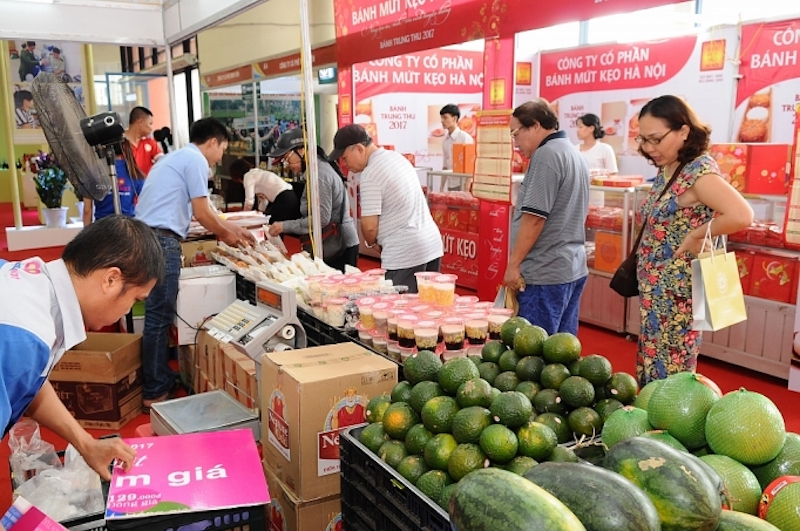
 An OCOP product displayed at a promotion fair.

Hanoi has the most craft villages in the country with 1,350, nearly one-third of the total number. It also leads the country in using QR codes to trace the origins of agriculture, forestry, fishery and food products.

Approved in May 2018, the national OCOP program aims to develop the rural economy as a way to realize the national target of building "new style" (modern) rural areas. So far, there have been 5,177 communes nationwide (accounting for 58.2% of the total number of communes) classified as the new rural areas, an increase by 113 communes compared to April. 

In addition, there are 168 communes meeting enhanced rural standards and nine communes classified as exemplary new rural areas according to the regulations of the Prime Minister.

The country has 126 out of 664 districts in 45 provinces and cities recognized by the Prime Minister as fulfilling the new rural area construction (accounting for about 18.9% of the total districts nationwide).


Reactions:
Share:
Trending
Most Viewed
Related news
Hong Van Commune rises as Hanoi’s emerging model for community-based tourism

Hong Van Commune rises as Hanoi’s emerging model for community-based tourism

Blessed with natural beauty, strengthened by deep cultural heritage and supported by its residents, Hong Van Village is emerging as one of Hanoi’s most distinctive tourism destinations. From ecology and agriculture to handicrafts and festivals, this Red River village is shaping a dynamic vision of sustainable community tourism for the capital.

Hanoi unveils digital heritage journeys to connect tradition with modern urban life

Hanoi unveils digital heritage journeys to connect tradition with modern urban life

Hanoi has launched a new digital heritage program that brings centuries-old cultural assets into a modern, interactive format. By mapping key monuments and creating themed journeys, the city aims to help residents and visitors explore its deep-rooted identity through fresh, engaging experiences.

Hanoi launches two-wheel electric vehicles to expand green urban mobility

Hanoi launches two-wheel electric vehicles to expand green urban mobility

Hanoi has introduced two-wheel electric vehicles for the first time in its transport network, offering residents a new green mobility option and marking a key step in the city’s smart-transport development.

Thai AirAsia launches new Hanoi–Luang Prabang route to boost regional travel

Thai AirAsia launches new Hanoi–Luang Prabang route to boost regional travel

Thai AirAsia has opened a new direct Hanoi–Luang Prabang route using Fifth Freedom traffic rights, creating a faster and more convenient link between two major heritage destinations in Vietnam and Laos.

Hanoi orders strong air-pollution measures and warns schools to adjust schedules

Hanoi orders strong air-pollution measures and warns schools to adjust schedules

Hanoi has issued new directives requiring schools to restrict outdoor activities and consider suspending classes when air quality drops to hazardous levels, while launching a sweeping crackdown on pollution sources across the city.

Hanoi – Vientiane ties set pace for bilateral cooperation

Hanoi – Vientiane ties set pace for bilateral cooperation

The two sides have inked two city-level agreements and eight agreements covering areas such as Party building, economic and investment cooperation, agriculture, health, education and people-to-people ties.

Hanoi completes tunneling for four underground stations of 2nd metro line

Hanoi completes tunneling for four underground stations of 2nd metro line

The completion marks a major step forward for the four-kilometer underground section of the metro line.

Rooftop solar push to boost Hanoi's green ambition

Rooftop solar push to boost Hanoi's green ambition

Rooftop solar in industrial zones has the foundations to become a new driver of Hanoi’s energy transition.