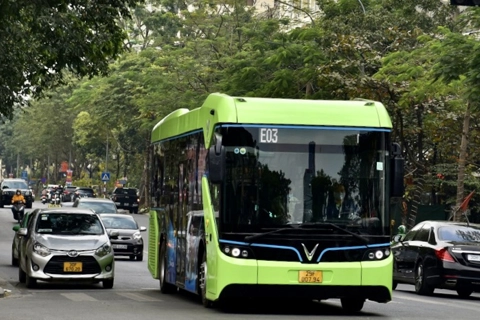
Hanoi targets up to 90% electric and green energy buses by 2030
The new bus lines will be operated primarily with electric and green energy buses.
Hanoi aims to run 70-90% of its buses on electricity and green energy by 2030, said Thai Ho Phuong, Director of the Public Transport Management Center, at a national policy dialogue on green transport development on August 21.
| Green buses in Hanoi have become popular over the years. Photo: Dang Khoa/The Hanoi Times |

Phuong stated that Hanoi currently has 1,905 subsidized buses of which 281 use clean energy (139 CNG buses and 142 electric buses) and over 1,200 buses meet Euro 4 emission standards or higher. So far, the operation of electric bus routes has contributed to reducing 36,000 tons of CO2 emissions.
In terms of charging infrastructure for electric buses, there are currently only two charging stations installed by Vinbus Eco, servicing 10 routes. Each station has 32 and 39 charging poles, respectively, with a capacity of 120-150 kWh, meeting the demand for full charging of all buses.
"The city has developed a plan and roadmap to transition to electric and green energy buses in line with the schedule approved by the Prime Minister. Hanoi aims to run 70-90% of its buses on electricity and green energy by 2030, and 100% by 2035," Phuong said.
The roadmap for the transition from conventional buses to electric and green energy buses includes three scenarios: (1): 100% electric buses, with a total of 2,433 vehicles after the transition; (2) 70% electric buses and 30% LNG/CNG buses, with 2,212 vehicles (1,592 electric buses and 620 LNG/CNG buses) after the transition; (3) 50% electric buses and 50% LNG/CNG buses, with 2,076 vehicles (1,100 electric buses and 976 LNG/CNG buses) after the transition.
“The city’s initial plan is to put scenario 3 into action. As conditions improve, Hanoi will aim to implement scenario 2, and then move to scenario 1 after 2040,” said Phuong.
The transition plan is based on selecting and determining a reasonable structure between electric buses and green energy buses, taking into account the actual capabilities of the infrastructure and electricity supply. New bus lines will be operated primarily with electric and green energy buses.
Diesel buses already in service n will be allowed to continue operating until the end of their contract period. To achieve these goals, Phuong emphasized the need for financial resources from the state budget (for conversion costs and annual subsidies) and from businesses (for purchasing vehicles, and investing in charging/fueling infrastructure).
Hanoi has also proposed several solutions, including promoting the roadmap, policies, and benefits of transitioning to green energy buses; refining cost norms for green buses; putting in place temporary cost norms for green bus orders while awaiting official regulations; and investing in infrastructure for electric and green energy buses.
Vision for green transport until 2050
Outlining the structure of Vietnam's transportation infrastructure, Luu Quang Thin, Deputy Director of the Department of Planning and Investment (Ministry of Transport), stated that the country currently boasts over 24,300 km of national highways, 2,000 km of expressways, 6,800 km of inland waterways, 2,640 km of national railways, 298 ports, 22 airports, and numerous other important large-scale projects.
However, he acknowledged existing limitations, such as the imbalance in infrastructure projects, with a heavy focus on road transport, followed by maritime and aviation. Inland waterways, despite their potential, have not been fully utilized in advantageous regions.
The railway system, while beneficial in many ways, has been underinvested in and remains outdated. Urban railways have been slow to develop, failing to alleviate traffic congestion and reduce environmental pollution in major cities.
"The main reason is the low starting point of Vietnam's economy, which has resulted in insufficient funding for transportation infrastructure development," Thin said. He emphasized that the strategic goal for transportation infrastructure development by 2030, with a vision toward 2050, is to create a well-balanced and harmonized system that leverages the strengths of various transportation modes and increases the proportion of public transport in large urban areas.
For road transport, the goal is to achieve around 5,000 km of expressways by 2030, with continued investment in highways that connect major economic centers, seaports, airports, and international border crossings with high crossings demand. There will also be synchronized investments in infrastructure for electric charging and green energy supply along highways to support the transition to green road transport.
"According to the plan, the total investment for these projects is estimated at $24.8 billion by 2030 and $33.64 billion by 2050," Thin added.
Rail transport will be prioritized due to its advantages in handling large volumes of goods quickly, safely, and cost-effectively while reducing environmental pollution. "Emphasis will be placed on constructing the North-South high-speed railway, accelerating investment in urban railways in Hanoi and Ho Chi Minh City to reduce traffic congestion, and connecting them with the high-speed railway to form a convenient passenger transportation network nationwide. Additionally, investment will be made in new, electrified railways to connect key seaports and airports," he explained.
Furthermore, existing railway lines will be upgraded with infrastructure that supports electric and green energy use.
Investing in electric-powered railways is seen as an optimal solution for transitioning transportation methods, particularly as Vietnam prioritizes developing a low-carbon economy with the goal of achieving net-zero emissions by 2050.
Thin stated that efforts will focus on mobilizing capital from all sectors for transportation infrastructure, with maximum investment incentives. The strategy includes attracting ODA and concessional loans for large-scale projects, leveraging existing assets, and developing mechanisms to optimize investment tailored to each sector's needs and international competitiveness.
"A list of transportation infrastructure development projects will be created and published to attract investment through PPP models and foreign investment by 2030 and beyond," Thin concluded.