Hanoi to have new airport in 2030-2050
The new airport is part of a master planning on airports in the 2021-2030 period, with a vision to 2050, proposed by the Ministry of Transport.
Hanoi is set to have another airport in the city’s southeast in the 2030-2050 period to relieve the pressure from the current Noi Bai International Airport.
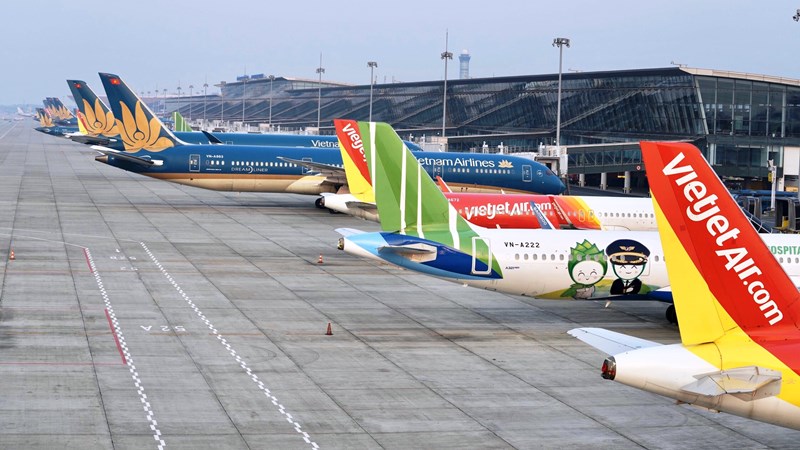
| Noi Bai Airport is fast reaching full capacity. Photo: Viet Hung |
The move was revealed in the Ministry of Transport (MoT)’s latest proposal on the planning of airports in the country during the 2021-2030 period, with a vision to 2050.
Meanwhile, the MoT would focus on the expansion of the T2 Terminal of Noi Bai to serve 15 million passengers per year, along with the construction of runway No.3, and the T3 Terminal in the south of Noi Bai Airport.
The ministry also mentioned the necessity to soon complete the Long Thanh International Airport Phase 1 with the capacity of 25 million passengers per year, and the T3 Terminal of Tan Son Nhat with a throughput of 20 million passengers per year.
In addition to the construction and upgrade of major airports in Hanoi and Ho Chi Minh City metropolitan areas (Noi Bai, Tan Son Nhat, and Long Thanh airports), the MoT would continue to ensure efficient operation of 22 existing airports and six new ones.
This would take the total number of airports in Vietnam to 28 for a combined throughput of 278 million passengers by 2030, 14 of which are international airports (Van Don, Cat Bi, Noi Bai, Tho Xuan, Vinh, Phu Bai, Danang, Chu Lai, Cam Ranh, Lien Khuong, Long Thanh, Tan Son Nhat, Can Tho and Phu Quoc), and the remaining are for domestic flights (Lai Chau, Dien Bien, Sa Pa, Na San, Dong Hoi, Quang Tri, Phu Cat, Tuy Hoa, Pleiku, Buon Me Thuot, Phan Thiet, Rach Gia, Ca Mau and Con Dao).
For the 2021-2030 period, the network of airports in Vietnam would be formed under the hub-and-spoke model with the two main hubs in Hanoi and Ho Chi Minh City, helping the country realize the goal of ensuring 95% of the population stay within the radius of 100 kilometers of airports by 2030.
“Vietnam would gradually upgrade the aviation infrastructure, including logistics centers, flight training and maintenance facilities, to meet growing transportation demand and reaching regional standards,” noted the MoT.
Haiphong International airport is set to replace the Cat Bi International Airport after 2030. By 2050, Vietnam would have 29 airports with another domestic airport of Cao Bang.
New airports would be constructed in remote areas, the highlands and islands such as Dien Bien, Con Dao, Sa Pa, or Pleiku, while the expansion of existing ones, Phan Thiet and Tho Xuan airports, is aimed at ensuring security-defense purposes.
The MoF estimates around VND400 trillion ($17.67 billion) would be needed for aviation infrastructure development, or 22% of total investment capital for the transportation sector, which should be mobilized via state budget and private sources.
“Vietnam gives priority social resources for the construction of new airports, especially via the public-private partnership (PPP),” noted the ministry.
Meanwhile, local provinces/cities would be given more authority in mobilizing resources for the expansion of existing airports in their localities.