Hanoi trade events foster Vietnamese-Japanese cooperation opportunities
The city has provided incentive policies for the development of ancillary industries.
Numerous conferences and trade fairs organized by the Hanoi authorities have created opportunities for cooperation between Vietnamese and Japanese companies.
| Visitors to the trade fair on August 23. Photos: VGP |
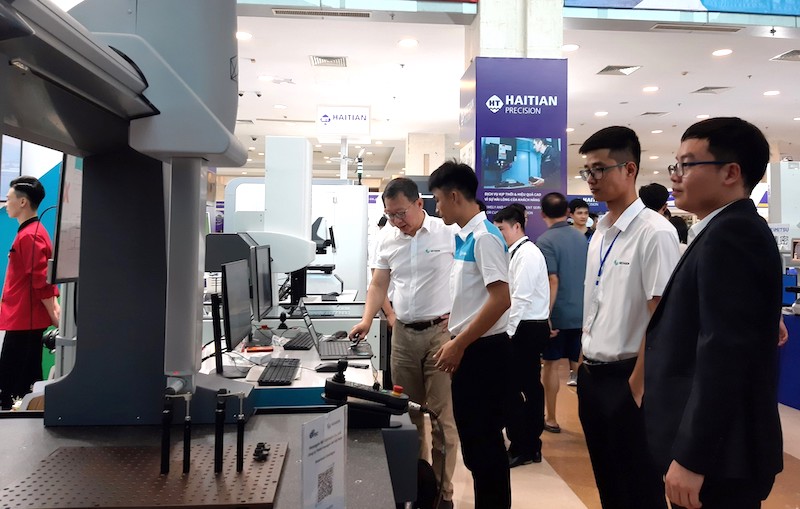
Noboru Kinoshita, an international consultant with the Aichi Industry Promotion Organization in Japan, shared this information at a seminar held in the capital city this week, adding that Japanese small and medium-sized enterprises are increasingly interested in investing in Vietnam. The number of enterprises seeking advice from his organization on investment opportunities in Vietnam has increased, especially in computer repair, network maintenance, and IT services.
However, when investing in Vietnam, Japanese enterprises are faced with a shortage of raw materials and components in Vietnam, he added at the seminar on "Encouraging Investment in High-Tech and Ancillary Industries - Experience and Solutions" on August 23.
Through these activities, Japanese companies have come to understand the current situation of Vietnam's manufacturing industry and found solutions to overcome difficulties, helping both sides develop, he said.
Enterprises and managers attending the seminar gained insights into the development of domestic and international ancillary industries, improved development policy mechanisms, enhanced investment promotion in high-tech and ancillary industries, and participation in global supply chains of multinational corporations and domestic and foreign-invested enterprises.
At the event, Deputy Director of Hanoi Department of Industry and Trade Nguyen Dinh Thang said that the supporting industrial sectors in Hanoi and the country had been formed and developed after other countries in the region. Hence, it needs appropriate policies and sound solutions to keep up with other countries in the region and the world.
He added that the city has supported local enterprises in realizing scientific and technical knowledge and participating in domestic and international trade promotion programs. As a result, the number, size, quality, and fields of enterprises have increased continuously, focusing on three groups of industries: component and spare parts manufacturing, products for the textile and garment - leather and footwear industries, and other products for high-tech industries.
Many companies such as TOMECO, PMTT Group, Hiraki Vietnam P&T, Indema, Brother Vietnam, Tri Cuong Industrial Co., Ltd and Hanoi CNC Mechanical Co., Ltd have signed contracts to supply their products to the domestic and export markets.
Tran Thu Trang, Chairwoman of the Hanel PT, said her company's successful participation in the supply chain of large enterprises is thanks to the application of policies on product quality, services, management, supervision, and human resources.
"Thanks to this, its products have met customers' demands and are continuously improved," she said.
The city has about 960 enterprises in supporting industries. Among them, about 320 enterprises have adopted international standard production systems, and their products are able to participate in the global network of multinational corporations in Vietnam.
| The opening ceremony of the fair. |
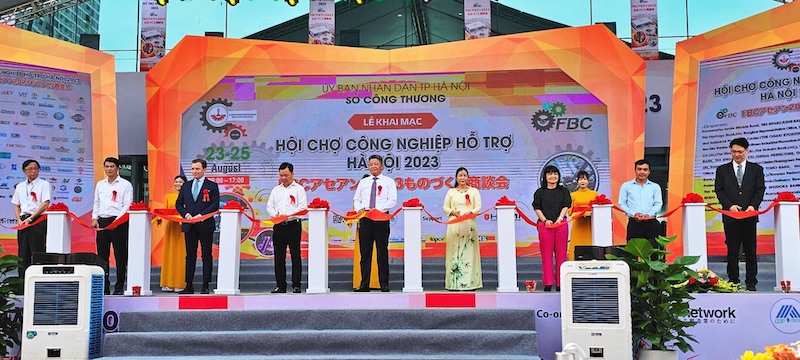
As part of the event, the 2023 Hanoi Supporting Industry Fair will take place from August 23 to 25 at the National Architectural Planning and Construction Exhibition, Hanoi.
The fair attracted more than 250 booths of domestic and foreign supporting industry enterprises, including large corporations from Japan, China, Thailand, and Malaysia, to display and introduce their products and nearly 40 buyers from domestic and international markets through direct and online methods.