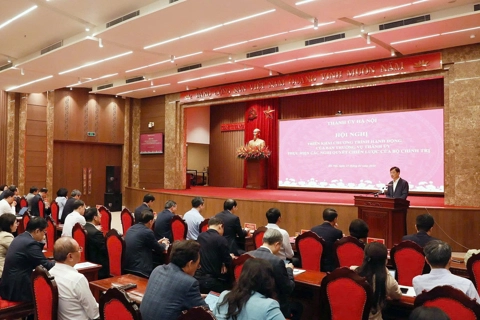
Hanoi transport sector – a highlight of Resolution 15
Transportation has made a remarkable contribution to the stimulation of socio-economic growth, contributing positively to the overall success of the capital's construction and development.
Hanoi has experienced remarkable economic growth since its administrative boundaries were expanded 15 years ago, and the city's transportation sector has been one of the key contributors.
Significant transformation
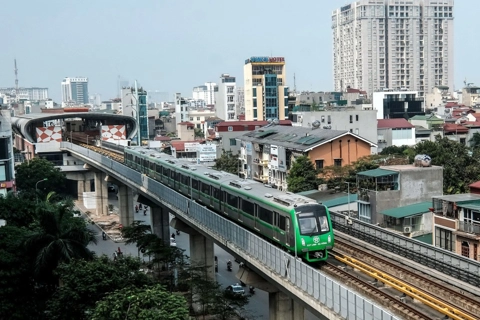
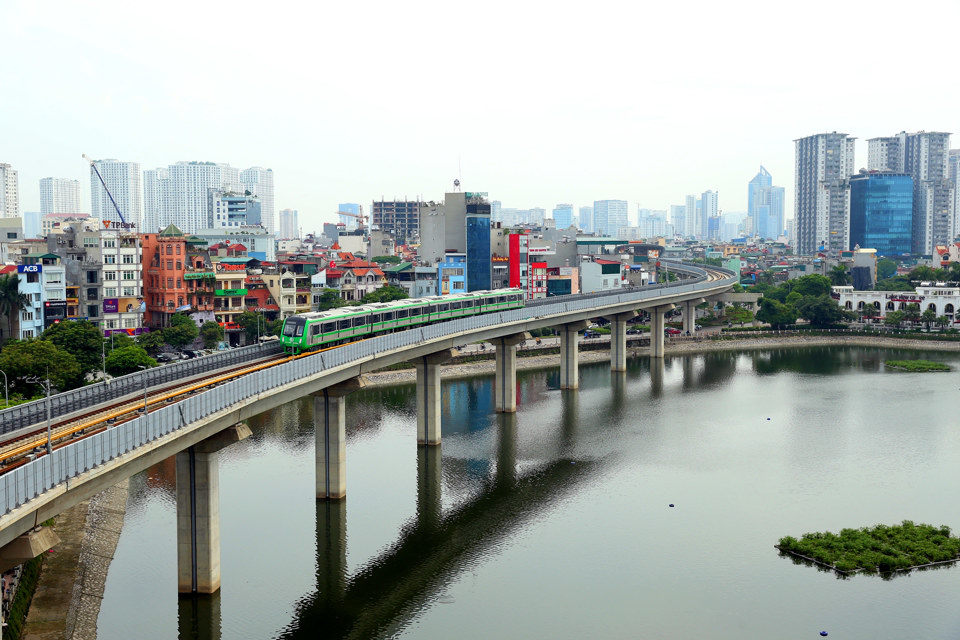
| The Cat Linh - Ha Dong urban railway. Photos: Ha Linh/The Hanoi Times |
The development of transportation infrastructure plays a key role and is a prerequisite for urban development. Transportation infrastructure serves as a crucial benchmark for assessing the quality of life in modern cities.
Following the merging of Ha Tay province and parts of Hoa Binh and Vinh Phuc provinces, the capital's transportation network has undergone significant changes over the past 15 years.
At present, all seven radial highways (total length over 111.32 km) and eight radial national highways (total length 244.58 km) have been built as planned. At the same time, the construction of seven ring roads has started or under investment process. In particular, work on Ring Road .No4, which is of strategic importance for the entire capital region, began in June. Four axes connecting the central urban hub with satellite cities, namely West Lake - Ba Vi, West Thang Long, Ngoc Hoi - Phu Xuyen, and Ha Dong - Xuan Mai, are also undergoing rapid development.
In addition, a number of major transportation projects are underway to facilitate connectivity within and beyond the region. These include the renovation and extension of National Highway No. 6, the road connecting Phap Van - Cau Gie Expressway with Ring Road No. 3, the extension of National Highway No. 21, and the Bai Dinh - Ba Sao - My Dinh route, among others. Of the 18 planned bridges over the Red River, 9 have been built and preparations are underway to start construction of the remaining 6.
Hanoi's public transport network has been expanded with 154 bus lines covering 100% of districts, towns and 88.4% of communes and wards - an 88% increase compared to 2008 before the border expansion. The network is currently served by a fleet of 2,279 buses, nearly 14% of which use clean energy sources.
Hanoi has the distinction of being the first place in the country to inaugurate an urban rail line, the 2A Cat Linh - Ha Dong, ushering in an era of widespread, modern, well-mannered and environmentally conscious public transportation.
At the same time, the city has launched the BRT 01 Kim Ma - Yen Nghia bus line and is actively speeding up the construction of the Nhon - Hanoi Station metro line, aiming for the elevated section to be operational in 2024. Intensive preparations are also underway for the investment phase of the remaining metro lines.
These achievements and results have noticeably eased traffic congestion in the capital, gradually reducing traffic jams and accidents in the surrounding area, while improving connectivity between the capital and surrounding provinces and cities in the region. In essence, transportation has made a notable contribution to stimulating socio-economic growth and has contributed positively to the overall achievements in the capital's construction and development journey, especially since the administrative boundary expansion in 2008.
This transport has bridged the geographical gap between the central urban region and the rural and suburban areas, thereby minimizing disparities in quality of life. This has enabled all residents of the capital, regardless of their location, to enjoy uniform policies and public services, as well as equal development conditions.
Challenges remain
Despite the achievements and opportunities of 15 years of progress, Hanoi's transport sector faces numerous challenges and obstacles. The expansion of the capital's administrative boundaries has led to increased travel demand, especially within the metropolitan districts, putting immense pressure on inner-city traffic.
The demand for investment in transport infrastructure development far exceeds the capacity of local budgets. Access to Official Development Assistance (ODA) funds is challenging, and mechanisms and policies to incentivize investment in the transport sector have yet to become truly attractive to potential investors.
Implementation of transport planning requires local adaptation to reality, which is lacking. In addition, policies on land clearing and construction investment are subject to frequent changes.
Large-scale construction projects, particularly urban rail projects, involve lengthy procedural and technical complexities that often require reliance on foreign consultants due to limited Vietnamese expertise.
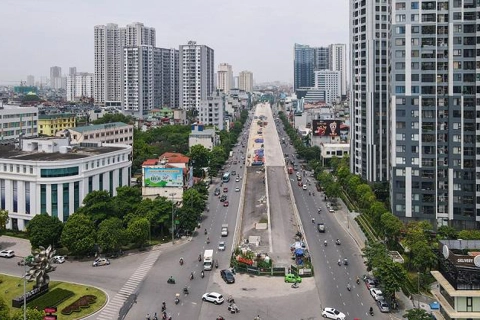
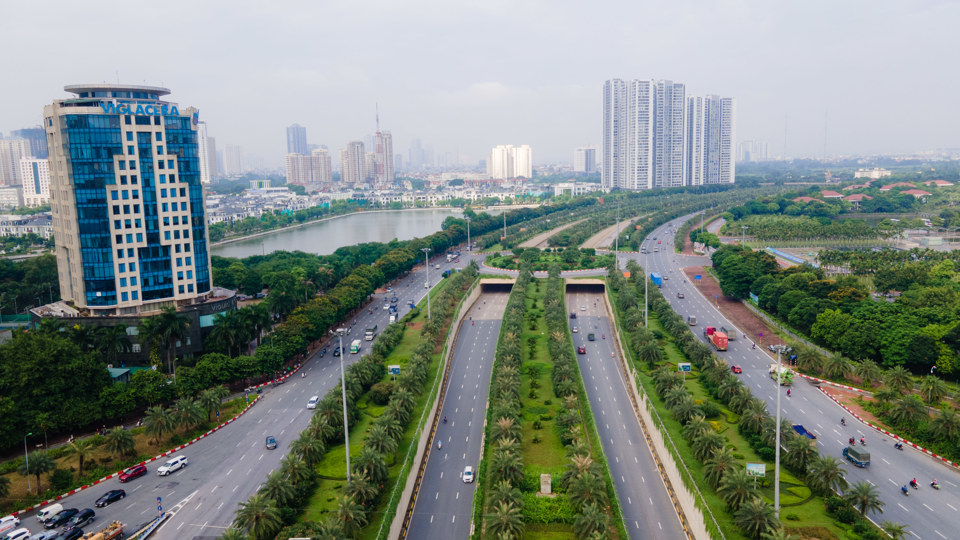
| Thang Long Boulevard. |
The Capital Transportation Plan until 2030, with a vision until 2050, approved by the Prime Minister, stipulates that the allocation of land for transportation should be 20-26%, the share of land for static transportation should be 3-4%, and public transportation should cover 50-55% of travel demand.
However, these indicators have not yet been achieved. The annual increase in the number of vehicles by 4-5% contributes to traffic congestion in the city. The basic transport infrastructure system has not yet been systematically developed according to the planned scheme. The radial axes rely primarily on the existing national road network.
Moving on to specific goals
In the coming period, Hanoi will focus on conducting a comprehensive assessment of the implementation of the Hanoi Capital Transport Planning Project until 2030, with a vision for 2050. This assessment will provide an overview of the current state of the transport sector and identify the challenges, obstacles, shortcomings and limitations encountered during the execution process.
Further progress in scientific research and technology application in urban transport will be promoted. Special emphasis will be placed on enhancing public transportation, especially fast and high-capacity systems. Priority will be given to the establishment of an online digital mapping system, smart ticketing infrastructure and intermodal tickets. State-of-the-art information technology will be used to manage and update public transport data and to optimize each travel experience.
An assessment will be conducted to identify a list of critical and immediate transport infrastructure projects, with a focus on their phased completion and commissioning to ensure viability. This will include defining the investment format, capital sourcing, progress, execution schedules and implementation phases with precision.
Urban rail development places the highest priority on concentrated investment along designated routes, ensuring holistic alignment along the entire route and seamless integration with other forms of public transportation. This approach seeks to optimize the effectiveness of investments along existing lines.
In the immediate term, the allocation of resources from the city budget for investment will remain a central focus. Ensuring an adequate reserve of investment resources will require the formulation of plans, mechanisms and policies to diversify funding sources.
Administrative procedures will continue to be reformed and streamlined to shorten the timeline from planning and project preparation to design, appraisal, approval, and site clearance. This includes defining responsibilities, roles, processes, progress, and individual efficiency levels at each level, department, and individual involved in the implementation process.
A multi-pronged site clearance strategy will be implemented to improve the accountability of local authorities at all levels in both land management and planning administration to facilitate the smooth progress of investment projects. Rigorous inspection and oversight of project implementation by investors will be intensified to promptly address challenges and surmount obstacles. A comprehensive assessment will be made of the capacity, professionalism and expertise of units involved in project investment, with a view to consolidating and improving their capabilities.