Hanoi's first power plant and city modernization
The electric lights in the lighting system of many large cities in France would envy the capital of Tonkin
Today's Hanoi Electricity Corporation, located on the shore of Hoan Kiem Lake, is a testament to Hanoi's development: over 130 years ago, the Bo Ho Lamp Factory, Hanoi's first power plant, was established here, providing the city's first electric lights in the late 19th century.
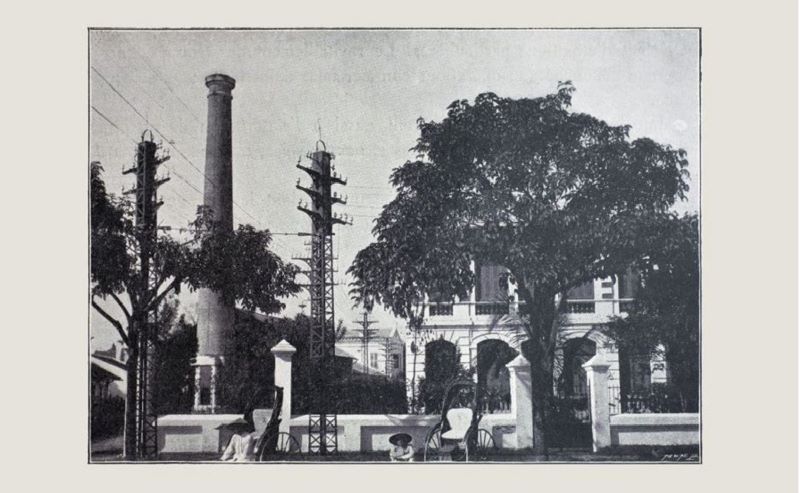
| Bo Ho Lamp Factory in the 19th century. File Photo |
From its humble beginnings, the Bo Ho Lamp Factory has grown into the Hanoi Electricity Corporation. Today, it is a leading national electricity distribution company.
The Corporation takes pride in being a reliable provider that helps fulfill the socio-economic policies of the Communist Party and the Vietnamese State, ensuring power for political, national security, cultural, and diplomatic activities in Hanoi.
How Hanoi's first power plant was built?
Back in 1884, after the French invasion forces took over Hanoi, French Senior Resident Bonal decided to make the Sword Lake the heart of a colonial city, reorganizing the "36 streets" ("Old Quarter"), as well as building a new Western-style neighborhood east and south of the lake. The new city would not be a city without electricity, so the construction of a power station was considered.
On December 6, 1892, the Indochina Electrical Company broke ground for the first power plant on the site of the former Hotel de la Brigade or Lu Gia Hotel on Francis Garnier Street (east of Hoan Kiem Lake).
Over 132 years, Bo Ho Lamp Factory has become the head office of Hanoi Electricity Corporation (EVN HANOI), always located at 69 Dinh Tien Hoang Street in Hanoi.
| Today's Dinh Tien Hoang Street (formerly Francis Garnier Street). File Photo |
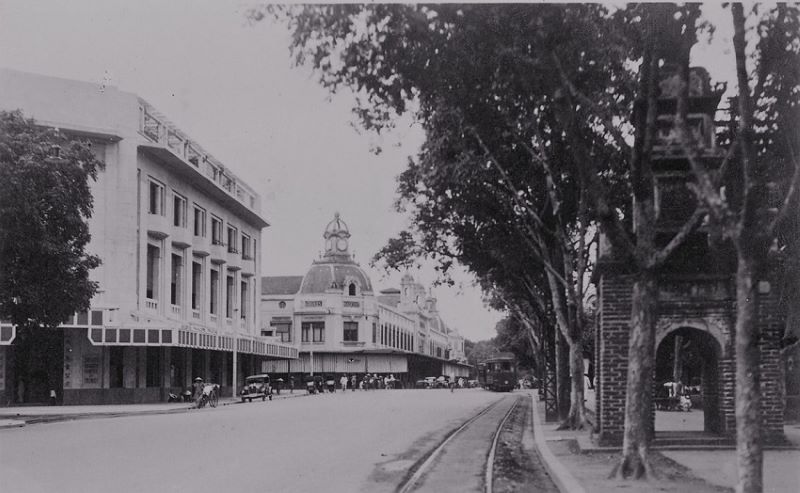
The City provided the company 10,000 francs per year for four years, given the considerable financial outlay required to get the project built.
In the book "Le Vieux Tonkin 1890-1894", author Claude Borrin recounted that on Lunar New Year 1894, De Lanessan - Governor General of French Indochina from 1891 to 1894 - organized various games around Sword Lake to amuse the populace.
At that time, the oil-fired power plant was nearing completion, so Lanessan asked for a test run of a generator set to light up the sky with a spotlight. Hanoians were amazed by the vertical beam of light in the darkness of Sword Lake.
The plant was completed in early 1895. In his book La colonization Francaise en Indochine, De Lanessan wrote: "On January 5, 1895, the day before my return home, I had the pleasure of witnessing the final test run of the machinery; a few days later, the electric lighting was fully operational."
Interesting history of ‘Bo Ho Lamp Factory’
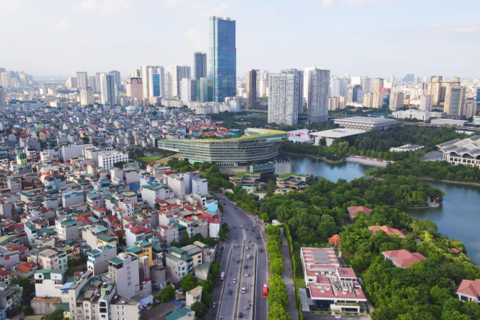
| Today's vibrant Hoan Kiem Lake. Photo: Lucas Vu |
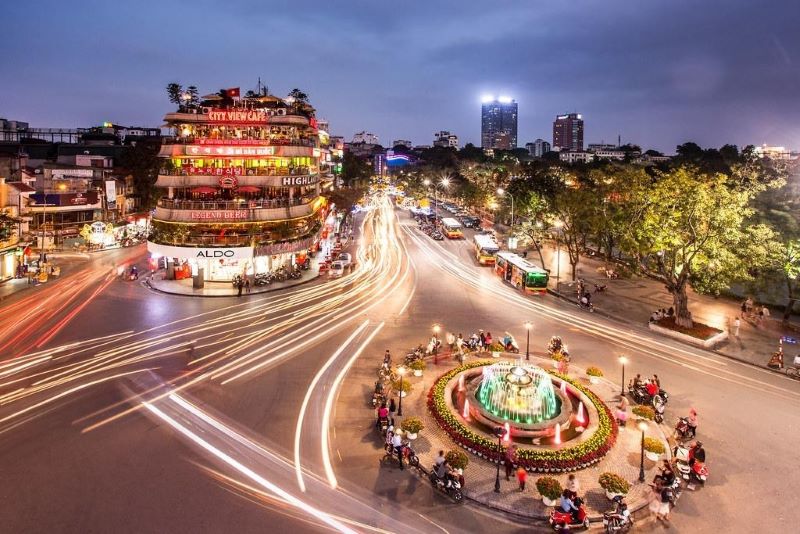
By 1897, Hanoi 's population was just 30,000. As the initial capacity of the power plant was rather small, electricity was mainly supplied to the Mayor's Hall, banks, post offices, the Palace of the Governor of Tonkin, private houses of officials, including that of the Deputy Governor General (now the headquarters of Nhan Dan Newspaper), and street lighting.
At first, lamp posts were placed in the middle of the street. Later, with the advent of cars in the city, they were moved to the sidewalk. When the lamps were found to be lit by electricity, the Nha may den power plant became known as the "Bo Ho Lamp Factory" (Bo Ho means "lakeside").
Before electric lighting, Hanoi's streets were lit by kerosene lamps inside a glass box suspended from cast-iron poles erected by the Public Works Service.
At dusk, workers would climb the ladder to refill the lamps with oil and light them before blowing them out in the morning. Some streets were also lit with carbide lamps.
In the evenings, workers would pour calcium carbide into the iron chamber at the base of each post and then water into a drip tank just above. A chemical reaction would occur, pushing the acetylene gas onto the metal burner inside the glass box, which produced a broader light than that from the kerosene lamp.
| Bo Ho Lamp Factory, the first power plant in Hanoi. File Photo |
.jpg)
According to the appendix of the report "Situation de L'Indochine 1897-1901" by Governor General Paul Doumer, on January 1, 1897, Hanoi's street lighting consisted of 55 carbide lamps, 584 kerosene lamps, and 523 electric lamps in part of the Old Quarter and suburban areas.
Each pole was made of riveted diagonal iron rods, with the base larger than the top, an iron rod overhanging the street to attach a round light bulb, and a circular hood on top to protect the bulb from rainwater.
Also in this report, Paul Doumer wrote with unconcealed pride: "The electric lights in the lighting system of many large cities in France would envy the capital of Tonkin."
Later, two more generating sets were added to increase the plant's capacity to meet civilian demand. However, until the beginning of the 20th century, electricity was still mainly used for offices, hotels, the Grand Opera House, and the 2,665 French civilians living east and west of Hoan Kiem Lake.
The plant could only provide sufficient services to the Vietnamese populace following its third capacity expansion. At that time, the city had a population of 120,000.
Trams in the city, however, were powered by energy generated at a different power station on Place du Général Négrier (today the Shark Jaws building).
| The Shark's Jaw building (formerly Place du Général Négrier). Photo: Yeu Ha Noi Group |
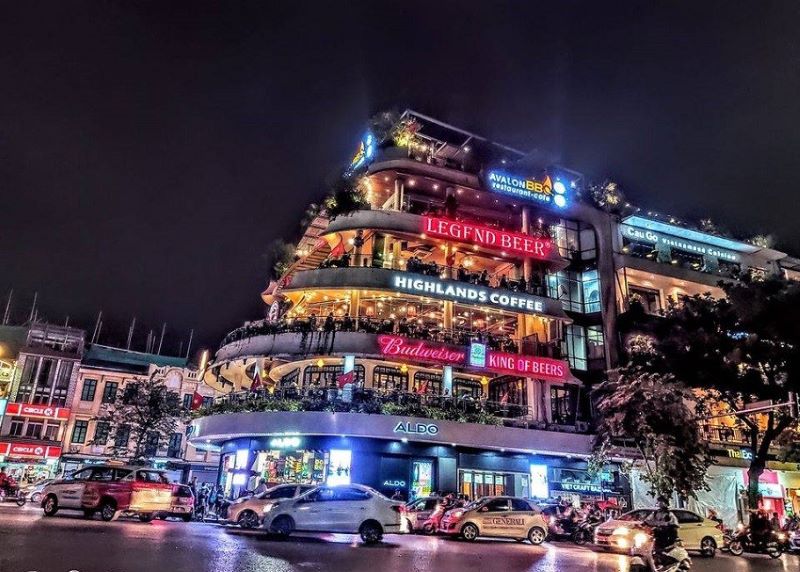
In 1925, construction began on a coal-fired power station near the Yen Phu dyke. In 1928, its two generator sets were put into operation, causing the Bo Ho Lamp Factory to close down.
There are very interesting historical details: according to historian Duong Trung Quoc, the first place in Vietnam to have electricity was not Hanoi, but the city of Haiphong.
"The famous port city saw its first electric light since 1891, while Hanoi was lit up a year later after the Resident of Hanoi worked with the Indochina Electrical Company to provide electricity to public areas around Hanoi's Sword Lake," he said.
The arrival of electricity has also had a humorous effect on the Vietnamese language, with the appearance of a number of relevant slang words.
Some people believe that the slang term 'nha que' or 'bumpkin' was born in 1930, when the character of Ly Toet was caricatured by some satirical writers and journalists as a symbol of feudalism and obsolescence - as opposed to civilization.
For example, looking at the electric light bulb, Ly Toet criticized: "Why is it hanging upside down?".
In fact, the word came into use at the end of the 19th century, when power stations were built in Hanoi and Hai Phong. Its original meaning was 'the countryside' - where there was neither electricity nor tap water as in urban areas, without the negative connotation of today.