Log in
Vietnam

Japan, UK concerned about China maritime law

The two countries see China’s escalating influence and military activity in the region as a security threat.

Four ministers from Japan and the UK have expressed serious concern over China’s newly-enacted Coast Guard Law that is implicit to change the status quo in the South China Sea and East China Sea.

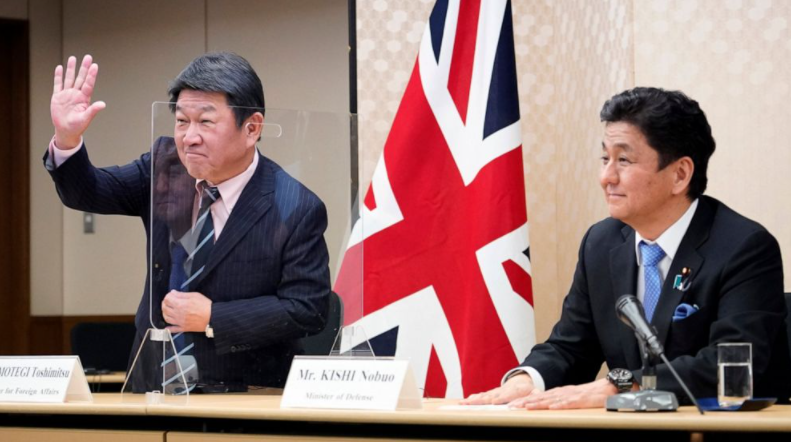
 Japan's Foreign Minister Toshimitsu Motegi, left, and Defense Minister Nobuo Kishi attend a video conference with their British counterparts. Photo: AP

Foreign Minister Toshimitsu Motegi and Defence Minister Nobuo Kishi of Japan, and their respective British counterparts Dominic Raab and Ben Wallace showed their concern in the joint statement released on February 3 after an online meeting, reported Reuters.

“The four ministers reaffirmed the importance of upholding freedom of navigation and overflight above the South China Sea and urged all parties to exercise self-restraint and refrain from activities likely to raise tensions,” the statement said.

According to AP, Foreign Minister Toshimitsu Motegi said in online talks between the two sides “Japan is staying alert and paying close attention to its effect on us.” “I believe the law should not be used in a way that violates international law.”

The concern came two days after the China’s Coast Guard Law took effect. The law enables Chinese Coast Guard to “take all necessary measures, including the use of weapons, when national sovereignty, sovereign rights, and jurisdiction are being illegally infringed upon by foreign organizations or individuals at sea.”

It means that the law explicitly allows the coast guard to fire on foreign vessels, authorize demolition of other countries’ structures built on Chinese-claimed reefs, and to seize or order foreign vessels illegally entering China’s territorial waters to leave.

China claims almost all the resources-rich South China Sea, where it has established military outposts on artificial islands. Brunei, Malaysia, the Philippines, Taiwan and Vietnam also have claims to parts of the sea.

In the East China Sea, China claims a group of uninhabited Japanese-administered islets, called the Senkaku in Japan and Diaoyu in China. The dispute has plagued bilateral relations for years.

Japan sees China’s escalating influence and military activity in the region as a security threat and has been stepping up defense cooperation with the US, Australia, Southeast Asian countries, as well as Britain.

In the joint statement, the ministers urged all parties “to exercise self-restraint and refrain from activities likely to raise tensions, in particular militarization and coercion.”

The ministers also agreed to deepen defense and security cooperation between Japan and Britain to ensure a “free and open Indo-Pacific” vision.

Japan and Britain are jointly developing an air-to-air missile defense system and increasing the inter-operability of defense equipment and technology as their troops work together more closely.

Reactions:
Share:
Trending
Most Viewed
Related news
Japan rejects China’s claims in South China Sea

Japan rejects China’s claims in South China Sea

21 Jan, 16:18

Japan is the 10th country rejecting China’s maritime claims in the South China Sea (called East Sea by Vietnam) following Malaysia’s initial role with a Note Verbale submitted in December 2019.

Vietnam U22 stage dramatic comeback to defeat Thailand and claim SEA Games gold

Vietnam U22 stage dramatic comeback to defeat Thailand and claim SEA Games gold

Vietnam U22 overturned a two-goal deficit to defeat Thailand U22 3-2 after extra time, confirming their growing dominance in Southeast Asian football.

Vietnam, Germany seek more sustainable economic, trade cooperation to boost 50-year ties

Vietnam, Germany seek more sustainable economic, trade cooperation to boost 50-year ties

Through a seminar in Hanoi, half a century of friendship and cooperation between the two countries has been reviewed, while opening further avenues to promote bilateral ties in the next phase.

Independence and integration: Vietnam’s power of balance

Independence and integration: Vietnam’s power of balance

Vietnam’s shift from participant to proactive contributor in shaping global norms reflects its rising confidence, deeper engagement in rule-making and commitment to stability and shared development.

Sweden nurtures road safety for children in Vietnam

Sweden nurtures road safety for children in Vietnam

In Vietnam’s traffic context, proper helmet use for children is a critical measure to reduce fatalities and serious injuries, drawing on lessons from Sweden’s comprehensive approach that combines safe infrastructure, strict enforcement and community education.

First nonstop air route between Vietnam and Northern Europe launched  

First nonstop air route between Vietnam and Northern Europe launched  

The new route marks an important step in the national flag carrier’s European expansion strategy for 2025-2030, meeting increasing demand for travel, trade and family visits between Vietnam and the Nordic region.

Cultural contest connects Vietnamese youth in Japan with President Ho Chi Minh

Cultural contest connects Vietnamese youth in Japan with President Ho Chi Minh

A children’s cultural contest held in Tokyo has helped nurture pride, creativity and a deep connection to President Ho Chi Minh among Vietnamese families living across Japan.

Vietnam strengthens role in ASEAN after 30 years of membership

Vietnam strengthens role in ASEAN after 30 years of membership

Apart from economics, Vietnam has strengthened ASEAN unity and centrality by contributing across all three pillars, from political-security to economic and socio-cultural cooperation, including maritime security, climate action, digital transformation and people-centered development.

First technical flight safely lands at Vietnam’s US$16-billion international airport

First technical flight safely lands at Vietnam’s US$16-billion international airport

Long Thanh International Airport in Vietnam's southern province of Dong Nai, with an investment of more than US$16 billion, is expected to welcome 25 million passengers each year once operational.