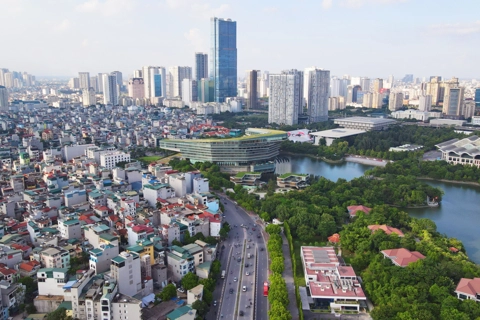
Key for addressing traffic congestion in Hanoi
Recommendations to ease traffic congestion in Hanoi were made by leading experts, including those involved in drafting the Capital Law which is a legal foundation for the city’s growth momentum.
The Capital Law 2024 helps facilitate the development of Hanoi's urban railway system through specialized mechanisms and policies, local experts said at the talk show titled “The Capital Law 2024: Realizing Hanoi’s Ambitions for Growth” held in the capital city on December 31 by the Economic and Urban Newspaper.
| Dang Huy Dong, Director of the Institute for Planning and Development Research, speaks at the talkshow held in Hanoi on December 31. Photos: The Hanoi Times |

Dang Huy Dong, Director of the Institute for Planning and Development Research, said the law provides a strong legal foundation for urban railway projects. Specifically, Article 31 of the law is dedicated to Transit-Oriented Development (TOD), covering urban railway system planning, TOD area development, investment policies, and surplus land value capture in TOD zones.
Article 31 of the Capital Law 2024 represents a transformative shift in Hanoi’s urban development, both in quality and scale. “We have high hopes for the policies on developing mass transit systems. By granting Hanoi full authority to oversee and decide on urban railway projects, the law accelerates the progress of Hanoi’s railway system, allowing the city to meet its ambitious urban railway development targets,” said Dong.
In this regard, public transit holds an important role in high-density urban development. Property along public transit lines would see an increase in value, and the proceeds from its commercialization can help fund public transportation infrastructure. In cities with populations exceeding three million, roads with mixed traffic often lead to congestion. Restricting private vehicles is critical but it requires public consensus. “To gain public support for reducing private vehicle use, there should be sufficient and reliable public transportation options,” he noted.
| Professor Dr. Hoang Van Cuong, Vice Chairman of the State Professors’ Council, joins the talkshow. |

Meanwhile, Professor Dr. Hoang Van Cuong, delegate to the National Assembly and Vice Chairman of the State Professors’ Council, believed the Capital Law opens the door to sustainable urban planning. He highlighted the role of Hanoi’s geographic location in developing transport.
He said major cities around the world capitalize on their rivers, yet Hanoi has underutilized the Red River’s potential. The river’s prime location offers vast opportunities for economic and cultural development. At the same time, Hanoi’s Old Quarter, while economically significant, struggles with overcrowding, affecting both living conditions and environmental quality.
“The Capital Law represents a significant institutional milestone, providing the legal framework to tackle these challenges. Riverfront urban development will become a defining trend, unlocking the cultural, ecological, and economic potential of these areas,” Cuong stated.
Cuong, who was among the drafters of the Capital Law 2024, elaborated on plans to develop both banks of the Red River under the new law. The western bank, for instance, could become a "heritage corridor," showcasing Vietnam’s rich historical and cultural narratives alongside modern commercial and tourism services. The space would host cultural and festival activities from all 63 provinces and cities, creating a vibrant hub for residents and visitors.
Cuong also highlighted the Red River's potential to rejuvenate inner-city waterways, such as the To Lich and Set Rivers, transforming them from "dead rivers" into vibrant, clean water systems. With these developments, the Red River could become Hanoi’s central axis of culture, scenery, and services, positioning the city as a true river metropolis.
| Dr. Architect Dao Ngoc Nghiem, Vice Chairman of the Vietnam Urban Planning and Development Association, at the event. |

Dr. Architect Dao Ngoc Nghiem, Vice Chairman of the Vietnam Urban Planning and Development Association, stressed the importance of Hanoi's autonomy and accountability in developing transport projects.
He pointed out that the Capital Law introduces more than 10 unique planning policies, granting Hanoi considerable autonomy.
“In the past, adjusting a plan approved by the prime minister required extensive clearance from several ministries and agencies. Now, the National Assembly allows Hanoi to make adjustments on its own if they are justified. This represents a major policy breakthrough but with greater autonomy comes greater responsibility. Hanoi must act independently, but with full accountability,” Nghiem stressed.
He underscored the importance of prioritizing public spaces and underground development, areas where Hanoi has already made progress. He said these priorities must match the city’s practical needs.
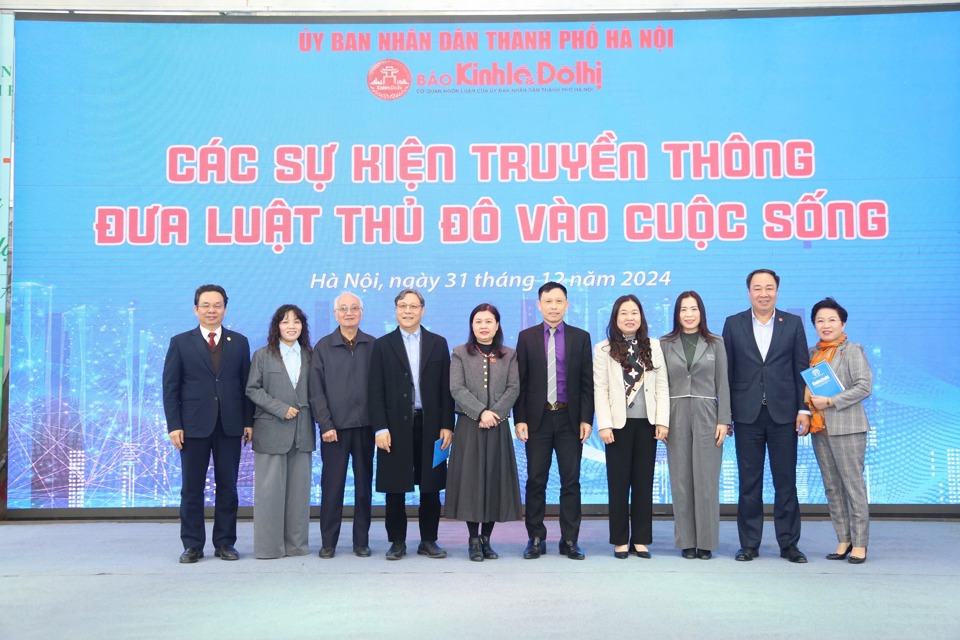
| Speakers, local officials, and the Economic and Urban Newspaper's leaders. |
The Capital Law 2024
The revised Capital Law, approved on June 28, 2024, by the National Assembly, consists of seven chapters and 54 articles, three chapters and 27 articles more than the 2012 law. It incorporates nine policy groups focusing on decentralization and empowerment across multiple sectors, enabling Hanoi to achieve breakthrough development.
Starting January 1, 2025, Hanoi will launch a comprehensive public awareness campaign about the law. With support from various government levels and the media, the city is poised to effectively implement the law. The Capital Law will serve as a critical tool for Hanoi to realize its vision of becoming a "Civilized, Modern, and Cultured Capital" by 2030 and beyond.