Mitigating Covid-19 impacts on workforce necessary to keep growth: NA
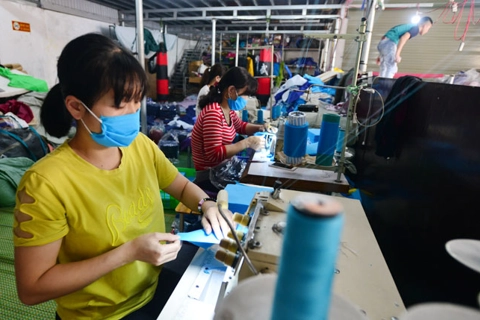
The situation of people leaving large cities during the pandemic showed a necessity to have a new approach in the industrialization process.
Supporting the labor force undergoing a tremendous ordeal due to the Covid-19 pandemic would be key to ensuring the country’s growth driving force is intact.
Deputy Tran Van Khai from the National Assembly (NA) Committee for Science, Technology, and Environment gave the remarks during a discussion session held by the 15th NA regarding Vietnam’s socio-economic situation on November 8.
| Deputy Tran Van Khai. Source: VGP |

While there have been studies on the economic impacts of the pandemic, Khai noted the psychological issues are also of significance.
“Mental illnesses that workers are suffering are unprecedented and would cause long-term consequences,” he said.
For those that have left major cities and returned to their hometown, Khai said the most important factor for luring them back would be a safe working environment.
Khai suggested the Government and localities provide solutions for workers to soon return to work, including not only programs to connect job seekers and employers but also financial support for them to settle.
“The Government should continue mobilizing resources to build social housing, especially for immigrants and workers at industrial parks,” he noted, adding a budget provision may be needed in emergent situations.
| Deputy Vu Tien Loc. |
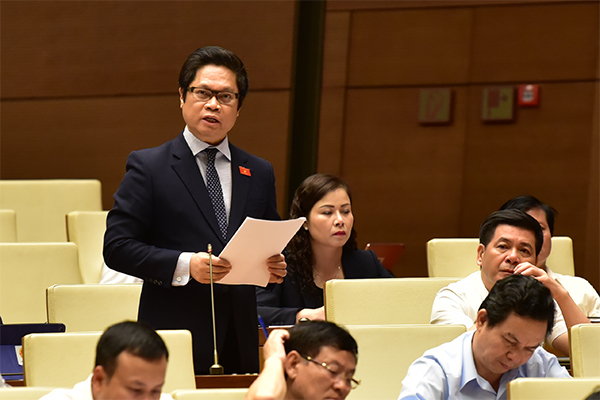
From a different perspective, Deputy Vu Tien Loc from Hanoi added the situation of people leaving large cities during the pandemic showed a necessity to have a new approach in the industrialization process.
According to Loc, this is the time for major cities such as Hanoi to move away from labor-intensive industries that rely mainly on assembling and manufacturing products with low added value.
“Such trend would continue to further put pressure on these already-overloaded cities while taking away investment opportunities from less-developed localities,” he said, pointing out this model’s lack of sustainability against future disasters that are similar to the Covid-19 pandemic.
Loc proposed the construction of new urban areas at different economic zones in a bid to share the burden of economic spearheads in Hanoi, Ho Chi Minh City, and other major cities.
“People would not have to leave their hometown for jobs and future,” he said.
Priorities to boos short- and long-term growth
To further push for economic recovery during the next two years, Loc said non-financial solutions are needed alongside fiscal-monetary policies.
“These include simplification of risk management, including a shift from prior to post-process review, and authorities’ inspection on businesses to be carried out online,” Loc noted, adding local Government agencies should refrain from issuing new business conditions with rising procedure compliance costs.
While public investment has long been seen as a key solution to boost short-term growth, Loc expressed concern that a determination to speed up disbursement at all costs could lead to the limited resources flowing into ineffective projects.
Loc suggested the resources should be channeled to projects of national priority with strict supervision from the NA, while the remaining should be allocated for credit packages for the economy.
“The Government should continue to promote public-private partnership in infrastructure development,” he added.
| Overview of the NA discussion. |
.jpeg)
Deputy Huynh Thanh Phuong from Tay Ninh Province said the people and businesses have been pushed to their limits after nearly two years of coping with the pandemic, which means large-scale lockdown should not be an effective solution.
Phuong said economic reopening is an urgent matter, but the scale and sustainability of such an approach should go in line with the vaccination rate and the public awareness on Covid-19 countermeasures.
In this regard, Deputy Nguyen Van Canh (Binh Dinh Province) called for specific instruction regarding the Government’s Decree No.128 on flexible and safe adaptation to the pandemic.
According to Canh, enterprises and business households with sufficient financial capabilities and infrastructure requirements should be allowed to operate regardless of the Covid-19 risk levels.
In the case of catering services, Canh said businesses in a safe zone could be allowed to operate at full capacity and 30-50% for higher risk zones with strict requirements on safety and the number of customers.
“Adjusting operation capacity is much easier for businesses than shutdown and later resume activities,” Canh said, noting the supply chains involve many businesses, and any disruption would take time and resources to resolve.
“In a new normal, businesses and people should be allowed to do their normal works suitable to the levels of the pandemic risk, while the State should only intervene in a severe situation,” he concluded.