New findings about Thang Long Imperial Citadel revealed
The latest excavations at the Imperial Citadel of Thang Long revealed the remains of the Kinh Thien Palace and hinted at the relocation of the military headquarters outside the relic.
The latest excavations at the Imperial Citadel of Thang Long have revealed new remains that could provide a different lead in the study of the citadel, experts said on November 22.
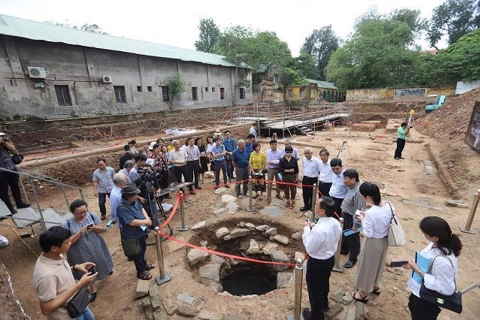
| The remains of the Dan Tri courtyard and Kinh Thien Palace at Thang Long Imperial Citadel revealed on November 22. Photo: The Hanoi Times |
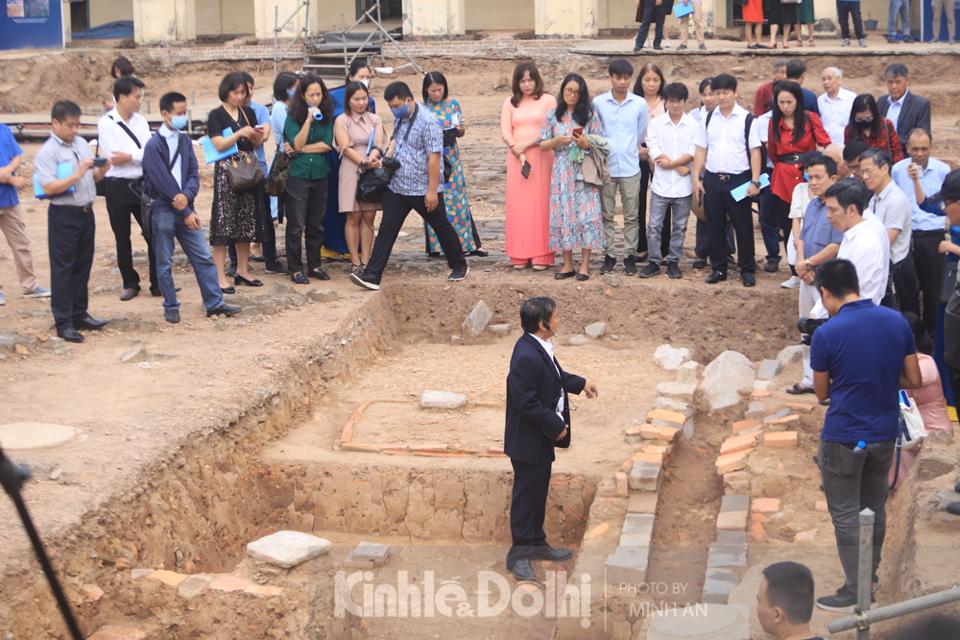
The Vietnam Archeology Association announced the new findings at an archeological workshop on November 22, including the king’s walkway, a two-layer brick walking path that seems to divide the Dan Tri courtyard, and the foundation of the palace’s walls.
Tong Trung Tin, chairman of the Vietnam Archaeology Association, said the latest findings had shed light on the architecture of the Dan Tri courtyard inside the citadel.
“Obviously, the architecture and structure of the imperial citadel are much more complicated than we think,” Tin said, adding archeologists may have to expand the excavation area to find more proof.
“The findings may help archeologists study the ancient architecture, thus assisting the recreation of the Kinh Thien Palace,” he said.
As part of the Kinh Thien Palace, where the king met with his officials to discuss important affairs of the country, the Dan Tri courtyard is where officials waited their turn to see the king and are where significant events took place in ancient times.
The Dan Tri Courtyard and the Kinh Thien Palace were destroyed during the wars and French colonization. Part of their remains is now under a building of the Combat Operations Department, the General Staff of the Vietnam People's Army.
For further exploration, archaeologists have suggested moving the department to a new site and demolishing the building.
Tran Duc Cuong, Chairman of the Vietnam Association of History Science, said that relocation is a must to return to the area of Kinh Thien Palace.
"The demolition will not affect the values of the Thang Long Imperial Citadel because the building was not part of Vietnamese culture. Apparently, it was a military barracks under French colonial rule."
However, the building served as a command center when Vietnam people fought for national liberation and unification in the war against the US and its allies.
According to Pham Le Huy, lecturer of Oriental Studies at the University of Social Sciences and Humanities, the relocation of the command center must be assessed carefully for its own historical values.
If no remains of the former palace are found after the demolition of the building, the move would be meaningless and regrettable, said Le Thi Minh Ly, former director of the Department of Cultural Heritage.
She said that archeologists and the management unit of Thang Long Imperial Citadel should study various solutions and consult the public and UNESCO before realizing the idea.